BEING RICH is not just about earning more. Prices differ between countries, and a modest salary can go further where things are cheaper. Working hours vary too: some places manage to generate high incomes with fewer hours of labour, leaving time for leisure. So which countries are truly rich?
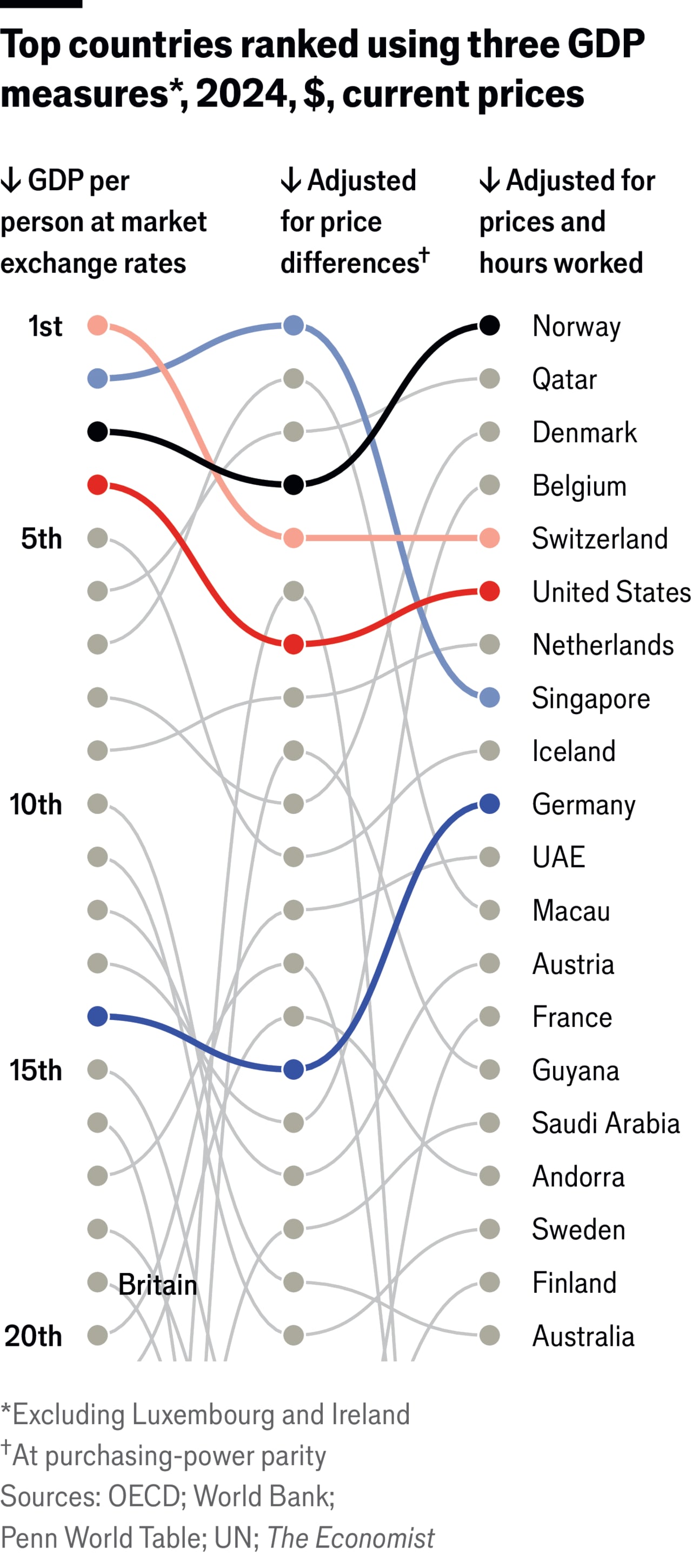
We ranked 178 countries using three measures.
To answer that we ranked 178 countries using three measures. The first is GDP per person at market exchange rates. It is simple and intuitive, and widely cited. But it ignores price differences between countries. The second measure adjusts incomes for these local costs (known as purchasing-power parity, or PPP). This offers a better guide to living standards but one that takes no account of leisure time: the share of people in work, and how long they work, varies by country. Our final yardstick accounts for both local prices and hours worked. See how the countries stack up below.
Chart
The three countries that top our lists are Switzerland, Singapore and Norway. In dollar terms Switzerland comes top, with average earnings above $100,000 last year. Singapore and Norway follow, at $90,700 and $86,800, respectively. But Switzerland is also one of the most expensive countries in the world, so its high salaries do not stretch very far. Adjusted for local costs, Singapore jumps ahead. And adjusted for hours worked, Norway takes first place, as it did last year, followed by Qatar and Denmark. America, the world’s biggest economy by GDP, ranks 4th, 7th and 6th on the three measures. Britain is placed 19th, 27th and 25th.
How countries’ ranking changes across measures can reflect social patterns. Those where few women are paid to work—such as Saudi Arabia and Turkey—rank higher on income per hour than on income alone, because earnings are concentrated among fewer people. Countries with unusually old or young populations also shift: in Italy, many people are retired; in Nigeria, many are not yet of working age. In both, a smaller working cohort supports a larger one.
Since last year the biggest overall climber was Guyana, which gained an average of 17 places across the rankings. An oil boom has lifted average incomes by more than 40% year on year. America rose by an average of 1.6 places, though its tariffs are an assault on its living standards.
At the bottom of the ranking sits Burundi, where most of the population is under 17 years old. Incomes are barely 0.15% of Switzerland’s. Even adjusted for prices, one Swiss income would be shared between 100 Burundians.
Some places are excluded. Tiny territories such as Bermuda are too small to rank. The index also leaves out Ireland, where GDP calculations are polluted by tax arbitrage, and Luxembourg, where incomes are inflated by cross-border commuters. The ranking does not consider inequality or the value of assets. And in some included countries official data may be missing or unreliable(read our full methodology here). No single measure can capture how well people live. But taken together, the numbers offer a useful guide.
Get the latest headlines from US news and global updates from Pakistan, Nepal, UK, Bangladesh, Russia and US Iran war Live, get all the latest headlines in one place on Hindustan Times.
Home/World News/What Is The Richest Country In The World In 2025?

 E-Paper