E-Paper



Muslim devout in Bhopal worships cobras on Naag Panchami
This fifty-one year old Muslim from Bhopal has been ritualistically worshiping poisonous pairs of cobra for the last 19 years, despite opposition from his community.


This fifty-one year old Muslim from Bhopal has been ritualistically worshiping poisonous pairs of cobra for the last 19 years, despite opposition from his community.
Meet Mohammad Saleem, Bhopal's famous snake catcher, popularly known as 'Saleem Saanp walla'.
Working as a peon in Bhopal Municipal Corporation, he has been catching snakes from the age of 12, without charging money. Saleem claims that he has caught over two lakh snakes in the last 35 years and has been bitten four times by snakes.
Saleem says that being a Muslim, many oppose his worshipping snakes like Hindus. "Snakes don't know who is a Hindu and who, a Muslim. They understand love. Initially, my community members even said that they won't bury me but cremate me according to Hindu rituals when I die. But now, most of them have accepted my way. Some of them even come to have Prasad (food) in the langar (community feast) that I organise on Nag Panchami. Today, many politicians and bureaucrats including state home minister Babu Lal Gaur came here to offer prayers to the Cobra pair," he says.
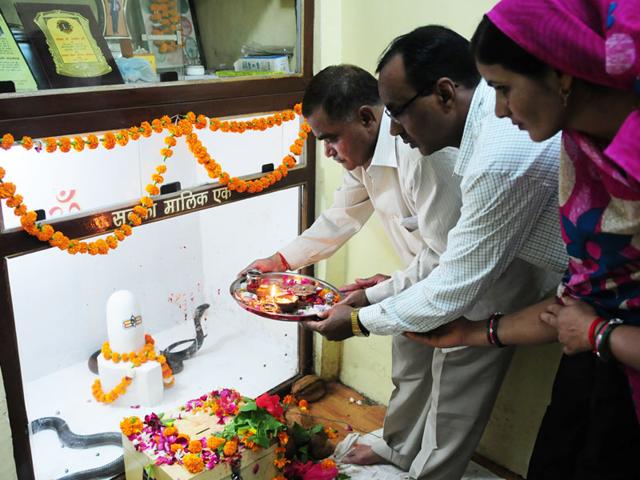
Squatted in front of a glass-made shrine at his snake research centre in Bhopal's Roshanpura, Saleem offers flowers to a white Shiv Lingum, with a pair of poisonous cobras moving around it. Though many devotees come with milk, he doesn't allow them to feed it to the snakes, arguing that due to such a tradition, thousands of snakes get killed every year.
"I feel I have a spiritual connection with snakes. After I started catching snakes as a teenager I decided that the day I find a pair of cobra before Nag Panchami, I would start the ritualistic worshipping of the pair on Nag Panchami and then release them the next day. Every time, I release them the in the forests of Pachmari", he says.
On what attracted him to snakes, he says that his uncle Amu Taelwal, who worked as a deputy ranger in the state forest department had a mysterious connection with snakes.
"It was he who taught me how to catch snakes and ordered me to follow three rules throughout my life: never tease a snake, never sell a snake or charge money for catching them and always release the snakes caught in the forest, which I have been following religiously," he says.