E-Paper



Gandhi-Tolstoy’s seven letters inspire descendants’ new book on truth, love
Both writers find that the power of human conscience, the conscious choice of love and non-violence

 Prefer HTon Google


What happens when the descendants of two of the 20th century’s most impactful thinkers meet in New Delhi through a common friend? They fulfill their destiny set in motion nearly 200 years ago, and write a book together.
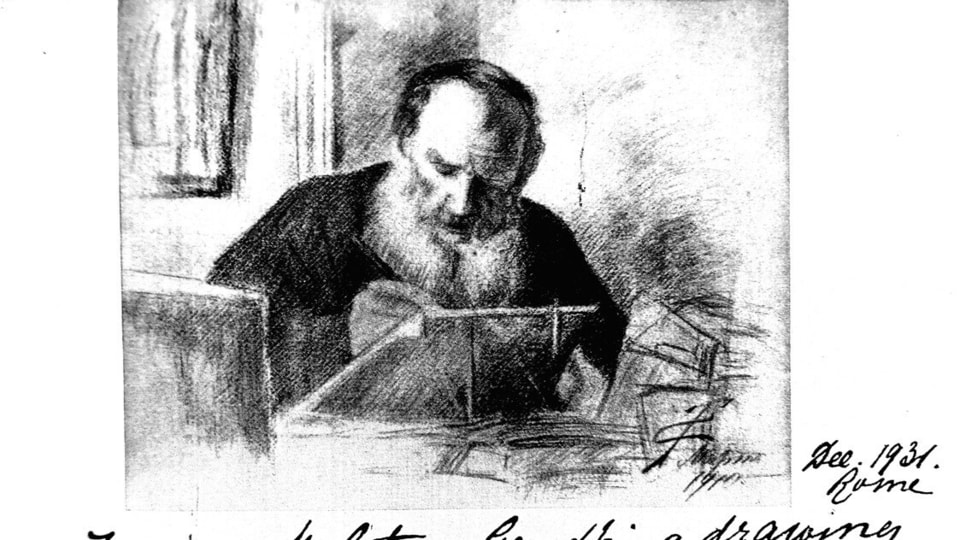
On September 30, Truth and Love: The Gandhi-Tolstoy Letters, written by Daniil Tolstoy and Gopalkrishna Gandhi, and published by Penguin Viking, will hit the stands, bringing to light a little-known but deeply transformative exchange between Anna Karenina author Leo Nikolayevich Tolstoy and Mohandas Karamchand Gandhi.
Tolstoy, an academician and publisher based in Sweden and the Russian author’s great grandson and Gandhi, a retired diplomat, author and the grandson of Mahatma Gandhi, met in the capital a few years ago. The meeting was fortuitous: more than 115 years ago, their forebears had exchanged exactly seven letters over the course of 12 months, between 1909 and 1910. They discussed matters central to their respective worldviews, such as the political act of passive resistance, its basis in human conscience, and quite simply, the meaning of truth and love.
Although the duo exchanged only seven letters (that are documented), “it was through these letters that Tolstoy became the engine of his great movement he had named satyagraha,” their descendants write in the soon-to-be published book.
“(Leo) Tolstoy believed that all religions contained in themselves a common core — love, or what the Greeks would call agape, which is not a sentimental romance, but a metaphysical recognition that life in another person is identical to life within oneself. It’s the conscious, practical willing of the other’s good without demand for return. For Tolstoy, it was the supreme law of life that superseded all state decrees or institutional dogmas. Some of those ideas were transmitted to Gandhi from ‘A Letter to a Hindoo’ and also from Gandhi’s reading of The Kingdom of God is Within You, such as the principle of nonviolence, his deliberate refusal to inflict harm in thought words or deeds, and the idea that the absence of action is not a weakness, but in any living entity, it’s the supreme spiritual strength and requires enormous courage,” Tolstoy said.
“Leo Tolstoy and MK Gandhi are about us. They are us. They are, of course, the Russian philosopher who took on the Tsar and the Gujarati émigré in South Africa striving to secure civic rights for his compatriots. But so real is their concern for the human condition that what they said and did for justice and for an order free of hate and fear makes their voices today's voices, their struggles today's struggles. It also makes the success of today's democratic and non-violent protests their successes, and any failures of those, setbacks to their ideals. Daniil and I were clear that this new compilation of their old letters should go beyond an archival iteration to an urgent call for sanity today,” Gandhi said.
The letters were variously in the possession of the Leo Tolstoy State Museum and published in the Collected Works of Mahatma Gandhi, publicly available volumes that include his correspondence and newspaper articles.
Mahatma Gandhi’s epistolary exchanges ranged from leading figures of national and international politics, literature, law, and business to common men, women and children who wrote to him seeking his advice on simple living. Leo Tolstoy was already a famous author when he struck up a conversation with Gandhi; at 81, his preoccupation with the Church, the state’s violence, and what it meant to live a conscientious life occupied much of his thinking and writing. However, it was Leo Tolstoy’s exchange with another Indian that pushed the Mahatma, then 40 and based in Transvaal, South Africa, to write the first letter.
Taraknath Das, a revolutionary nationalist based first in British Columbia, and later in the United States of America, wrote to Tolstoy in 1908 with an “appeal” to his “Christian spirit to take up the cause [of India]”. In response, Tolstoy wrote “A Letter to a Hindoo”, in which he laid down some of his central ideas around colonialism in India.
“If the English have enslaved the people of India, it is just because they [Indians] recognised and do recognise coercion as the main and fundamental principle of their social order,” Leo Tolstoy wrote back to Das.
For the Mahatma, who was already acquainted with the Russian’s spiritual views, and who now got hold of a copy of Leo Tolstoy’s response to Das, these ideas consolidated his views on the “voice of the soul”.
In his first letter dated October 1, 1909, the Mahatma wrote to Leo Tolstoy asking him to expound on a matter of morality: Would it amount to “buying opinion”, the Mahatma asked, “if a general competition were held on the Ethics and Efficacy of Passive Resistance” in order to popularise it?
The context, the Mahatma explained, was the resistance that a small colony of 13,000 Indians living in Transvaal, South Africa, had been putting up for the past three years to a law passed by the British. More than 2,500 had willingly gone to prison to resist the law, and more than half of the colony had chosen to leave rather than live under the degrading law, he wrote.
In 1906, the Transvaal government, which was a British Crown colony, passed the Transvaal Asiatic Registration Act, which required Indians to carry registration certificates — a clear bid to keep a check on their numbers.
“The struggle still continues and one does not know when the end will come. This, however, some of us have seen most clearly that passive resistance will and can succeed where brute force must fail,” the Mahatma wrote, adding that he had travelled to London with a friend to make a case for repealing the law.
The events unfolding in Transvaal caught the world’s imagination — this was the first time Gandhi had led a Satyagraha movement — and, importantly, Leo Tolstoy’s too.
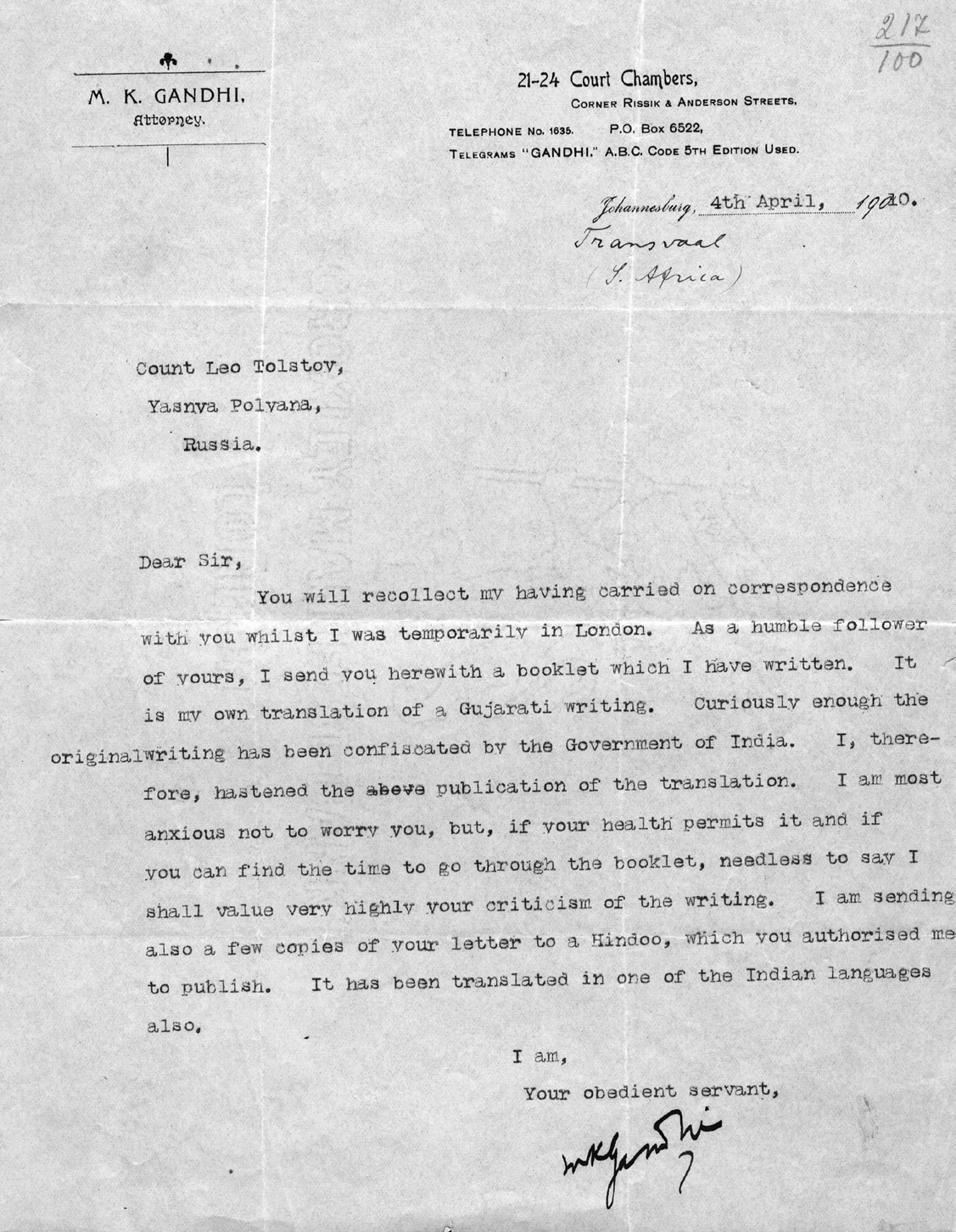
“God help our dear brothers and co-workers in the Transvaal,” Leo Tolstoy wrote to Gandhi dated October 7, 1909. “That same struggle of the tender against the harsh, of meekness and love against pride and violence, is every year making itself more and more felt here among us also, especially in one of the very sharpest of the conflicts of the religious law with the worldly laws—in refusals of military service. Such refusals are becoming ever more and more frequent,” he wrote.
In 2025, soon after their meeting, Gopalkrishna Gandhi and Daniil Tolstoy struck up a correspondence on the ideas that moved their ancestors, holding them up for examination in light of the modern-day concerns: nuclear armamentation, climate change, incessant war.
“My agony is not caused by the policies of the leaders and governments of nuclear weapons states as much as from the passivity, the suicidally insane imperviousness of us, the people of the world, to the nuclear, biological, chemical and now, the cyber threats sharpened by artificial intelligence, that hovers over us a genie that is out of the bottle,” Gandhi writes.
“What Tolstoy and Gandhi once called the ‘voice of the soul’ has grown faint. In place of reflection, we have speed; in place of moral intuition, calculation; and in place of conscience, algorithms,” Tolstoy responds.
Both writers find that the power of human conscience, the conscious choice of love and non-violence — which both their ancestors stressed upon — remains humanity’s strongest weapon.
“Love in Gandhi’s conception is the opposite not just of hate, but equally of suspicion, bias and bigotry. Nonviolence, in Gandhi’s system, is faith in the power of persuasion through reasoning and if that does not work, through self-suffering. It is also about a complete eschewal of ill-will towards the target of non-violent action. Above all, it is about seeking justice with one’s own hearts, hands and words being clean,” Gopalkrishna Gandhi said.