
 E-Paper



India’s economy actually touched the magical 10% mark in 2006-07, says report
While the report deals with a larger gamut of issues, one of its chapters is devoted to linking the old and new GDP series.

 Prefer HTon Google


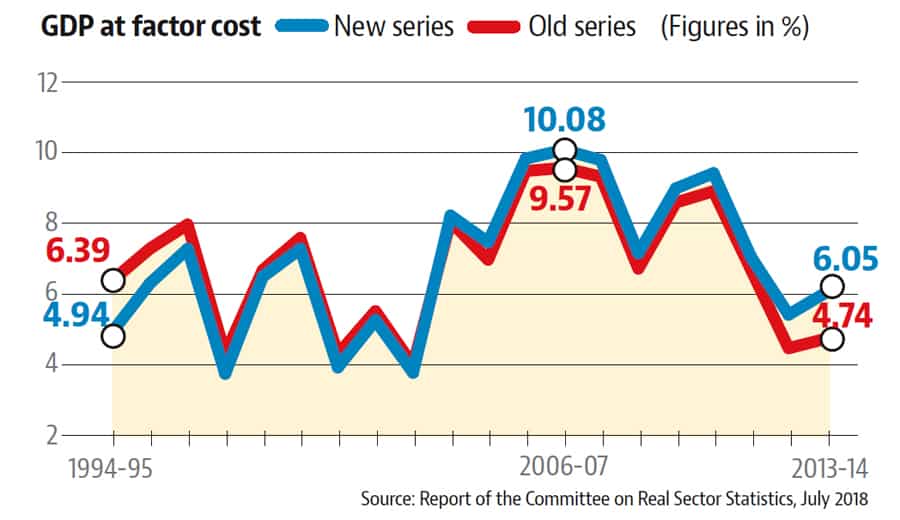
Achieving a double-digit growth rate has been a long-cherished goal for the Indian economy. If the current Gross Domestic Product (GDP) series, which has 2011-12 as its base year, were to be extended backwards, the Indian economy may have actually achieved this feat in 2006-07, with annual growth of Gross Value Added (GVA) at factor cost reaching 10.08%. To be sure, these figures are not from the Central Statistical Office (CSO), the official source of GDP statistics in India.
There is still no official back-series of the 2011-12 GDP numbers and no line of sight on when they will be released. But these numbers are credible because they are from the report of the Committee on Real Sector Statistics, which was chaired by Sudipto Mundle, emeritus professor at the National Institute of Public Finance and Policy.
The report was submitted to the National Statistical Commission last month. While the report deals with a larger gamut of issues, one of its chapters is devoted to linking the old and new GDP series. This work has been done by a sub-committee chaired NR Bhanumurthy, a professor at National Institute of Public Finance and Policy.
To be sure, 2006-07 was not the first time India achieved a double digit growth rate. GDP at factor cost grew at 10.16% in 1988-89, largely because of a strong base-effect as the previous year’s growth rate was just 3.53%. The 2006-07 case was completely different as GVA growth for the past three years was 7.5% or higher.
A comparison of the old GDP series with 2004-05 as the base year and the backward calculations done by the committee shows that the two move in tandem with each other. 2006-07 was also the year when the old GDP series recorded the highest growth at 9.57%, on the back of an investment, consumption and export boom, the seeds of which were sown in the early 2000s.
This is important given the criticism from some quarters about the veracity of the present GDP numbers.
What is the probability of these numbers being a good prediction of CSO estimates, when they are released finally? The committee’s report says that it has followed a different technique, called the production-shift approach, to arrive at its estimates. This is different from the approach used in the unpublished “tentative estimates” done by the CSO which has relied on a similar methodology used for calculating GDP figures under the 2011-12 series.
Bhanumurthy told HT that replicating the current GDP calculation methodology will not allow calculation of GDP figures before 2006-07. This, he said, was because of non-availability of statistics from sources such as the MCA-21 database which is compiled by the ministry of corporate affairs. This is one of the reasons why the committee adopted a different methodology while preparing its estimates, Bhanumurthy explained.
Can these new estimates tell us more about what triggered the high-growth phase in the Indian economy than what we already know? Any such analysis will require a long-term availability of data, which is what we lack in India, Bhanumurthy told HT. Given the short time-span of the 2011-12 series, the quality of both GDP forecasts and macro-economic research is suffering in India, he said. India needs to overhaul its statistical system to overcome these deficiencies, which is what the report has dealt with in detail, he added.


