
 E-Paper



Covid cases continue to rise in Karnataka; 623 new infections reported
Bengaluru accounted for the maximum number of 588 Covid cases, the health department said. The day also saw 412 people being discharged, taking the total number of recoveries in Karnataka to 39,15,683.


Covid-19 cases continued to spike in Karnataka as the state reported 623 new cases and one death on Sunday, taking the caseload to 3,960,831 and fatalities to 40,071 respectively, according to the daily bulletin of the state health department.
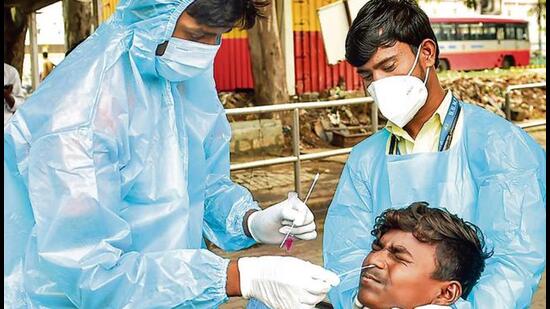
Bengaluru accounted for the maximum number of 588 cases, the health department said.
The day also saw 412 people being discharged, taking the total number of recoveries to 39,15,683. Active cases in the state stood at 5,035, a health department bulletin said.
The lone death due to Covid-19 on Sunday occurred in the Belagavi district while 19 districts in the state reported zero infections and zero deaths.
Other districts, too, reported new Covid-19 cases, including 13 in Dakshina Kannada, six in Mysuru, four each in Udupi and Uttara Kannada, and two in Bengaluru Rural.
A total of 23,170 samples were tested in the state, including 17,466 using the RT-PCR method, taking the cumulative number of specimens examined to 66.7 million, the health department said.
On Sunday, the number of vaccinations against Covid-19 done in the state rose to 110.8 million, with 10,382 people being inoculated, it said.
Karnataka has seen a sharp spike in numbers since May 20 when daily infections were under 100 per day, registering a six-fold increase in less than three weeks. The positivity rate in the state rose to 2.68%.
There are 27 active clusters in Bengaluru, of which 21 are in the Mahadavapura zone, two each in Yelahanka, Dasarahalli and RR Nagar according to the Bruhat Bengaluru Mahanagara Palike (BBMP, the city’s civic body). There are 129 wards in the city with over 10 cases, data shows.
The Indian Institute of Science (IISc) in Bengaluru on Friday released the findings of a study to understand the risk of an infected person spreading the virus.
The team that carried out the study includes researchers from the Department of Aerospace Engineering, Indian Institute of Science (IISc), along with collaborators from the Nordic Institute for Theoretical Physics (NORDITA) in Stockholm and the International Centre for Theoretical Sciences (ICTS) in Bengaluru. Their study was published in the journal Flow.
“The team visualised scenarios in which two maskless people are standing two, four or six feet apart and talking to each other for about a minute, and then estimated the rate and extent of spread of the speech aerosols from one to another. Their simulations showed that the risk of getting infected was higher when one person acted as a passive listener and didn’t engage in a two-way conversation. Factors like the height difference between the people talking and the number of aerosols released from their mouths also appear to play an important role in viral transmission,” IISc stated.
In the early days of the covid-19 pandemic, experts believed that the virus mostly spread symptomatically through coughing or sneezing but soon realised that asymptomatic transmission also leads to the spread of novel coronavirus.
“Speaking is a complex activity … and when people speak, they’re not conscious of whether this can constitute a means of virus transmission,” says Sourabh Diwan, Assistant Professor in the Department of Aerospace Engineering, and one of the corresponding authors.
To analyse speech flows, he and his team modified a computer code they had originally developed to study the movement and behaviour of cumulus clouds – the puffy cotton-like clouds that are usually seen on a sunny day.
“The computational part was intensive, and it took a lot of time to perform these simulations,” said Rohit Singhal, first author and PhD student at the Department of Aerospace Engineering.
Diwan added that it is hard to numerically simulate the flow of speech aerosols because of the highly fluctuating (“turbulent”) nature of the flow; factors like the flow rate at the mouth and the duration of speech also play a role in shaping its evolution.
Bengaluru has brought back the use of masks but is yet to implement the fines for not wearing them in public.
The IISc study stated that in the simulations, when the speakers were either of the same height or of drastically different heights (one tall and another short), the risk of infection was found to be much lower than when the height difference was moderate – the variation looked like a bell curve.
“Based on their results, the team suggests that just turning their heads away by about nine degrees from each other while still maintaining eye contact can reduce the risk for the speakers considerably,” the study finds.
The team plans to focus on simulating differences in the loudness of the speakers’ voices and the presence of ventilation sources in their vicinity to see what effect they can have on viral transmission. They also plan to engage in discussions with public health policymakers and epidemiologists to develop suitable guidelines. “Whatever precautions we can take while we come back to normalcy in our daily interactions with other people, would go a long way in minimising the spread of infection,” Diwan said.
Stay updated Bengaluru Weather Live and with all the Breaking News and Latest News from Bengaluru. Click here for comprehensive coverage of top cities including Delhi, Mumbai, Hyderabad, and more across India . Stay informed on the latest happenings in World News.


