
 E-Paper



Karnataka: sewage flow one of the reasons behind foam in Bellandur Lake
Researchers at the Indian Institute of Science have identified three reasons for the foam, froth and occasional fire that affects Bengaluru's Bellandur lake. The study found that sewage entering the lake took up to 15 days to spread, with surfactants from the sewage collecting on sludge over time. Heavy rains then churn up the surfactant-laden sludge, dislodging the accumulations of surfactants. At the same time, the researchers suggest that suspended solids containing certain bacteria could also be responsible for the foam formation. The researchers have called for untreated sewage to be prevented from entering the lake.

 Prefer HTon Google


A four-year long study by researchers at Indian Institute of Science (IISc) has revealed three key aspects that are causing upsurge of foam, froth and occasional fire in the lake Bellandur lake in Bengaluru .
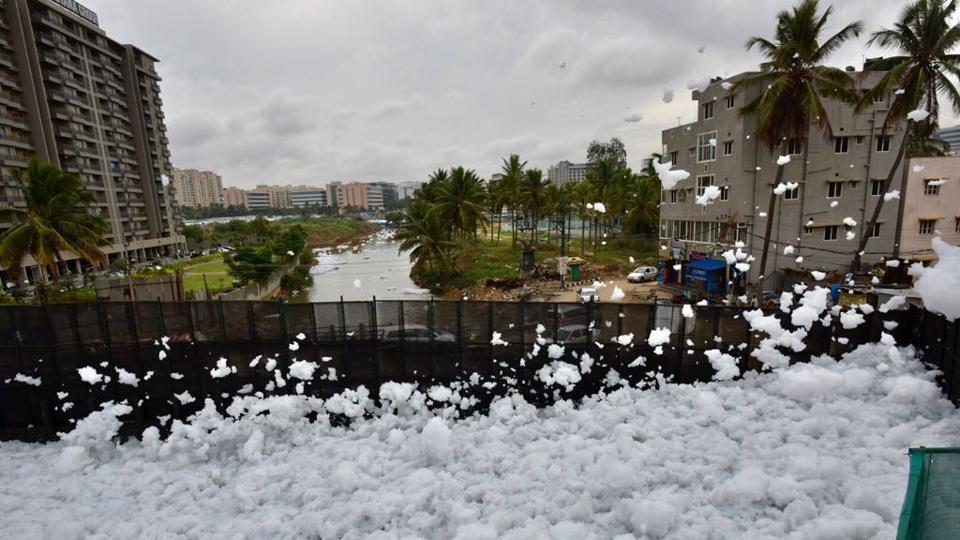
The study, ‘Unravelling the reason for seasonality of foaming in sewage-fed urban lakes,’ noted that the foaming has puzzled scientists since it counter-intuitively increases only after heavy rains, which are supposed to dilute pollutants in the lake that may be causing the foaming.
The entry of sewage into the lake which takes 10-15 days to spread in the water body stands as the first reason highlighted by the team on Tuesday.
“During this time, a part of the organic material gets degraded in the absence of oxygen and settles down as sludge. As more and more sewage flows through the lake, surfactants in the sewage do not decompose and instead get loosely attached to the settled sludge, gradually increasing in concentration – in some cases, up to 200 times the original concentration entering the lake,” points out Chanakya HN, chief research scientist at CST and one of the authors of the study.
“Imagine adding one full scoop of washing powder into a bucket of water. It will definitely foam given the right conditions,” he explains.
Secondly, the run-off water during heavy rain churns up the surfactant-laden sludge, dislodging the accumulated surfactant from the sludge, and bringing it back into solution, making it ready to foam.
“Deep inside the lake itself, there is little foam, because air bubbles do not form. However, as the water level in the lake rises due to rains, the excess water containing large concentrations of the surfactants spills over into the lake’s outlet to depths as high as 25 feet, trapping air bubbles which turn into foam. This is an important phenomenon that converts the surfactant-laden water into foam,” said Lakshminarayana Rao, associate professor at CST and one of the authors.
In addition to these two factors, the researchers also suggest that suspended solids containing certain bacteria might be responsible for foam formation.
To study the foam formation, the researchers collected water samples from the lake, analysed various parameters, and recreated a lab model to track the changes in chemical composition of the surfactants across different regions of the lake as well as at different times of the year.
“I had to go to the lake every month over the years to collect water and foam samples, and conduct experiments on them,” says Reshmi Das, PhD student at CST and first author of the study. She took the help of officials from the Bangalore Water Supply and Sewerage Board (BWSSB) and Bangalore Development Authority (BDA) to collect the samples.
The researchers also suggested that a single type of surfactant commonly used in most of the household washing powders and shampoos plays a dominant role in driving this foaming.
The authors proposed that stopping the entry of untreated sewage into the lake is crucial to prevent the build-up of surfactants and sludge, their churning, and the resulting foaming. They also suggest that wherever this is not immediately possible, removing the accumulated sludge in the polluted lakes, at least before the rains, as well as proper disposal of it can help address this burning issue.


