
 E-Paper



Tejasvi Surya presents 15-point vision for a smarter, future-ready Bengaluru amid crumbling infrastructure
MP Tejasvi Surya proposed a 15-point action plan, including a 'Bengaluru 2050 Vision Group' to improve the city's governance.

 Prefer HTon Google


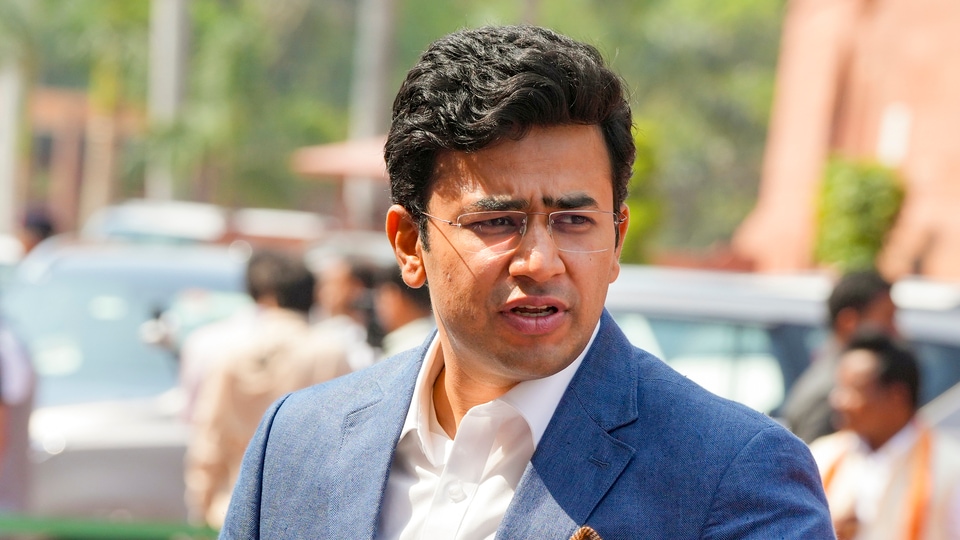
As Karnataka Deputy Chief Minister D.K. Shivakumar convened a high-level meeting on Saturday with Bengaluru’s MPs and MLAs to address the city’s infrastructure challenges, Bengaluru South MP Tejasvi Surya submitted a detailed 15-point action plan aimed at transforming the city’s civic systems, traffic flow, and transport networks.
Also Read - Four prime accused in Hangal gang rape case re-arrested after celebratory parade in Karnataka's Haveri
Though Surya could not attend the meeting in person due to his travel to the United States as part of an all-party parliamentary delegation, he sent across his vision document, which outlines a strategic roadmap to modernise Bengaluru’s urban governance.
At the heart of Surya’s proposal is the creation of a ‘Bengaluru 2050 Vision Group’ — a think tank of subject experts, civic leaders, and public representatives that would craft a long-term development blueprint for the city. His office described the initiative as key to building a resilient, well-governed, and future-ready metropolis.
Also Read - 'No cause for concern': Karnataka health minister Dinesh Gundu Rao on Covid cases surge
Highlights of Tejasvi Surya’s 15-point agenda
- Vision 2050 group: Formation of a multidisciplinary task force to steer long-term urban planning with inputs from experts and stakeholders.
- AI-driven traffic management: Deployment of artificial intelligence for smarter traffic signals, real-time congestion mapping, and traffic decongestion on key corridors.
- Revamp of public transport: Strengthening the BMTC bus service, promoting last-mile connectivity, integrating metro, suburban rail, and multi-modal options.
- PM-eBus Sewa rollout: Induction of 4,500 electric buses to boost sustainable public transport.
- Empowering BMLTA: Establishment of Bengaluru Metropolitan Land Transport Authority as the central mobility planning and coordination body.
- Road infrastructure upgrade: Scientific improvement of major arterial and sub-arterial roads to reduce commute times.
- Time-bound project execution: Completion of long-pending flyovers, underpasses, and railway over bridges (ROBs) under fixed deadlines.
- Traffic engineering and junction decongestion: Redesign of major junctions using modern traffic engineering solutions to ease bottlenecks.
- Pedestrian-friendly zones: Expansion of footpaths and creation of walkable, people-first public spaces.
- Stormwater drain modernisation: Scientific revamp of stormwater drains to tackle chronic flooding and waterlogging.
- Dedicated MD for suburban rail: Appointment of a full-time managing director for K-RIDE to expedite the Bengaluru Suburban Rail Project.
- City-level war room: Creation of a centralised command centre for real-time traffic management and infrastructure project monitoring.
- Decongestion corridors: Operationalisation of critical bypass links like NICE Road–Mysuru Road and Whitefield–Airport alternative routes.
- Environmental safeguards: Measures to address environmental degradation, including increased green cover and lake rejuvenation.
- BBMP elections and governance reforms: Call for timely local body elections to improve grassroots accountability and ensure efficient delivery of services.
In his letter to Deputy CM Shivakumar, Surya said the action plan was designed to tackle the city’s "most visible and urgent concerns" such as mounting traffic congestion, failing civic amenities, and poor institutional coordination. He emphasised that a new, results-driven approach to urban governance is needed to secure Bengaluru’s future as a global city.
“I hope this roadmap receives your attention and brings about a much-needed shift in how we plan and manage our urban spaces,” he further wrote.


