
 E-Paper



Bumper paddy yield a procurement challenge in Punjab
Production of non-basmati paddy may exceed 220 lakh tonnes this season against 180-lakh tonne quota fixed by Centre

 Prefer HTon Google


Chandigarh
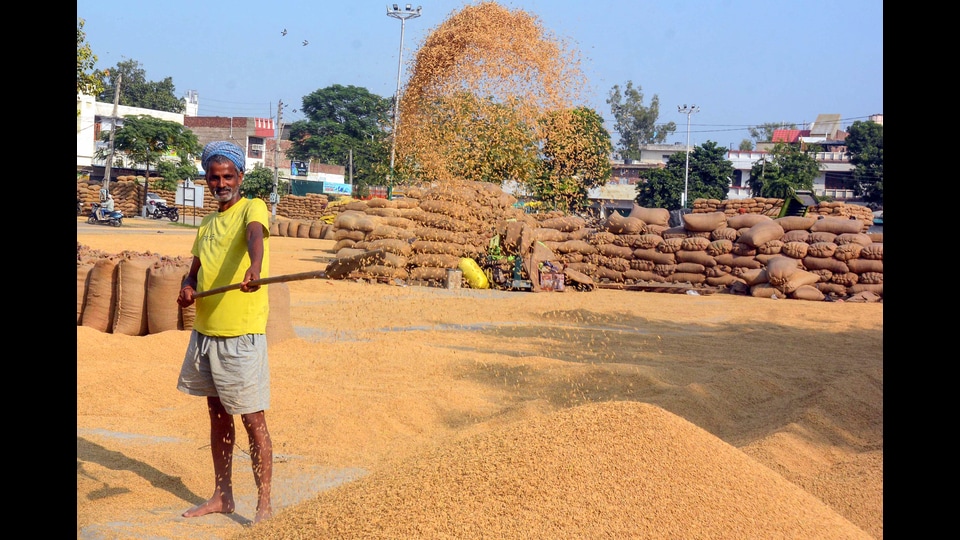
Punjab is heading towards a challenging paddy procurement season, with the state’s expected production likely to exceed the procurement quota of 180 lakh tonne fixed by the Union ministry of consumer affairs, food and public distribution.
The state’s total non-basmati paddy production — which is procured by government agencies for the public distribution system — is expected to exceed 220 lakh tonnes this season. Given the historical trend of around 90% of the total production reaching mandis for procurement, the quantity arriving in the markets could surpass the Centre’s approved quota, putting pressure on the state’s procurement machinery and finances.
“The procurement scenario seems tougher this season, as we have been signalled by the Union ministry that the crop beyond the defined quota will not be accepted. We hope to stay within the limits; otherwise, we will seek an extension,” a senior official in the Punjab food and civil supplies department said.
Haryana experience raises concerns
The state government’s concerns have been heightened by the Centre’s handling of excess paddy procurement in Haryana during the previous season. Against a quota of 36 lakh tonnes, Haryana procured 62 lakh tonnes in 2025, exceeding its approved limit by 26 lakh tonnes. The Centre’s refusal to accept the additional quantity has served as a warning for Punjab, which is now preparing to manage a potentially similar situation.
For the current season, Haryana has been allocated a procurement quota of 59 lakh tonnes.
Punjab officials believe the Centre’s approach towards Haryana indicates that exceeding the approved procurement limit could create serious complications for the state.
Initially, the Centre had fixed Punjab’s procurement target at 156 lakh tonnes, equivalent to the quantity procured during the previous season. Following representations by the state government, the Centre considered the average procurement over three years and revised the target to 171 lakh tonnes.
The state food department subsequently sought a further increase, following which Punjab was permitted to procure 180 lakh tonnes.
The state may have to approach the Centre again if the actual procurement exceeds the sanctioned limit. Such a request could involve revising the procurement quota and increasing the financial arrangements required to purchase the additional grain at the minimum support price (MSP).
Paddy yield rises by nearly 9 quintals per hectare
“According to the results of crop-cutting experiments, the production is 67.35 quintals against last season’s production of 58.6 quintals per hectare. We are expecting a bumper harvest of 220 lakh tonnes or maybe more,” Punjab agriculture director Gurjeet Singh Brar said.
Punjab cultivated paddy over 32.76 lakh hectares during the current kharif season. Of this, approximately 6.5 lakh hectares were under premium basmati varieties, which are not procured by government agencies for the public distribution system. Consequently, around 26.25 lakh hectares fall under the non-basmati paddy area generally covered by government procurement at the MSP.
Favourable factors for high yield
Explaining the increase in paddy production, former Punjab Agricultural University (PAU) vice-chancellor BS Dhillon said Punjab could witness higher crop output even during drought conditions because of several favourable factors.
According to Dhillon, increased sunshine, reduced incidence of diseases, lower nutrient leaching and the availability of adequate irrigation water can contribute to higher yields despite deficient rainfall. He said the authorities would have to determine how best to procure and manage the additional grain generated by the bumper crop.
PAU director of extension Makhan Singh Bhullar said increased paddy production creates additional challenges for the government.
Existing rice stocks add to storage woes
Punjab’s procurement concerns extend beyond the immediate challenge of purchasing the current crop. The state’s godowns already hold approximately 150 lakh tonnes of rice from the previous three seasons.
With the current season’s procurement expected to generate at least another 120 lakh tonnes of rice, the total stock could increase substantially, adding to the pressure on storage facilities and grain management arrangements.
Punjab has cash credit limit of ₹42,786 cr
To facilitate procurement, Punjab has been sanctioned a cash credit limit (CCL) of ₹42,786.68 crore to purchase 180 lakh tonnes of paddy, pay farmers the MSP of ₹2,441 per quintal and meet administrative expenses.
However, if arrivals exceed the approved procurement quantity, the state may have to seek an increase in the CCL to finance the purchase of additional paddy.
According to Varinder Sharma, director of the Punjab food and civil supplies department, they have received an assessment from the agriculture department indicating that arrivals would remain within the approved limit, and arrangements were made accordingly.
“We are taking all caution so that nothing from outside the state is allowed in Punjab mandis and the state farmers are able to sell their produce,” Sharma said.


