
 E-Paper



Delhi Metro to resume services in phased manner from Sept 7, stations to be closely monitored: SOP
Services will be resumed in phases, and all corridors will be operational by September 12, according to the standard operating procedure (SOP) announced by the Union ministry of housing and urban affairs (MoHUA) said on Wednesday.

 Prefer HTon Google


The Delhi Metro is all set to resume operations on September 7, after more than five months shut. Services will be resumed in phases, and all corridors will be operational by September 12, according to the standard operating procedure (SOP) announced by the Union ministry of housing and urban affairs (MoHUA) on Wednesday. Upon its restart, operations will be monitored in real-time, and officials will be tasked with ensuring distancing and minimising crowds.
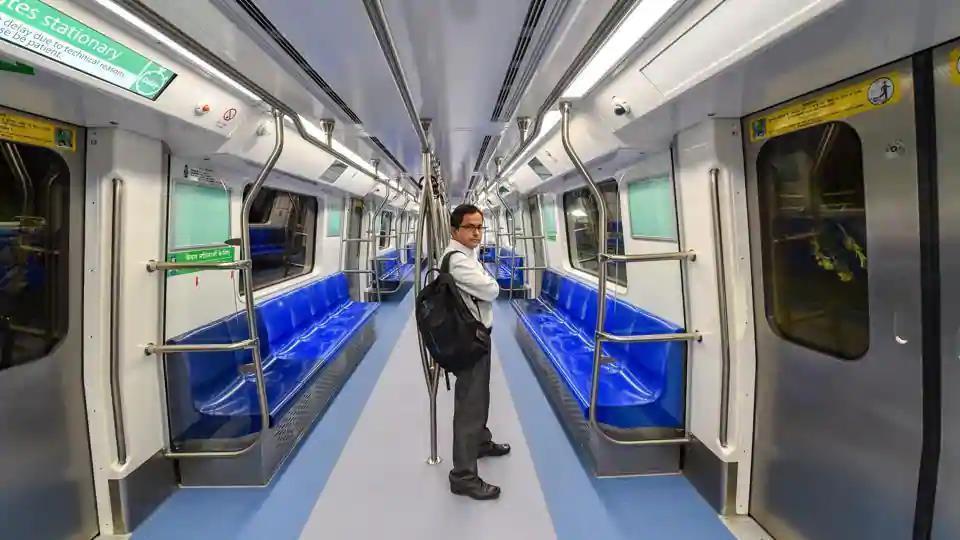
For instance, senior officials said, trains will be allowed to skip a station if crowds are deemed too large. Further, no further passengers will be allowed entry into a station if officials consider it to have hit peak capacity.
The Delhi Metro, before it shut on March 22 — when Prime Minister Narendra Modi had called for a ‘Janta Curfew’, serviced around over 2.7 million people a day. But come September 7 — when it will be 169 days since it was closed, it is expected to cater to far fewer, to ensure social distancing at stations and inside Metro trains.
Announcing the protocol for reopening Metro services under the Unlock 4 plan, Union minister Hardeep Singh Puri said the Delhi Metro, which runs across 10 lines and comprises 389km of the 678km of Metro lines in the country, will be monitored closely initially, and reviewed after a week.
“We will closely monitor crowd control measures and operations, and will review the arrangements. Initially, the frequency of service and entry and exit inside stations will be regulated, but full functionality will be resumed by September 12,” Puri said on Wednesday.
The Delhi Metro Rail Corporation (DMRC) will reopen its doors to passengers in three stages. In the first stage, the Metro will function for truncated periods — from 7am to 11am, and then from 4pm to 8pm. In this stage, Metro lines will also be opened in phases starting with the Yellow Line (Samaypur Badli to Huda City Centre) and the Gurugram Rapid Metro, which will be open for passengers from September 7.
This will be followed by the Blue Line (Dwarka Sector-21 to Vaishali/Noida Electronic City) and the Pink Line (Majlis Park to Shiv Vihar) on September 9.
From September 10, the Metro will also resume services for the Red Line (Rithala to Shaheed Sthal), Green Line (Inderlok to Brigadier Hoshiyar Singh Marg/Kirti Nagar) and Violet Line (Kashmere Gate-Ballabhgarh).
Operational hours will be increased in the second stage, which will commence from September 11. Trains will continue to ply over two shifts, each of which will be extended — 7am to 1pm. and 4pm to 10pm. In this stage, the Magenta (Janakpuri West to Botanical Garden) and Grey (Najafgarh-Dwarka) lines will also be made operational.
In the third stage, from September 12, when Delhi Metro operations are expected to return to its full-functionality, service hours will go return to their pre-lockdown schedule — from 6am to 11pm. At the same time, Airport Express Line (Dwarka sector-21-New Delhi Railway Station) services will also be thrown open to passengers.
Mangu Singh, managing director, DMRC, said all arrangements necessary have been made at stations and inside trains to ensure social distancing is maintained at all times. All stations will be monitored from a control room using CCTV cameras to ensure there are no crowds and that commuters follow all required norms.
Arrangements have also been made to spot passengers flouting guidelines and train drivers, through a real-time communication system, will be directed to not stop trains at such stations.
Singh also said the footfall inside Metro stations would be monitored regularly, and entries stopped if the station is deemed full.
“We have a comprehensive plan in place, where everything will be monitored on a real-time basis,” Singh said.
The agency will focus on the regular sanitisation of station premises and inside trains and trains will stop at stations for a longer duration to allow passengers to board and de-board with ease, without having to crowd the train gates. This might affect the frequency of the trains and increase the journey time in the initial days, but the Delhi Metro will try to maintain its frequency at 5-7 minutes, he said.
“In the initial period, we have decided that all the gates of stations will not be opened for entry and exit. For each of the station, depending on the footfall and the size, we have released a list of one or two gates that will be used for entering and exiting the station,” said Singh.
He added, “Since the use of tokens is risky now, because they could be carriers of the virus, we will only allow smart cards for trips. Top-up options will also be restricted to cashless modes for the time being.”
Stations located in containment zones will stay closed and trains will not stop at these stations, the DMRC guidelines read.
The SOP also specified that masks will be mandatory for all passengers entering the station, and only asymptomatic passengers will be allowed to travel. Masks will be available for purchase at kiosks in stations. Passengers will be screened before entry and hand sanitisers placed across the station.
Singh also said that with schools and colleges yet to open and several private companies encouraging employees to work from home, the footfall in the network will be lower, making crowds more manageable.
Union housing affairs secretary Durga Shankar Mishra said, “We will closely monitor the operations of the Metro through our control room, and if there is any instance of crowding observed, we will review the measures. We request the passengers to cooperate. Stand only where there are markings and follow the guidelines. Rules such as naming and shaming erring passengers, and not letting trains stop even if one passenger ignores the rules will encourage passengers to be more careful.”


