
 E-Paper



50% work-from-home in Delhi-NCR now hastened to combat worsening air quality
Delhi-NCR tightens air pollution measures, enforcing 50% work-from-home for offices and stricter curbs under the Graded Response Action Plan.

 Prefer HTon Google


New Delhi: The Commission for Air Quality Management (CAQM) in Delhi-NCR has further tightened its curbs under the Graded Response Action Plan (Grap) to curb air pollution, continuing an exercise that started last Wednesday, when it started moving to stricter curbs under the initial stages. As part of this, the recommendation for states to impose 50% work-from-home for all government and private offices has been moved from Stage 4 of Grap to Stage 3, according to a notification issued on November 21.
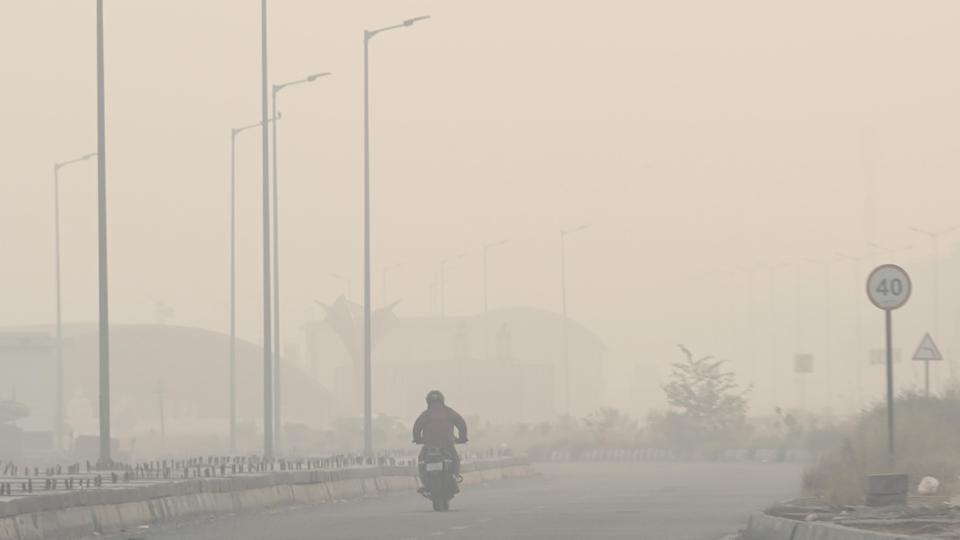
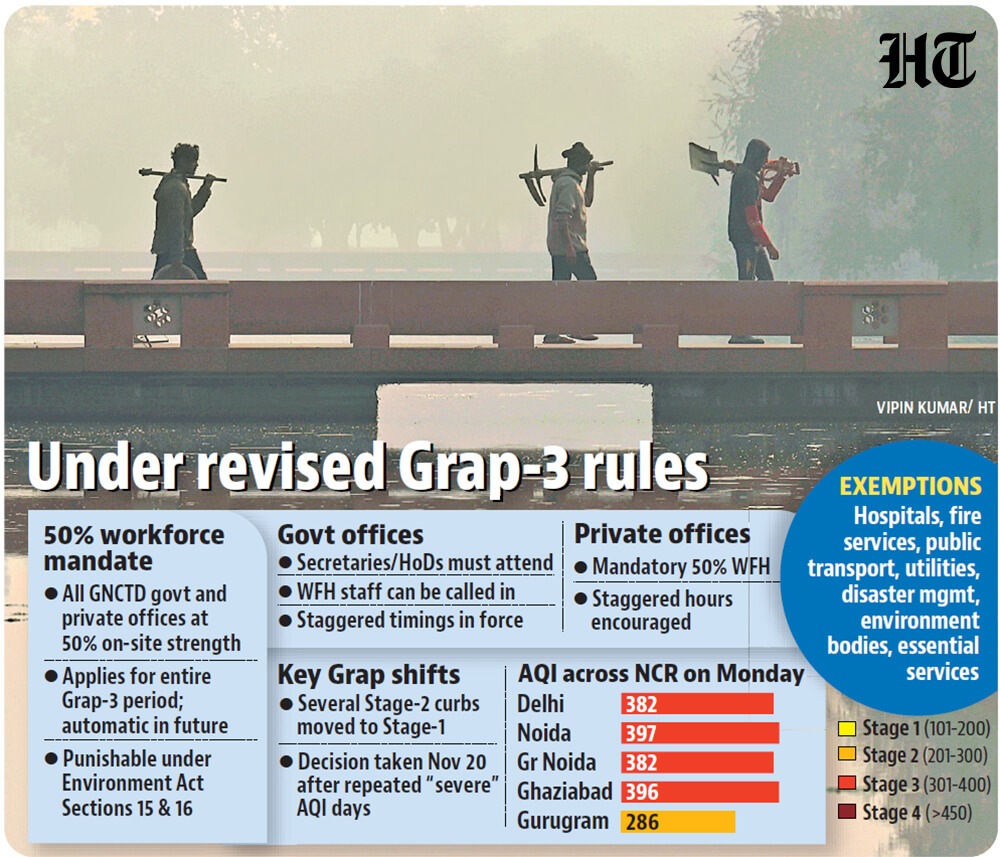
In keeping with the recommendation, the Delhi government on Saturday issued an advisory asking private offices to operate with 50% on-site staff and allow the remaining staff to work from home, in line with CAQM’s directions under GRAP Stage-3. Environment minister Manjinder Singh Sirsa said the government is implementing all pollution-control measures with full seriousness and round-the-clock monitoring. The city has also enforced staggered timings for MCD and GNCTD offices to curb peak-hour traffic emissions.
Stage 3 of Grap has been in force in Delhi since November 11. Officials said over 1,200 inspections of construction sites and industrial units have been carried out, leading to issue of more than 200 show-cause notices and 50 closure orders for violations.
Also read: Violations rampant amid persisting ‘poor’ Gurugram air
“It has also been felt that mobility restrictions need to be triggered earlier to have any meaningful impact on pollution levels, especially during prolonged ‘severe’ spells. This is why work from home option is being stressed as it will reduce congestion and vehicular emissions,” said an official, who did not wish to be named.
Under the new set of recommendations, several measures that were earlier part of Grap Stage 2—which is enforced when the air quality index (AQI) is between 301 and 400—will now be enforced under Stage 1, which comes into force when the AQI is between 201 and 300. These include uninterrupted power supply to curb diesel generator use, deployment of personnel at traffic choke points, public advisories on pollution, and boosting public transport by increasing the frequency of buses and metro trains.
The updated plan, which state governments have been asked to implement immediately, effectively advances stringent measures under the initial phases of the response plan. Since CAQM is not an enforcing authority, states act upon its directives and pass orders to implement the Grap norms. Officials said the changes were finalised in a meeting of the Grap subcommittee on November 20, held in the backdrop of repeated “severe” and “very poor” air quality days in Delhi and the court’s criticism that interventions often came too late.
More shifts include starting staggered working hours for government and municipal offices in Delhi-NCR. The Centre may decide on altering office timings for its staff in the region too.
The quicker enforcement of 50% office strength, moved from Stage 4 to Stage 3, will recommend that NCR state governments decide on working from home earlier than before. The Centre may also recommend that half of its workforce works from home.
“The NCR State Governments and GNCTD shall take a decision on allowing public, municipal and private offices to work on 50% strength and the rest to work from home,” the notification reads.
The Supreme Court, on November 17 and 19, observed that the CAQM must take “proactive action” and revisit the existing Grap classifications to better align them with on-ground pollution trends. The court noted that delays in implementing critical measures were undermining the impact of the mechanism.
Responding to this, the CAQM placed a detailed note before the court proposing revisions, and subsequently, held consultations with stakeholders on November 20 before finalising the new schedule. The CAQM has directed all NCR agencies to update their action plans in line with the new stage-wise requirements and implement the changes without delay.
Lack of winds keeps AQI ‘very poor’
The national capital saw a relatively clear and sunny Saturday morning, even as stagnant air continued to maintain the air quality in the “very poor” territory. Delhi’s 24-hour average AQI, according to the Central Pollution Control Board’s daily bulletin, was 370, in the “very poor” category and inching close to the “severe” threshold of over 400.
This was marginally higher than Friday evening’s reading of 391. Meanwhile, neighbouring NCR cities of Ghaziabad and Baghpat remained the most polluted in the country. Crossing the AQI threshold of 400 into the “severe” zone, Ghaziabad had an AQI of 434 and Baghpat, 403.
The minimum temperature at the Safdarjung weather station, which is representative of Delhi’s weather, was 11.8°C on Saturday, 0.5 degrees above normal and also 0.6 degrees higher than a day ago. According to the India Meteorological Department, the minimum temperature is expected to linger between 9°C and 11°C over the next few days.
The maximum temperature was 27.3°C, about 0.6°Cabove/below normal. The IMD has forecast mainly clear skies with shallow morning fog over the next few days.


Stay updated with all top Cities including, Bengaluru, Delhi, Mumbai and more across India. Stay informed on the latest happenings in World News along with Delhi Election 2025 and Delhi Election Result 2025 Live, New Delhi Election Result Live, Kalkaji Election Result Live at Hindustan Times.


