
 E-Paper



A search for imprints: Subtle art of reading a crime scene in Delhi
The National Automated Fingerprint Identification System, a web-based platform under the NCRB, gives investigators access to 150 million prints across India.

 Prefer HTon Google


At 8.05am on a summer morning, assistant sub-inspector Jaswant Singh, a fingerprint expert, received a call at his Dhaula Kuan office: a burglary had been reported in Safdarjung Enclave. Singh, a veteran of over a decade, quickly gathered his team -- head constables Jitendra Kumar, a photographer, Arun Kumar, a videographer, and fingerprint assistant Mansi Dhawan.
Within minutes, a white forensic van rolled out, carrying within it black cases stacked with four kits that carry the delicate instruments of their trade.
The team arrives at the crime scene, an old-style bungalow with cream-coloured walls belonging to the Nigam family, where they meet the investigating officers. The burglars, they are told, had scaled the rear boundary wall, cut open the iron grill of a ground-floor room, and slipped inside. Once in, they locked doors from within, poured oil on the floor to quietly drag a heavy almirah, and escaped with jewellery and cash.
Gloved, Singh, with his decade of experience, was the first to move to the back of the house. Jitendra and Arun followed with their cameras, while Dhawan carried jars of coloured powder and black-feather brushes – used to locate fingerprints on surfaces, if any.
Singh leaned over the air-conditioner’s pale surface. “We use multiple colours and brushes depending on the surface,” he explained. “For this cream-coloured surface of the AC, I will use black powder and a black brush. We have white, fluorescent and other colours in powders and brushes.”
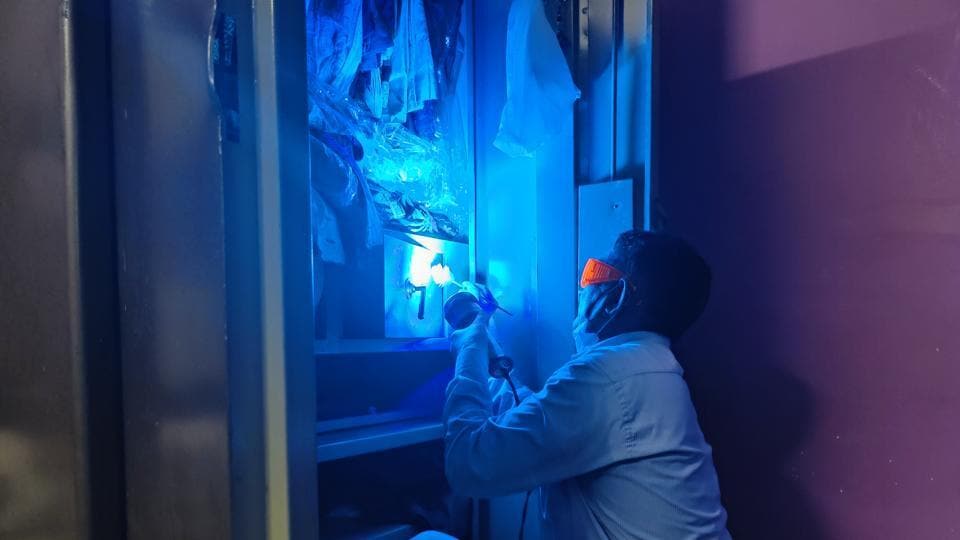
Five minutes of delicate brush strokes later, a faint impression was visible on the AC’s surface. Singh slipped on his ultraviolet glasses and shone a UV torch. The ridges sharpened into view. “We now have both rechargeable and electricity-run UV torches. These help us see prints clearly,” he said.
Evolution of the fingerprint bureau
Delhi’s fingerprint bureau has come a long way from its humble beginnings. Four decades ago, the Capital’s prints were examined hundreds of kilometres away in Phillaur, Punjab, causing frustrating delays. Though functional, the process was cumbersome – investigators often had to wait long for crucial fingerprint results. That changed in 1983, when Delhi Police established its own bureau at RK Puram. Two years later, the first cadre of experts formally joined.
“The database was tiny in those days,” recalled Sanjay Kumar Jha, now director of the Finger Print Bureau (FPB). “We started with a few hundred. Then by the time I joined in 1992, we had only a few thousand prints. Now, the number is in hundreds of thousands.”
Over the next four decades, the bureau shifted offices several times -- from RK Puram to Malviya Nagar to Kamla Market -- before finally moving into a modern facility at Punjabi Bagh, inaugurated July 30, just a few days after receiving the ISO-9001:2015 certification.
“In the 90s, we worked without UV lights or coloured powders,” Jha recalled. “We used to lift prints using either black or white powder, depending on the surface colour, and with the naked eye. Now there are several ways to ensure we are able to find prints,” he said, adding that the database was also small, which meant fewer cases were solved using fingerprints.
Deputy commissioner of police (crime branch) Harsh Indora explained how the bureau’s database has grown. “Before 2000, we had only around 60,000 stored prints in our system. Today, we have more than 600,000 prints in our Delhi database alone.”
But the real game-changer has come from the National Automated Fingerprint Identification System (NAFIS), a web-based platform under the NCRB. It gives investigators access to 150 million prints across the country, said special commissioner of police Devesh Srivastava.
In Punjabi Bagh, Jha gestured towards a row of 15 iron almirahs, each holding 72 lockers . Known as the “Pigeon Hole,” this archive stores thousands of physical prints. “We have digitised everything,” he said. “But under rules laid out by the Union home ministry, we must preserve the physical copies for 75 years.”

Prints that tell a story
At the Safdarjung bungalow, Singh’s patience soon paid off. He dusted the handles of three almirahs. “Most of these prints might belong to the family,” he cautioned. But inside a safe-within-a-safe, he spotted ridges that looked fresh. “These, I believe, are of the accused,” he said.
The process demanded careful choreography. First, the prints were marked with slips carrying the date, serial number, and Singh’s initials. Then Arun photographed them, ensuring high-resolution evidence. Only after this could Singh lift the print with transparent tape and place it onto black film for storage.
While physically lifting the prints is important, their photographs and videos hold more significance, he explained.
“Before we take the photographs and video, we mark the prints using chits on which we mention the date, a serial number and initials of the fingerprint expert who has taken it. The physical print can be damaged, but these photographs will remain in our system,” said Singh.
Between 8.30 and 1pm, the team had lifted 11 chance prints from across the house. Singh carefully packed the films and powders back into the van, ready for the next stage of analysis.
Back at the Dhaula Kuan office, Singh and his team uploaded the Safdarjung prints into the system. Each entry was checked against national records. “The system throws up five to eight close matches,” Singh said. “We then manually compare ridge patterns until we find the exact one.”
The work is meticulous, requiring both patience and intuition.
As Singh leaned back after hours of careful lifting and sorting, he knew his morning’s work will soon give Delhi Police its next lead. For the Safdarjung burglars, however, the faint ridges left behind could yet prove their undoing.
A week later, ASI Singh shared his findings; one of the burglars was identified.


Stay updated with all top Cities including, Bengaluru, Delhi, Mumbai and more across India. Stay informed on the latest happenings in World News along with Delhi Election 2025 and Delhi Election Result 2025 Live, New Delhi Election Result Live, Kalkaji Election Result Live at Hindustan Times.


