E-Paper



Capital’s evening air improves to ‘poor’ as winds get stronger
Monday was also the first day this November when visibility improved to beyond 3,000 metres in Palam, said officials of the India Meteorological Department (IMD).

 Prefer HTon Google


Even though Delhi’s 24-hour average air quality index (AQI) stayed in the “very poor” zone according to the central pollution control agency’s 4pm bulletin, the city’s pollution levels improved sharply through the evening on the back of stronger winds to enter the “poor” zone.
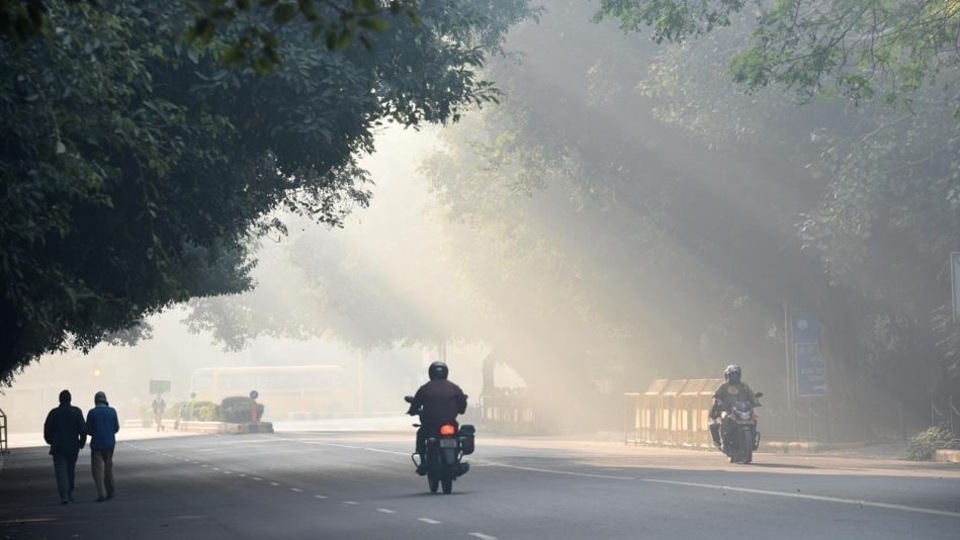
Monday was also the first day this November when visibility improved to beyond 3,000 metres in Palam, said officials of the India Meteorological Department (IMD).
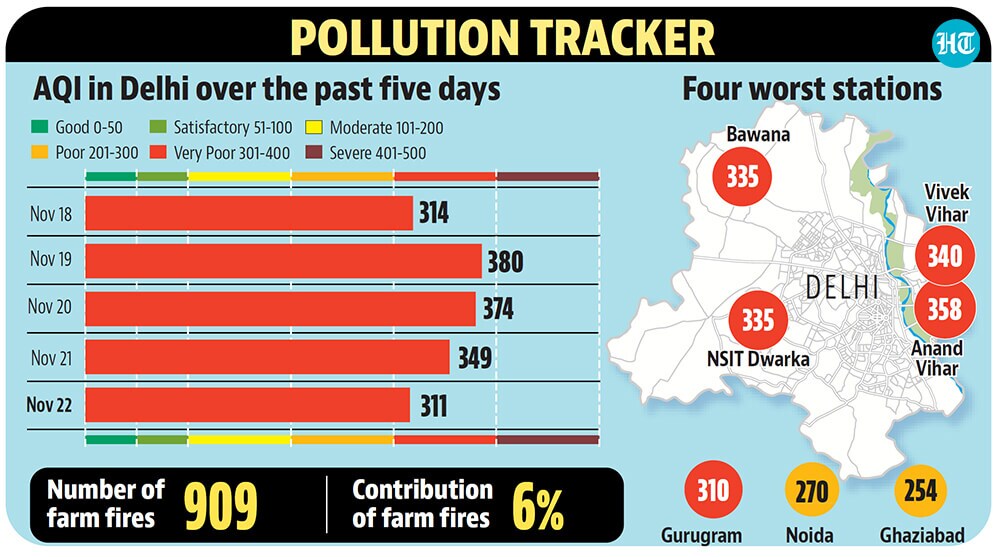
The air quality index (AQI) readings did not cross the 300 mark in at least 10 stations, owing to a combination of strong surface winds and low contribution from stubble burning. The overall AQI of Delhi was 311 at 4pm on Monday, according to the Central Pollution Control Board (CPCB), a climbdown from Sunday’s reading of 349. This reading dropped further to 288 at 10pm, according to CPCB’s Sameer app. Weather analysts said wind speeds touched 25km/hr during Monday, helping disperse pollutants.
IMD said this is the first time this month that visibility has gone beyond the 3,000 metres mark in Delhi, ranging between 1,500 and 3,200 metres during the day in Palam. Agencies forecast strong surface winds to continue on Tuesday as well, and the air quality to improve to the ”poor” category, provided the fire count remains low.
According to the Union earth ministry’s System of Air Quality and Weather Forecasting And Research (Safar), 909 fire counts were recorded across the northern plains in the past 24 hours, with the contribution of stubble burning to Delhi’s PM 2.5 share pegged at 6%.
PM 2.5 are fine, inhalable particulate matter with diameters that are generally 2.5 microns, or about 30 times smaller than a strand of human hair.
“Local surface winds were relatively high on Monday and similar winds are expected on Tuesday. Air quality is expected to improve to the ‘poor’ category in the next two days; however, wind speed is expected to drop after November 24, which may lead to worse air quality,” said Gufran Beig, founder and project director, Safar.
Delhi recorded a maximum temperature of 27.5 degrees Celsius (°C) on Monday – one degree above normal, while the minimum was recorded at 11.4°C, normal for this time of the year. Mercury is set to fall in the coming days, the IMD said, dropping to 10°C by Wednesday. “This was the first November day, when visibility was over 3,000 metres at the Palam station. Wind speeds ranged between 15-25km/hr. However, by November 24, wind speeds will drop considerably,” said RK Jenamani, scientist at the IMD.