
 E-Paper



Lesson from stampedes: Communication key to crowd control, say experts
HT spoke with veteran police officers, planners, urban designers, and academics to dissect the anatomy of stampedes and how to prevent them

 Prefer HTon Google


This year, stampedes at the New Delhi Railway Station, at the Maha Kumbh in Uttar Pradesh, and during a cricket match victory celebration in Bengaluru have led to at least 72 deaths and a few hundred injuries so far — a grim statistic which exposes the glaring gaps in crowd regulation rules, official apathy and tokenistic governance.
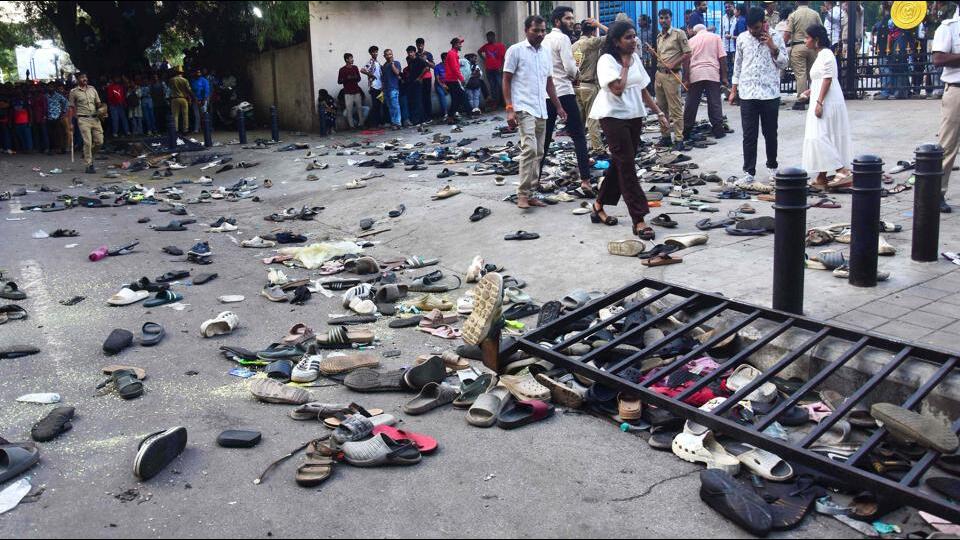
Action taken following these tragic, largely preventable deaths does little to avert such incidents in the future — after the June 4 stampede in Bengaluru, the state leadership, replicating the action of its counterparts in other parts of the country, suspending the city’s top cop and other police staff, and ordered a probe by a retired judge.. Later, the Karnataka high court also took suo motu notice.
In light of these developments, HT spoke with veteran police officers, planners, urban designers, and academics to dissect the anatomy of stampedes and how to prevent them.
Gaps in messaging, policing
Prakash Singh, a retired IPS officer who was the state police chief of Assam and Uttar Pradesh and the director-general of the Border Security Force, said the Bengaluru tragedy appears to be a case of overriding political desire overruling reservations from the police. Multiple reports, including by HT, suggest that the police had initially dismissed the idea of a parade due to paucity of time. But as some players from the overseas were scheduled to return home, there was a rush to hold the celebrations on June 4 itself, according to people aware of the matter.
“But this should have never been made part of the consideration. No event can be organised without the clearance from the police,” Singh said.
The second issue, he pointed out, was the inconsistent messaging. “There were multiple versions of when and where the parade will be held.”
The most significant lapse, however, was the police’s alleged failure to react when the crowd started trickling, Singh said. “Around 200,000-300,000 people tried to make their way towards the stadium when the capacity was only 36,000. It was a policing failure, given that there are enough surveillance measures that would have indicated swelling of crowds.”
Police should have, through existing intelligence and surveillance measures, prevented the crowd from converge from all directions. Another lapse was the inadequate deployment of forces, he added. “Ideally, civic volunteers, armed battalions, and the fire brigade should have been mobilised. If there was fatigue, police from outside the commissionerate should have been engaged, he said.
Crowd control SoPs not a alien concept
While Karnataka home minister G Parameshwara has announced that the government will formulate a new SOP for crowd control, these mechanisms are not alien to India, where heavy footfall events such as the Maha Kumbh are held regularly. They have been part of the police manual since colonial times, and even the National Disaster Management Agency (NDMA) has issued guidelines to manage crowds at events.
To prevent stampedes, the administration — be it government, private organisers or temple trusts— should actively control the “hype” through constant messaging, said Monika Vij, a geography professor at Delhi’s Miranda House, who has researched extensively on crowd management at religious events.
Referring to the Kumbh tragedy in January, where the official death toll was 30, she said, while the authorities made “excellent arrangements”, the hype of a historical event overshadowed everything. Authorities could not effectively communicate with the crowd when the stampede took place, she said. “There has to be greater control and responsibility over disseminating information.”
On the Bengaluru stampede, she said it was the “lack of clarity over the venue and ticketing” which led to the tragedy. Similar confusion was seen at the February 15 stampede at the New Delhi Railway Station over train departures, Vij said.
Another retired IPS officer Nazrul Islam, who was the ADGP in West Bengal, said a crowd, by default, is fuelled by frenzy and not rationality — be it a religious procession or a sports event. “Visible, prompt policing is important to keep the crowd disciplined. Staggered movement of crowds is essential, and for that, checkpoints are installed in all directions from approaches to the event venue,” he said.
Recounting an incident in Siliguri’s Kanchenjunga Stadium in 1988 during the Nehru Gold Cup, Islam said a section of the crowd unhappy with a referee’s decision had entered the pitch. He said, “In no time, we arrested all of them and started applying force to prevent further spillage of the crowd into the field. Any second thoughts about prompt action would have created an irreversible situation.”
Kolkata, which sees frenzied football club among the fans that often spills over to outside stadiums, has regular deployment of horse-mounted police to discipline unruly crowds, right from the British era. “Whenever there is a big sporting event, they are activated at the slightest incident of indiscipline. They can charge faster than their counterparts on foot, and the height advantage gives police the upper hand to assert dominance.”
Like Singh, he said, for any potentially large event, armed battalions are kept ready for deployment if the situation escalates.
Role of planning and design
KT Ravindran, founder of the Institute of Urban Designers India, said, for any kind of gathering, authorities must ensure that designing standards, such as entry and exit points and emergency exit, are followed. “At any point in time, the potential to disperse should be higher than the potential to gather.”
Ujan Ghosh, the former president of the institute, said the combined action of authorities, including police, along with the architecture, either prevents or causes a stampede.
He also questioned if the Bengaluru stadium was the right choice as the venue for the cricket felicitation event. Spaces, such as streets and pavements, are often designed for specific purposes, he said, suggesting that stadiums are usually for ticketed events.

Stay updated with all top Cities including, Bengaluru, Delhi, Mumbai and more across India. Stay informed on the latest happenings in World News along with Delhi Election 2025 and Delhi Election Result 2025 Live, New Delhi Election Result Live, Kalkaji Election Result Live at Hindustan Times.


