
 E-Paper



Copper robbers: The great Metro heist
Gangs of 7-8 people have struck the Delhi Metro 89 times in the past year – stealing a total of 22km of copper wire worth over ₹4 crore.


Under cover of darkness, the three men scaled a boundary wall near Shahdara Metro Station in east Delhi, stepping on to a precarious ledge beside a “resting track” of the Red Line. Undeterred by the danger, and with trains hurtling past them on the two functional tracks, the three worked deftly, slicing through copper cables using battery-operated cutters they had brought with them. By 9.30pm, while Delhi’s lifeline operated at full swing, they vanished into the darkness with 20 metres of copper wire — executing a heist in plain sight.
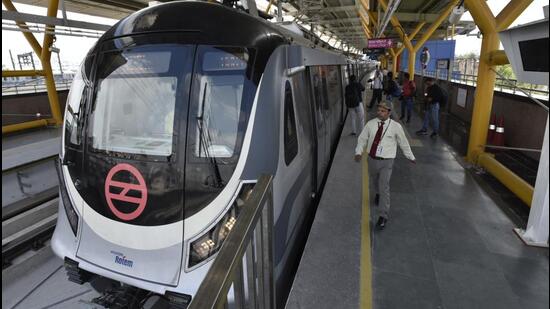
Hours earlier, another theft on the same line, between Seelampur and Welcome stations, caused a six-hour disruption after signal cables were stolen before morning services began.
These two thefts on March 13 are among a growing number of such thefts that have forced emergency shutdowns, frustrating commuters and posing a new challenge to Delhi Metro’s security.
Since June last year, at least 89 instances of cable theft have been reported across the network, according to data from the Delhi Metro Rail Corporation (DMRC). In these cases, a whopping 22 kilometres — or 44,000 kilogrammes — of copper wire worth nearly ₹4 crore has been stolen, data accessed by HT shows.
The frequency and scale of these heists have turned them from a nuisance into a serious operational crisis.
Investigators say the thefts are carefully planned and executed by gangs of at least seven to eight people, each assigned a specific role. Most thefts occur between midnight and 6am, when metro operations are halted, but a disturbing new trend has emerged — thieves are now striking even when the metro is running.
Delhi Police data shows that as of March 18, 28 FIRs have been registered in 2025 — already more than half of the 52 cases recorded in all of last year. While 33 cases were solved in 2024, only 11 have been cracked so far this year. Notably, not all thefts are even reported, particularly in cases where cables are cut, or damaged, but not successfully stolen.
A growing epidemic
While traditional theft hotspots such as Yamuna Bank on the Blue Line have been reinforced with extra security, new ones have emerged. Recent cases have been reported near Seelampur and Shahdara (Red Line), between Jahangirpuri and Haiderpur (Yellow Line), and between Kirti Nagar and Rajouri Garden (Blue Line).
After talking to DMRC officials and investigators who have probed these cases, HT pieced together the effort required to pull off such a dangerous heist.
These heists are the work of well-organised groups that conduct thorough reconnaissance before striking. Posing as regular commuters, gang members study station layouts and pinpoint vulnerable entry points, the people cited above said.
On the night of a heist, at least four members scale walls, climb trees, or use ropes to access metro tracks. They move to predetermined spots and slice through copper wires — often hundreds of metres long and often weighing over 200kg.
“These gangs operate with remarkable precision. It is quite apparent that the man who cuts the wire is always highly skilled—he knows exactly how to handle live wires without getting electrocuted,” a police officer who has investigated cable thefts said.
The severed cables are then thrown over boundary walls to waiting accomplices, who quickly load them into pickup trucks stationed for the purpose.
Next, the stolen copper is transported to a clandestine network of warehouses, often in northeast Delhi or areas such as Madanpur Khadar, where it is stripped of its rubber insulation. The copper is sold to scrap dealers in Mustafabad and parts of Uttar Pradesh for ₹700-750 per kilogramme — lower than the market rate of ₹900. The quick turnover makes it nearly impossible for police to track the stolen metal.
“We arrested scrap dealers in 2021 and 2023, but the challenge is that by the time we catch them, the stolen copper is long gone — melted and resold,” the officer cited above explained. “If we don’t manage to trace the cooper within hours of a theft, there’s nothing left to recover.”
Exploiting security vulnerabilities
Cable thefts have occurred across all types of metro infrastructure—surface-level tracks, elevated viaducts, even underground tunnels. Out of 89 reported cases, 40 have taken place on elevated tracks, where thieves exploit gaps in security by climbing viaducts at night.
Recent high-profile thefts include the March 12 theft of overhead equipment between Qutub Minar and Chhattarpur, and a March 9 incident where cables were cut between Mayur Vihar and Nizamuddin. The largest single theft occurred in October 2024 at Mukundpur Depot, where three kilometres of cable were stolen.
Investigators say thieves use multiple methods to gain access. Some climb trees or garbage piles near metro stations, while others throw ropes over elevated sections and climb up. In some cases, houses near Red Line stations provide easy access, allowing thieves to jump from terraces directly onto metro property.
For underground stations, tunnels serve as entry points. “The tunnel openings often have boundary walls no higher than nine feet, making them easy targets,” the police officer said.
Previously, thieves used to focus on ground-level stations such as Yamuna Bank. But after police cracked down and added security measures they have shifted their attention elsewhere.
“Yamuna Bank is at the surface level, which made access easier for thieves. The interventions made include cementing over cables there, installation of anti-theft clamps, hiring private security guards and installation of concertina coils on the boundary,” said a DMRC spokesperson. “We are now looking to put these measures in place at other stretches too, with plans to also use drones and CCTV surveillance for vulnerable areas.”
Out of the 89 cases, around 40 have actually occurred on elevated sections. The most commonly struck section, however, remains the Red Line, accounting of 25% of all instances of theft. It is followed by the pink (18% of all cases), and yellow (11%) lines.
However, monitoring the DMRC’s massive 395-km network remains a challenge.
“Despite having over 8,500 CCTV cameras on the DMRC network, it is not possible to cover every section of every track. Thieves also use access the tracks by climbing viaducts and making openings there itself. Since there are so many viaducts and girders, installing cameras or placing guards there is simply not possible,” said a DMRC official, who asked not to be identified.
A long-running crisis
According to officers probing cases of copper wire thefts on the metro, these incidents largely began around late-2017 and early-2018 and escalated sharply around the pandemic, as security became lax, passenger numbers shrunk and train operations became scarce.
According to a second police officer, who also asked not to be named, the thefts were dominated by gangs from Rangpuri Pahadi in southwest Delhi, but they disappeared from the scene around 2021. Later, a gang from Khekada, Uttar Pradesh, became active. “In fact, this heist has become so lucrative that thieves are going to Mumbai and Kolkata to commit copper wire theft there as well,” a second police officer said.
Today, cable theft has become a free-for-all, with no single gang in control.
Despite repeated police crackdowns, the problem persists. The stolen copper is simply too easy to offload, making thefts highly profitable with minimal risk, the people cited above said.
Anuj Dayal, principal executive director, corporate communications at DMRC acknowledged the growing crisis and the impact on daily commuters. “These incidents cause massive inconvenience to passengers who rely on metro punctuality. We are working closely with law enforcement to tackle this problem.”
But with copper thefts increasing in both scale and brazenness, authorities are now in a race against time to prevent Delhi’s metro from becoming an easy target for organised crime.

Stay updated with all top Cities including, Bengaluru, Delhi, Mumbai and more across India. Stay informed on the latest happenings in World News along with Delhi Election 2025 and Delhi Election Result 2025 Live, New Delhi Election Result Live, Kalkaji Election Result Live at Hindustan Times.


