
 E-Paper



Delhi AQI improves further, now in the ‘poor’ category
Delhi’s air quality continued to improve on Wednesday, dipping back to the ‘poor’ category with an Air Quality Index (AQI) of 271, a rarity in the immediate aftermath of Diwali but a phenomenon mostly credited to stronger-than-usual winds for this time of the year


Delhi’s air quality continued to improve on Wednesday, dipping back to the ‘poor’ category with an Air Quality Index (AQI) of 271, a rarity in the immediate aftermath of Diwali but a phenomenon mostly credited to stronger-than-usual winds for this time of the year.
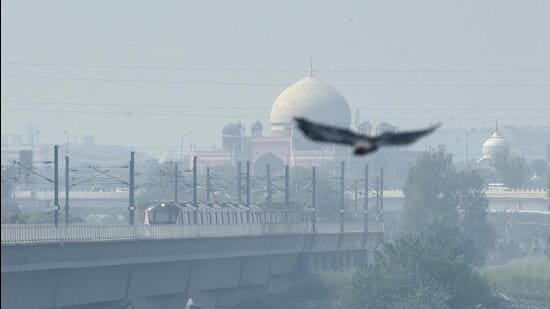
Wednesday’s pollution figure recorded as per Central Pollution Control Board’s (CPCB) national bulletin at 4 pm each day was lower than Tuesday’s 302, which lay in the very poor range. Forecasts show air quality may marginally deteriorate in the next 24 hours, but is likely to remain in the ‘poor’ category till October 29.
“The air quality is likely to deteriorate marginally but will remain between the ‘poor’ category or the lower end of the ‘very poor’ category on October 27. The air quality is likely to remain in the ‘poor’ category on October 28 and 29. The outlook for the subsequent six days shows that the air quality is likely to remain largely between ‘poor’ and ‘very poor’,” said the Early Warning System (EWS), which is used by the Commission for Air Quality Management (CAQM) to plan and take pre-emptive action through the Graded Response Action Plan (Grap).
Farm fires in upwind states of Punjab and Haryana have increased, potentially raising the likelihood of a drastic drop in air quality. In the last 24 hours, active fire counts in Punjab, Haryana and Uttar Pradesh have increased over the last 24 hours, but they seem to not yet be making an impact in Delhi’s air. This was mainly due to wind direction switching to westerly for large parts on Tuesday, experts said.
“Overall, Delhi’s AQI is in the ‘poor’ category and fine particles (size < 2.5 micrometer) are contributing to around 50% to PM10. Share of stubble fire emissions over the northwest region to Delhi’s PM2.5 is meagre, at around 5-6%. Peak ‘mixing layer height’ during daytime at around 1.5 kms is leading to moderate vertical dispersion of pollutants at the moment,” said the System of Air Quality and Weather Forecasting And Research (Safar), a body under the ministry of earth sciences.
A high mixing layer height is good for air quality since it indicates that pollutants are dispersed over a wider area in the sky, instead of settling close to the ground.
Based on forecasts, Delhi is likely to end this October without a single ‘severe’ air day, a stage when the AQI is over 400. While Delhi did not record a single ‘severe’ air day last October or in 2020, however, it recorded at least one ‘severe’ air day between October 2016 and 2019.
In 2020, the AQI went as high as 395 in the month of October, but the highest AQI last October was just 298. October 2021 was also Delhi’s cleanest October for Delhi in the last seven years, based on average AQI.
Stay updated with all top Cities including, Bengaluru, Delhi, Mumbai and more across India. Stay informed on the latest happenings in World News along with Delhi Election 2025 and Delhi Election Result 2025 Live, New Delhi Election Result Live, Kalkaji Election Result Live at Hindustan Times.


