
 E-Paper



Diwali in Delhi: Ban or no ban, markets abuzz with cracker sales
HT finds vendors in Chandni Chowk, Sadar Bazaar, Jama Masjid openly selling crackers; police look away as vendors earn lakhs despite blanket ban in Delhi-NCR.

 Prefer HTon Google


Even as Delhi-NCR awaits the Supreme Court’s final verdict whether or not firecrackers will be allowed this Diwali, the festive buzz in the Capital’s markets revealed a different story. Despite a blanket ban on their manufacture, sale, storage and use, firecrackers are being sold openly across several parts of the city, an HT visit to Chandni Chowk, Jama Masjid and Sadar Bazaar found. Meanwhile, the sound of firecrackers has already filled the air across NCR with a large number of such incidents reported last week, according to residents’ welfare associations (RWAs).
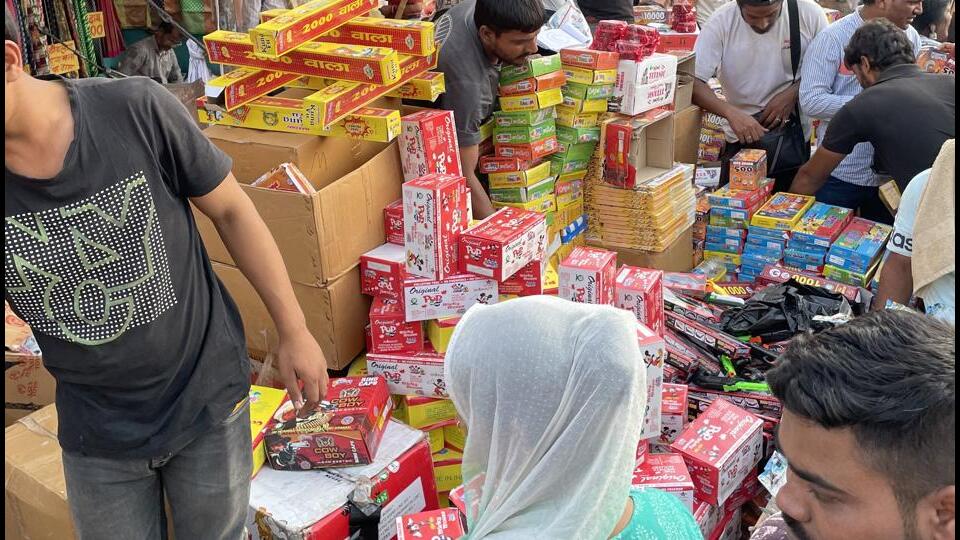
Last week, the apex court reserved its verdict on petitions filed by cracker manufacturers against the permanent ban. The Centre, at the hearing, recommended restricting sales to licensed traders and barring online platforms from facilitating firecrackers sales in Delhi-NCR.
The lanes of Sadar Bazaar on Sunday and Monday were alive with Diwali shoppers, with many discreetly enquiring about and buying crackers. HT spotted at least 10 vendors – three of them on the main road – selling packets of bombs and sparklers, some kept hidden under tables or behind cartons of sweets.
“We don’t display the big crackers, it is kept under the table. But if, someone asks for them, then we sell them discreetly,” said a 19-year-old street vendor at Sadar Bazaar said on condition of anonymity. The vendor, who otherwise works in various shops in the area, claimed he earns more in two days of Diwali sales than in a month of regular work.
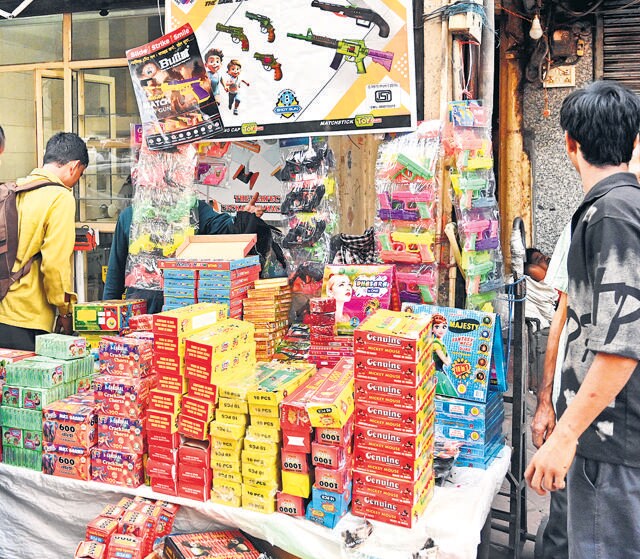
According to him, nearly 15 vendors in the area make between ₹50,000 and ₹4 lakh a day on weekends, collectively earning over ₹30 lakh each through the festive period.
On Sunday, these vendors went unnoticed by Delhi Police personnel, who were managing the crowds and traffic. “Yesterday the police caught me selling crackers and kept me at the station for few hours before releasing,” another vendor told HT.
He further explained how vendors like him were benefitting from big manufacturers being unable to openly sell firecrackers. “We buy the stock from wholesalers who can’t sell directly because of the ban. We sell it with a margin of 50-60%,” he said, showing a packet of “green craackers” priced at ₹300 – up 60% from its original value.
While shops that used to sell firecrackers in front of Jama Masjid’s gate no. 3 remained closed, children, along with their parents, were walking around the market with packets of crackers in the same lane. Street vendors were openly selling sparklers, flower pots and light crackers to families. Prices ranged from ₹200 to ₹1,000.
“We bought this stock before the ban was imposed. These are just for children,” said one, shrugging when asked about the restrictions. “You can’t stop children from celebrating Diwali.”
Still, many established shop owners are cautious. At Majestic Fire Works Co. in Sadar Bazaar, the shutters were half down, and the shelves empty. “We have all kinds of crackers in stock – even the green ones – but not here in the shop. If the court allows, we will start selling after Tuesday,” the owner said.
In north Delhi’s Shakti Nagar, smaller shops displayed only “kids’ crackers” such as colourful plastic toy guns or green cracker boxes. A few even offered regular fireworks on request.
One owner, who also asked not to be identified, showed HT a 22-page PDF catalogue with images of dozens of firecrackers. “People know us. We don’t display them, but we have everything. Once customers choose from the catalogue, we get the stock from our storehouse,” he said.
Residents’ welfare associations confirmed that firecracker activity in many homes has increased over the past week. “We’ve been hearing crackers every night. We’ve asked shopkeepers to only sell green crackers if they must, but even those aren’t really available,” said Ashok Bhasin, president of a North Delhi RWA.
To be sure, the city’s previous experiment with allowing green firecrackers between 2018 and 2020 failed as it is impossible to distinguish between the conventional and green ones simply off face value. Experts have previously said that “green” firecrackers largely remain a misnomer and allowing them might open the floodgates of all of sorts of crackers — further defeating the poorly implemented ban.
A comprehensive ban on firecrackers was first implemented in 2017 when the Supreme Court intended to check whether the ban would positively impact air quality and the health of residents. In 2018, the SC permitted the manufacture and use of green crackers. However, since 2020, the Delhi government has imposed annual blanket bans on all firecrackers during the winter season, when pollution gets particularly bad in the city, due to the challenge of distinguishing between the various kinds.
To be sure, the bans are poorly enforced and every festival season, Delhi is shrouded in smog with air quality touching hazardous levels. In December last year, after directions from the Supreme Court, the Delhi government imposed a complete ban on all firecrackers through the year.

Stay updated with all top Cities including, Bengaluru, Delhi, Mumbai and more across India. Stay informed on the latest happenings in World News along with Delhi Election 2025 and Delhi Election Result 2025 Live, New Delhi Election Result Live, Kalkaji Election Result Live at Hindustan Times.


