E-Paper



Delhi gets its first dense fog of the season; AQI deteriorates to ‘severe’
A weather department official said the dense fog layer started spreading from Punjab, and made its way all the way to eastern UP, via Haryana, Delhi and western UP. However, there were pockets within this region, where visibility was over 1,000 metres too.

 Prefer HTon Google


NEW DELHI: A thick layer of dense fog descended across the Indo-Gangetic Plains including Delhi in the early hours of Monday, the national capital’s first spell of the fog of the season which caught weather department officials off-guard.
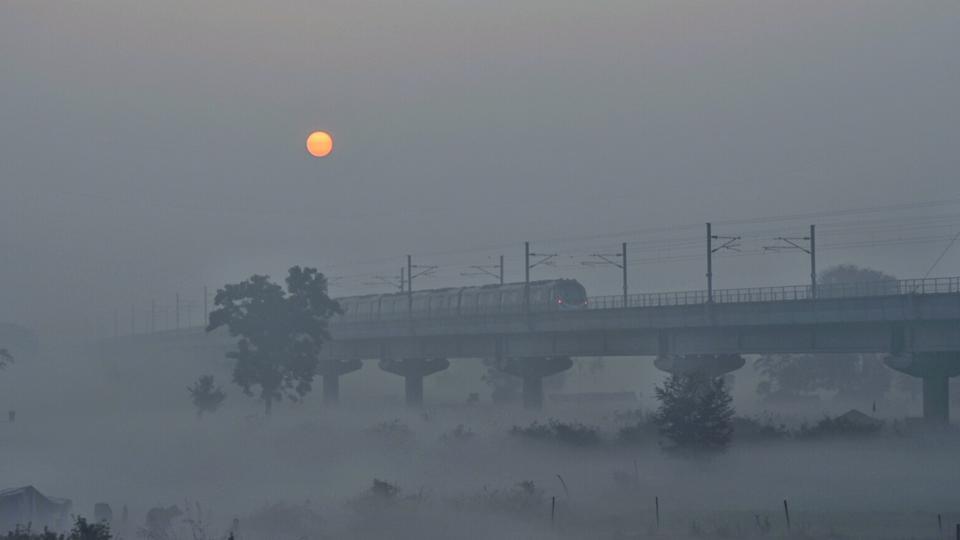
India Meteorological Department (IMD) officials said visibility suddenly dropped overnight due to fog developing in Punjab and pushing its way to Delhi-NCR. So far, Delhi has only had isolated spells of shallow fog, owing to unfavourable conditions such as low moisture and good wind speed.
A weather department official said the dense fog layer started spreading from Punjab, and made its way all the way to eastern UP, via Haryana, Delhi and western UP. However, there were pockets within this region, where visibility was over 1,000 metres too.
“Fog is the only meteorological event with high spatial variability, meaning the fog cover could be extremely thick in one part of the city and very shallow in another part. It is thicker closer to water bodies and canals,” said RK Jenamani, scientist at IMD. Jenamani added that factors such as wind speed, humidity levels, low temperature and pollutants, all play a role, in the fog forming near the surface.
“For fog to become thick, one needs adequate moisture, calm winds and low temperatures. Delhi was already seen calm winds at night and low temperatures, with additional moisture also possibly getting added through the northern plains, coming all the way from Punjab,” Jenamani said.
Mahesh Palawat, vice president at Skymet meteorology, said while the dense fog was not likely in Delhi until the end of the month, meteorological conditions changed within a matter of hours, becoming conducive for fog formation.
“This fog began forming in Punjab and was gradually pushed towards UP, as the wind direction during this season is northwesterly. Local winds in Delhi also became calm late at night and with sufficient moisture and low temperatures, the moisture began to condense and form fog,” he said.
“When there is low moisture, then chances of dense fog are less, but they can still form under ideal meteorological conditions. However, the duration of such a fog is less. If there is high moisture, this fog spell can last several hours and stretch into the day too, blocking sunlight and bringing cold-day conditions,” he added.
Delhi’s Indira Gandhi International (IGI) airport, where the Palam observatory of the IMD is located, saw visibility oscillate between 150 to 200 metres between 3:30 am and 6am. The visibility gradually improved to 700 metres after 7am, officials said.
The airport initiated low visibility procedures from midnight and kept it in place till 4am, which led to some flights getting delayed.
“This was initiated as visibility dipped, but no flights were diverted or cancelled due to the fog. Only slight delays occurred,” said an airport official.
This layer of fog also saw Delhi’s air quality index (AQI) deteriorate to the ‘severe’ category, with a reading of 409 recorded at 11am this morning.
Delhi’s AQI in comparison was 353 (very poor) at 4pm on Sunday.
Fog is termed as ‘smog’ when pollution levels are already high, and the pollutants combine with moisture to reduce visibility. This happens when the moisture in the air traps pollutants closer to the surface, and the low temperature and calm winds make it difficult for the pollutants to disperse.