
 E-Paper



Delhi parking costs to double when Grap stages 3 and 4 kick in, says govt notification
The notification exempts those parking lots operated by the DMRC to promote public transport, even as experts warn that the revision could create confusion.

 Prefer HTon Google


The Delhi government has issued a gazette notification mandating that parking charges across the capital be automatically doubled whenever Stages 3 and 4 of the Graded Response Action Plan (Grap) are invoked, a move aimed at discouraging private vehicle use during severe air pollution episodes.
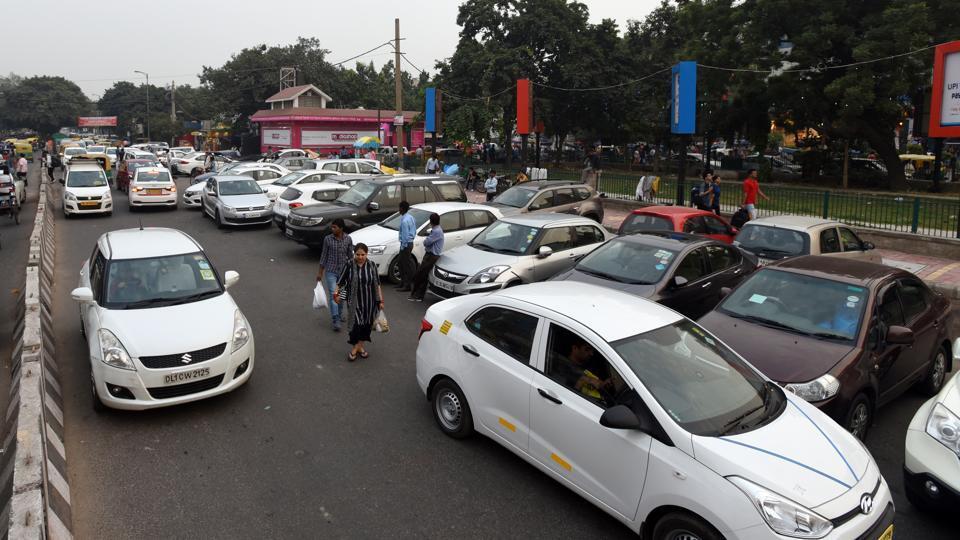
The notification, dated January 8 but uploaded by the environment department on its website on January 22, has been issued under the Environment (Protection) Act. It applies to all authorised parking facilities in the city but exempts those operated by the Delhi Metro Rail Corporation (DMRC) to promote public transport, even as experts warn that the revision could create confusion in implementation.
Issued under Section 5 of the Environment (Protection) Act, the notification empowers the lieutenant governor to direct the automatic doubling of parking charges in Delhi whenever Stage 3 (severe) and Stage 4 (severe-plus) curbs under Grap are enforced. It also amends earlier directions to exempt parking facilities owned and operated by the DMRC, citing their role in providing essential public transport connectivity and park-and-ride facilities. Violations of these directions would attract penalties under Section 15 of the Act.
Also Read | Cold wave is back as rain, snow to persist: IMD forecasts big dip in temperatureThe gazette states that Delhi has around 8.24 million registered vehicles, with about 677 parking facilities having an approved parking capacity for roughly 106,037 vehicles. This excludes vehicles parked in the 91 parking areas operated by the DMRC at metro stations and offices.
“To discourage the use of private vehicles and promote public transportation, there is a need to impose higher vehicle parking rates in the city as a deterrent,” the gazette says, adding that past studies — including a comprehensive 2015 study on air pollution and greenhouse gases by IIT Kanpur — flagged the high contribution of vehicles to Delhi’s pollution load.
The study found that vehicles contribute about 19.7% of PM10 and 25.1% of PM2.5 in winters, and about 6.4% of PM10 and 8.5% of PM2.5 in summers. It also noted that vehicles account for around 18% of methane (CH4) emissions, 92% of nitrous oxide (N2O) emissions, and 30% of carbon dioxide (CO2) emissions in the city, the gazette adds.
Increasing parking charges to disincentivise private vehicle use is already a measure prescribed under Stage 2, or the ‘very poor’ air quality category, of Grap. The latest revision to Grap in November 2025 also retains this measure under Stage 2. Experts said that with the gazette now explicitly calling for doubling of parking charges under Stages 3 and 4, confusion is likely over how and when the provision should be implemented.
“While Grap already provided for this measure under Stages 2 to 4, the gazette notification only adds to the confusion over whether it needs to be implemented at Stage 2 or not. Instead of improving on-ground implementation, it is creating uncertainty. The government should instead create a mechanism to proactively increase charges on the ground,” said Sunil Dahiya, founder and lead analyst at Envirocatalysts.
Queries sent to the Commission for Air Quality Management (CAQM) and the Delhi government seeking comment on the matter went unanswered.


Stay updated with all top Cities including, Bengaluru, Delhi, Mumbai and more across India. Stay informed on the latest happenings in World News along with Delhi Election 2025 and Delhi Election Result 2025 Live, New Delhi Election Result Live, Kalkaji Election Result Live at Hindustan Times.


