On Sansad Marg, the nearly 500-metre stretch connecting Connaught Place to Jantar Mantar, about 250 people stood on the road on Friday evening. But not one was a civilian. Delhi Police personnel, Rapid Action Force members and other central paramilitary forces occupied the carriageway, flanked by towering anti-riot vehicles, buses and police vans. Officers huddled in groups, ate snacks on pavements and listened to briefings from senior officials.
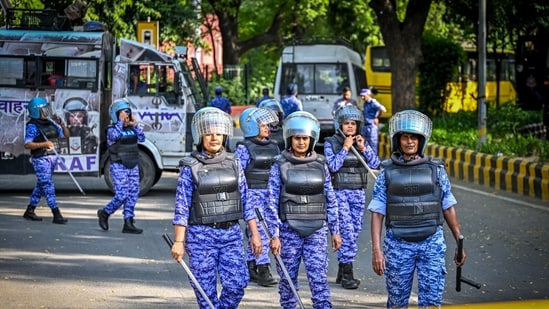
Across central Delhi, the scene was played out in varying degrees.
More than 40,000 personnel deployed
With a massive gathering expected on Saturday, the Capital has been turned into a fortress, with more than 40,000 Delhi Police and Central Armed Police Forces (CAPFs) personnel deployed to prevent protesters from converging on Jantar Mantar for a demonstration called by the Cockroach Janta Party (CJP) against Chief Election Commissioner Gyanesh Kumar over alleged electoral roll irregularities.
Jantar Mantar, the intended focal point of the protest, was sealed off even to media personnel. Its connecting roads were barricaded and manned by security forces, with loudspeakers at three key entry-exit points broadcasting warnings in Hindi and English against gatherings, processions, road blockades and other prohibited activities under Section 163 of the Bharatiya Nagarik Suraksha Sanhita (BNSS).
Delhi Police said more than 15,000 of its personnel had been deployed to handle Saturday’s anticipated protest, with the number of central force personnel in the city expected to be around 26,000.
One of the heaviest deployments was at the Tolstoy Marg-Sansad Marg intersection, a key approach to Jantar Mantar, and outside Parliament Street police station. At least two layers of barricades blocked pedestrian and vehicular movement towards the protest site. The carriageway leading to the Ashoka Road roundabout was blocked at Connaught Place’s Outer Circle, with traffic diverted to the opposite carriageway.
A senior police officer said New Delhi district had been divided into 20 zones, each headed by an officer of deputy commissioner of police rank. Barricades had been installed at 37 identified points from where protesters could potentially enter.
Officials privy to the deployment details said that CAPFs were also asked to send women personnel, including physically trained recruits, to manage and detain women protesters. Around 5,000 personnel from Haryana and Uttar Pradesh could also be deployed, the officer said.
Also read: CJP founder Abhijeet Dipke meets Gauri Lankesh’s kin in Bengaluru, calls them his ‘new family’
Transport and communications restrictions
The restrictions extend well beyond the barricades. The Delhi Metro Rail Corporation (DMRC) initially announced that entry and exit at 57 stations would be suspended from 9pm on Friday through Saturday, before revising the list late at night to 45 stations.
In a separate order, Delhi Police directed the suspension of mobile internet services within a four-kilometre radius of the Janpath-Kartavya Path crossing from 10pm on Friday to 10pm on Saturday. The order, dated October 9, was issued under the Telecommunications Act, 2023, and the Telecommunications (Temporary Suspension of Services) Rules, 2024, and directed Airtel, Vodafone Idea, Jio and MTNL to implement the suspension.
Also read: Public safety, past lapses: Why Delhi Police denied CJP permission for Jantar Mantar protest
A late-night Delhi Traffic Police advisory warned of disruption across central Delhi, with diversions at 30 locations from 6am, depending on the situation. Affected stretches include Dhaula Kuan flyover, Jhandewalan, Mandi House, Minto Road, Deen Dayal Upadhyay Marg, Lodhi Road flyover, Patel Chowk, Rail Bhawan, Windsor Place, and junctions around Connaught Place. Jantar Mantar Road, Ashoka Road, Sansad Marg, Janpath and Barakhamba Road could also see restrictions. Commuters were advised to avoid non-essential travel and plan journeys to railway stations, inter-state bus terminals and the airport in advance.
The Railways also cancelled mail and express trains scheduled to arrive at New Delhi and Hazrat Nizamuddin stations between 4am and 2pm on Saturday, citing the likelihood of severe road congestion. The cancellations apply to trains scheduled to depart their originating stations after 2pm on Friday and reach the two stations during the specified window.
Police have also been visiting hotels, guest houses, hostels, paying guest facilities and other temporary accommodation across the Capital to question occupants considered suspicious. Officers have been asked to scrutinise stays between October 8 and 11, large groups, particularly people in their 20s and early 30s, and visitors’ stated reasons for coming to Delhi, officials said.
Also read: ‘Modi may have power, but we have the streets’: CJP’s Dipke leads Bengaluru protest against SIR
Previous protests and police justification
The security build-up has been gathering pace since October 2, when a major demonstration against the CEC involving opposition parties, student organisations and civil society activists led to around 1,000 people being detained. Since then, repeated attempts by the Congress, student groups and civil society activists to assemble in central Delhi have been prevented under prohibitory orders banning gatherings of more than four people in the New Delhi district.
Delhi Police, meanwhile, defended the heavy restrictions, citing violence during earlier demonstrations. “The right to peaceful protest is an important democratic right. At the same time, New Delhi houses important establishments and offices of constitutional authorities,” additional commissioner of police and PRO Rajeev Ranjan said.
He said more than 200 police personnel were injured during protests in July, which continued for about a month. Jantar Mantar, he added, was a relatively small site that could safely accommodate around 1,000 people at a time. The restrictions, he said, were temporary and precautionary.
The October 10 protest comes months after the CJP-led agitation in July, when thousands attempted to march towards Parliament on July 20, demanding the resignation of then Union education minister Dharmendra Pradhan. Police used tear gas and baton charges after protesters attempted to breach barricades. Videos circulated on social media appeared to show some protesters being beaten, while police maintained that force became necessary after demonstrators turned violent. The protest continued until July 25, when Pradhan resigned.
On Friday, loudspeaker announcements at Jantar Mantar warned that those violating prohibitory orders could face legal action, with separate proceedings threatened against anyone accused of assaulting or obstructing security personnel, vandalism or violence. Media personnel were also told to maintain a safe distance from protesters and security forces.
Frequently Asked Questions
How many security personnel were deployed in Delhi for the anticipated protest?
What restrictions were announced ahead of the protest?
Why did Delhi Police say the restrictions were necessary?
Stay updated with all top Cities including, Bengaluru, Delhi, Mumbai and more across India. Stay informed on the latest happenings in World News along with Delhi Election 2025 and Delhi Election Result 2025 Live, New Delhi Election Result Live, Kalkaji Election Result Live at Hindustan Times.
Stay updated with all top Cities including, Bengaluru, Delhi, Mumbai and more across India. Stay informed on the latest happenings in World News along with Delhi Election 2025 and Delhi Election Result 2025 Live, New Delhi Election Result Live, Kalkaji Election Result Live at Hindustan Times.