E-Paper



Delhi’s oversaturated landfills are tinderboxes waiting to ignite: Experts
According to the Delhi Fire Services data, four fires were reported from the Ghazipur landfill in 2021. In 2020 and 2019, eight and six such incidents were reported, respectively.

 Prefer HTon Google


East Delhi’s Ghazipur landfill saw the first major fire of this summer on Monday, which, if one goes by past year records, is just a precursor to the fires to come.
According to the Delhi Fire Services (DFS) data, four fires were reported from the landfill in 2021. In 2020 and 2019, eight and six such incidents were reported, respectively. At the Bhalswa landfill, there were 12 fires last year while two fires were reported this year so far. In 2020 and 2019, one and six fire incidents were reported, respectively, from that site. Similarly, Tughlakabad landfill reported two fires this year, while there was no fire last year. This landfill reported six blazes in 2020 and 25 in 2019, the fire department data shows.
“The steep vertical surface makes these landfill sites almost inaccessible. Sources of fires are located 10-20m down the surface and using water further increases the problem as due to the porosity of landfill, the entire mound becomes unstable. Unstable landfill portions have collapsed in the past,” a DFS official said, asking not to be named.
. A section of the oversaturated landfill had collapsed in September 2017 claiming the lives of two people.
Atin Biswas, a waste management expert and program director of municipal solid waste sector in Centre for Science and Environment, said, “There can be two causes for such fires. First, is human factor; waste pickers who scavenge the waste may inadvertently start a fire. Second, and the more dominant reason, is methane generation from rotting food waste. Once the pressure of trapped methane gas crosses a threshold, a fire is ignited. That kind of fire is much harder to extinguish as normal fire tenders cannot reach the source of the fire.”
East corporation mayor Shyam Sunder Aggarwal said the fire at Ghazipur on Monday was due to rising temperatures causing a buildup of trapped gases. “During this season a lot of dry waste and leaves reach the landfill. There is no human error involved. The environmental conditions could have ignited the fire which has spread. It should be controlled in half an hour,” the mayor said. However, the fire continued to burn even late into the night.
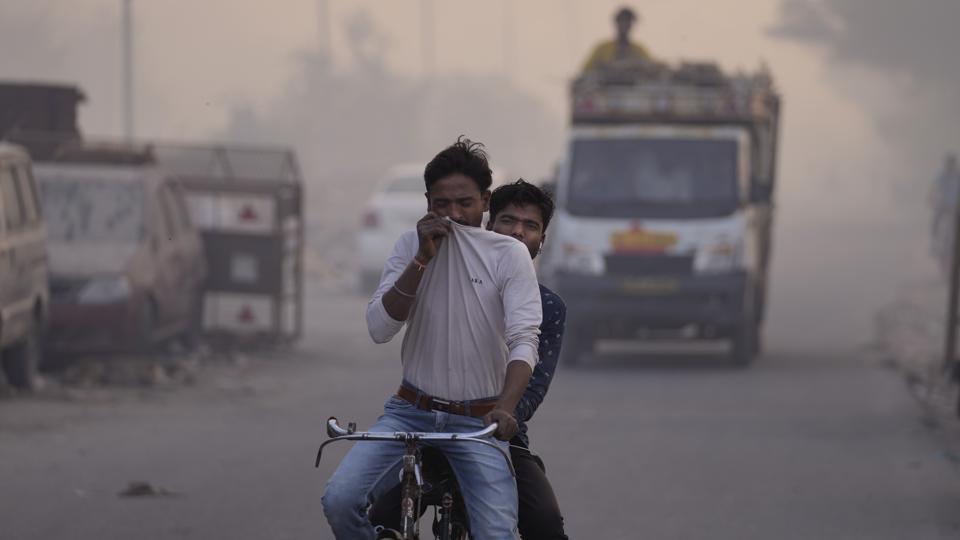
The fires also cause another grave problem, one that has become Delhi’s perennial bane — pollution. The emissions from Bhalswa landfill, the oldest operational dump, is the highest, say officials. While minor fires and smoke is a year-round occurrence there, come summer and it also witnesses the maximum number of fires.
Experts say toxic fumes that these landfills include extremely polluting and greenhouse gases — carbon dioxide and monoxide, hydrogen sulphide, dioxins and furans.
Dipankar Saha, former head of Central Pollution Control Board’s air laboratory, said depending on the wind speed, the smoke could travel several kilometres from the landfill. “Unburnt hydrocarbons are released during the combustion process and landfill sites also have plastic and batteries which can release toxic chemicals, heavy metals and furans,” said Saha, adding that the impact can range from short-term — such as an itchy throat or eyes — to long-term, such as asthma.
Data from two nearest ambient air quality stations — Patparganj and Anand Vihar — showed that the average PM10 levels ranged form 150-355 micrograms per cubic, from 2pm to 10pm, while the PM2.5 levels ranged from 50-120 µg/m3. The safe standard for PM10 is 100µg/m3,and PM2.5 is 60µg/m3.
Solutions
Based on the directions issued by the National Green Tribunal, the East corporation launched a bio mining project to flatten this garbage mountain. Agarwal said the bio mining of Ghazipur started in 2019 and the corporation has set a deadline of December 2024 to completely clear the landfill. Similar trommelling and bio mining exercises are on in Bhalswa and Okhla sites as well.
However, issues such as suspension of the process during monsoon, continued dumping of fresh waste and disposal of inert waste have slowed down the project.
Biswas said in long run, the only solution is to prevent food waste from reaching the landfill. “Under the Swachh Bharat Mission, financial incentives have been linked to push local bodies to divert the waste reaching landfill sites before 2026. Segregation at household is the way forward,” he said.