
 E-Paper



Delhiwale: This way to Gali Qasim Jan
Poetry in some form is everywhere in Gali Qasim Jan

 Prefer HTon Google


Poetry in some form is everywhere in Gali Qasim Jan. Not the poetry of Mirza Ghalib, who spent his last years on this Old Delhi street, but the poetry of shop names. De Cut Salon. Tip Top Gents Parlour. Grocers Gallery. Rafaa Cafe. Tamanna Guest House.
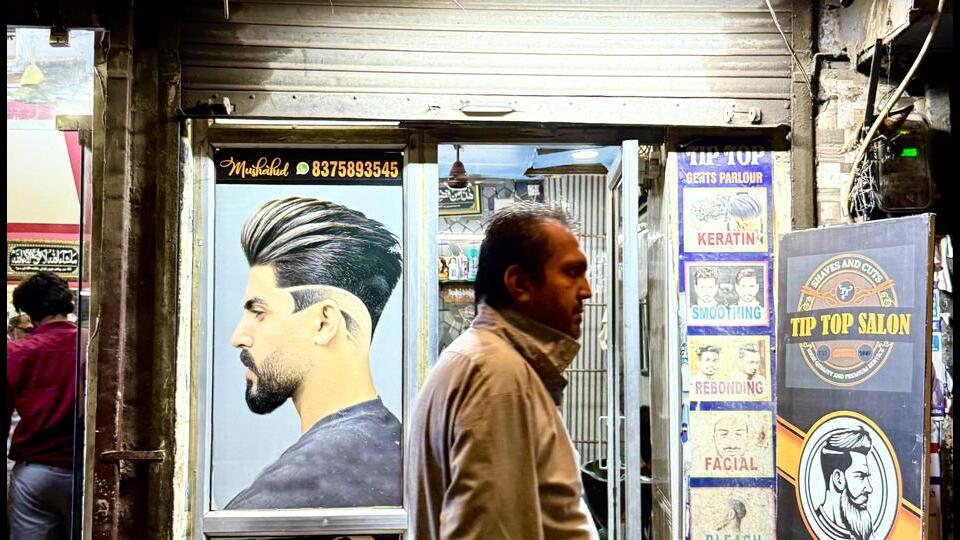
The names hang above the cramped street on boards in English, Hindi and Urdu. Electric wires hang higher. Monkeys travel across shop banners.
Much of the street’s old architecture is hidden behind signboards. Above Al Faiz Bakery rises a yellow facade. Projecting wooden beams support the upper floor, where tall wooden screens run along the street-facing front. Below, the overhang rests on a succession of curved brackets. A large blue ice-cream board covers much of the elegant façade.
As for Qasim Jan of Gali Qasim Jan, nobody around is certain. One passer-by suggests Qasim Jan was an aristocratic lady of long ago. Another passer-by points to Masjid Nawab Qasim Khan mosque and offers a theory: Qasim Jan’s name evolved out of Qasim Khan. The Nawab, he says, was a super-rich dhanna seth of Mughal times who lived in Ballimaran neighbourhood, of which this street is a part.
As for Ghalib, no Walled City street is named after Delhi’s greatest poet. He was famously fond of French wine, so if he were alive today he might have liked to get his regular haircut at De Cut Salon. The establishment, after all, has a vaguely Francophone inclination. That “De” in its name. Its board shows a red pair of scissors. The window is covered with photos of balding heads under the headline “Ganjapan ko khatam karne wala tel,” promising an oil that cures baldness. The salon owner says that hair cutting is only part of his business. He has a small factory in New Seelampur where he manufactures anti-lice shampoo, anti-lice oil and toilet cleaner.
A few doors away, Khass Gaming Zone glows blue, its frontage covered with Wolverine, Tekken fighters and a bare-chested WWE 2K26 wrestler. This is an establishment unimaginable in Ghalib’s time, though, as any reader of Ghalib could tell, the playfulness might not have been entirely alien to him.
Sadly, most of the haveli where Ghalib lived is gone. Some decades ago, its remains were turned into a coal store. What survives is now a memorial museum. Inside are the poet’s bust, books, quotations and objects recalling his life. One wall carries a framed declaration attributed to Ghalib scholar Ralph Russell: “Had Ghalib written in English, he would have been the greatest poet of all times, amongst all languages!” Isn’t it an unusual compliment to a poet whose greatness lies in the languages (Urdu and Persian) in which he wrote?
Ghalib died in this haveli in 1869. His funeral procession must have emerged from here into Gali Qasim Jan.


Stay updated with all top Cities including, Bengaluru, Delhi, Mumbai and more across India. Stay informed on the latest happenings in World News along with Delhi Election 2025 and Delhi Election Result 2025 Live, New Delhi Election Result Live, Kalkaji Election Result Live at Hindustan Times.


