
 E-Paper



Despite monsoon flow, Yamuna pollution markers remain high
The pollution parameters of the Yamuna have either remained constant or seen a marginal dip in July compared to the previous month, according to the latest assessment, despite the onset of monsoon rains that typically help improve the environmental flow (e-flow) of the river

 Prefer HTon Google


The pollution parameters of the Yamuna have either remained constant or seen a marginal dip in July compared to the previous month, according to the latest assessment, despite the onset of monsoon rains that typically help improve the environmental flow (e-flow) of the river.
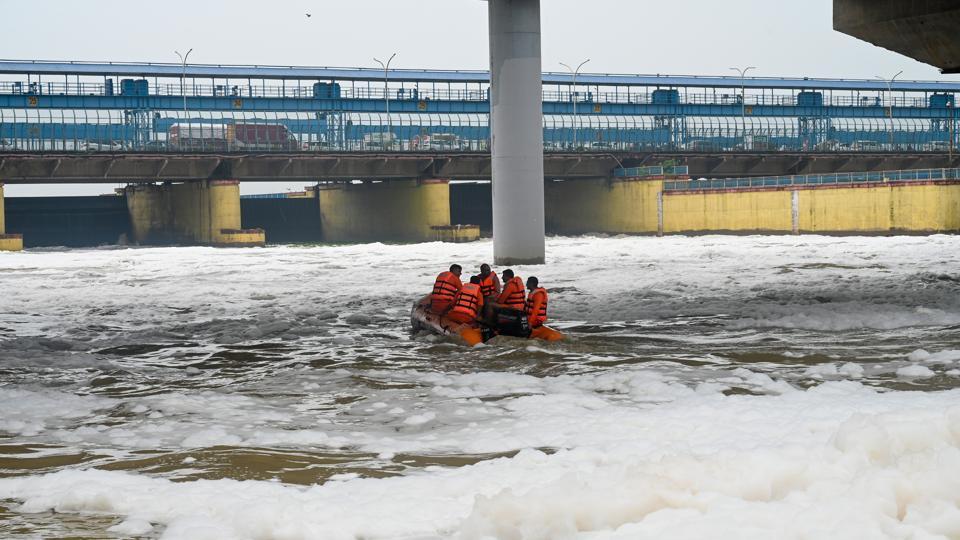
According to the Delhi Pollution Control Committee (DPCC) report, dated August 4, at the exit point of the river at Asgarpur, the faecal coliform level has dipped to 320,000 from 390,000 most probable number (MPN) units per 100ml. However, this indicator of sewage entering the river is still over 150 times over the Central Pollution Control Board (CPCB) limit of 2, 500 units.
According to the report, seen by HT, of the seven locations assessed along the river stream, only Palla had parameters within acceptable limits at 2,100 — better than 2,800 in June. Even at Wazirabad, from where Delhi draws its drinking water, faecal coliform was 3,500 MPN/100ml — a decline from 4,300 last month.
At Okhla barrage and ISBT bridge, the faecal coliform level has remained constant at 110,000 and 170,000 lakh units, respectively, in June and July.
Dissolved oxygen (DO) levels were recorded at 4.2mg/L at Palla, 3.1 at Wazirabad, and zero in the rest of the river. DO, which should be higher than 5mg/L, refers to the concentration of free oxygen present in water and is considered one of an important indicator of river health. The levels were worse than June at Palla (4.8) and Wazirabad (3.9), while they remained consistent for the rest.
Similarly, Biological Oxygen Demand (BOD), which should be less than 3mg/L, rise from 2mg/L at Palla and 4mg/L at Wazirabad to 44 and 58 mg/l at Okhla and Asgarpur respectively, the report further showed. BOD is a measure of the amount of oxygen required by microorganisms to decompose organic matter present in water, should be less than 3mg/L.
Officials said the sampling had been carried out on July 6 when the flow of the river was still low. HT has earlier reported how Yamuna stretch in Delhi ran largely dry in May and June.
To be sure, the comparative data from last year shows that the Yamuna water quality has relatively improved.
The highest BOD, COD, phosphate, and faecal coliform counts were recorded at Asgarpur, where the river exits Delhi, a sign of sewage and pollutants accumulating through the stretch of the river in Delhi. Between Wazirabad and Okhla stretch of the river, 22 major drains discharge wastewater into the Yamuna.
Water quality monitoring is currently carried out manually at seven locations in Delhi – Palla, where the river enters the city; Wazirabad; ISBT; ITO; Nizamuddin Bridge; Okhla Barrage; Agra Canal; and Asgarpur, where the river exits the Capital.
DPCC also released the monthly assessment of the major drains, finding none of them to be meeting the BOD standard of 30 mg/l set for drains. No water flow was observed in eight drains, including Civil Military, Vijay Ghat, and Tonga stand drains. Of the remaining 14 drains, maximum BOD was recorded in Barapullah drain (130mg/L) and Shahdara drain (125mg/L). Shahdara drain recorded maximum Chemical Oxygen demand levels at 280mg/L as well as Total Suspended Solids (240 mg/L).
Bhim Singh Rawat, coordinator of the South Asia Network on Dams, Rivers and People (SANDRP), said the July report has not seen any significant improvement perhaps because sampling was carried out on July 6 and delayed monsoon ensured that there was not much flow in the river.
“Yamuna riverbed remained completely dry this summer. Its overexploitation in the non-monsoon phase just reduces it to a sewage canal. During the rainy season, the river cleans itself, indicating how important the environmental flow is for the river. All basin states must ensure that the river gets its due share even during the non monsoon season,” he said.
Meanwhile, the Yamuna’s water level stabilised by Thursday night after rising by more than a metre over the previous day.
At the Old Railway Bridge, the river soared to 203.55 metres at 11pm on Wednesday before gradually receding to 203.5 metres by 5 am Thursday. The water level at 10pm was 203.1m


Stay updated with all top Cities including, Bengaluru, Delhi, Mumbai and more across India. Stay informed on the latest happenings in World News along with Delhi Election 2025 and Delhi Election Result 2025 Live, New Delhi Election Result Live, Kalkaji Election Result Live at Hindustan Times.


