
 E-Paper



Aim to make Yamuna clean, fully navigable soon, says Delhi LG
Lieutenant governor VK Saxena and NGT chairperson Justice Adarsh Kumar Goel inspected an 11km stretch of the Yamuna river in Delhi to assess its navigability. They stated that involving citizens at a physical level with the river will help with its rejuvenation. The Indian Navy had previously conducted a navigability assessment, revealing a depth range of 0.9m to 4m. Efforts to desilt and trap sewage on the Najafgarh drain, which accounts for 68% of the river's pollution, have shown improvement. However, maintaining sufficient water flow throughout the year is necessary for the project's success.


Lieutenant governor VK Saxena and National Green Tribunal (NGT) chairperson Justice Adarsh Kumar Goel on Tuesday inspected an 11km stretch of the Yamuna between Kashmere Gate and the ITO barrage on boat — a stretch of the river whose navigability was ascertained by the Indian Navy last month.
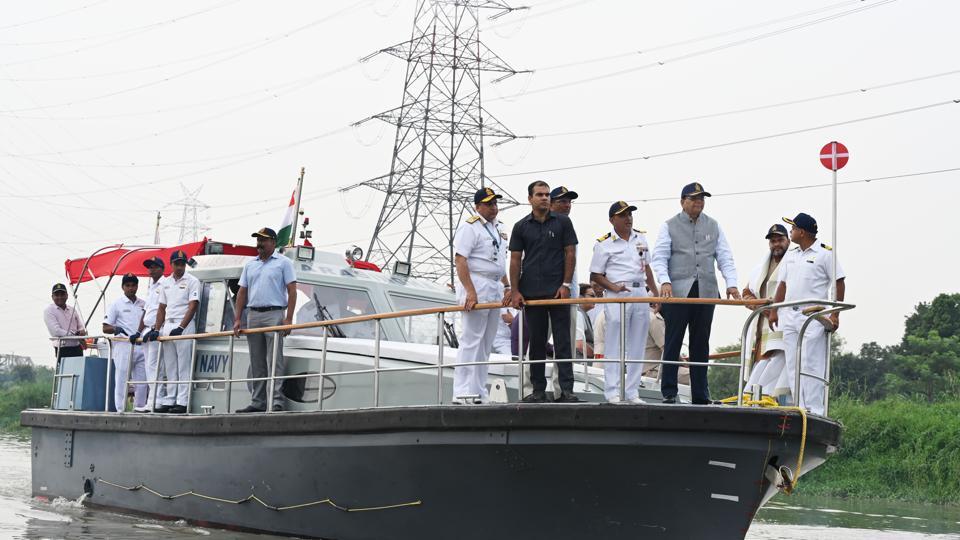
The boat ride was undertaken on an Indian Navy boat, and senior officials from all stakeholder departments, including the Delhi Development Authority, the irrigation and flood control (I&FC) department, the Municipal Corporation of Delhi, and the Delhi Jal Board were also present.
Speaking after the inspection, Saxena, who heads an NGT-appointed high level committee (HLC) on the Yamuna’s rejuvenation, said that once the waterway becomes fully navigable, it will allow common citizens to involve themselves at a physical level with the river.
After the inspection, Saxena said, “Cleaning works on the 11km stretch of the river till the ITO barrage had been successfully completed recently and is there for anyone to see. Any long-term solution to the rejuvenation of the Yamuna will have to involve the common residents of Delhi, and once the waterway becomes fully navigable, citizens could start involving themselves at physical level with the river. This, will help develop a sense of belongingness in the people towards the Yamuna.”
Last month, the Indian Navy had carried out a navigability assessment of the Yamuna. The assessment, completed on June 24, had revealed that the river’s depth ranges between 0.9m and 4m. For the exercise, locally available amphibious desilting equipment was deployed, and an approximately 30m wide channel was created to make it easier for the boat to traverse the river.
Saxena further said that efforts at rejuvenating the river had slowly started showing encouraging results. “If we compare it on a year-to-year basis, there has certainly been an improvement,” he said, pointing to the efforts being undertaken to desilt and trap sewage on the Najafgarh drain — a drain which accounts for 68% of the total pollution of the river.
Bhim Singh Rawat, a Yamuna activist and member of the South Asia Network on Dams, Rivers and People (SANDRP) said while such a plan will certainly connect people to the river, it will require sufficient environmental flow throughout the year.
“We will have to ensure desilting and dredging through the year. Post-monsoon, the river’s water level will also drop. During the lean season, the Yamuna primarily receives water through drains and so the HLC needs to look at a way to sustain this water level,” he said.


Stay updated with all top Cities including, Bengaluru, Delhi, Mumbai and more across India. Stay informed on the latest happenings in World News along with Delhi Election 2025 and Delhi Election Result 2025 Live, New Delhi Election Result Live, Kalkaji Election Result Live at Hindustan Times.


