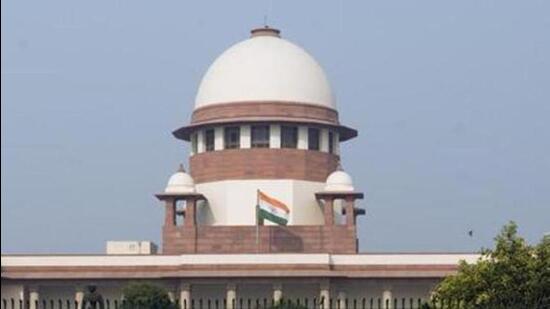
Maha crisis: SC to consider seven-judge bench for Sena v Sena tussle
It also raised questions over the correctness of the 2016 judgment in the Nebam Rabia case in holding that the speaker cannot initiate disqualification proceedings under the Tenth Schedule when his or her own removal is sought.
The Supreme Court on Tuesday decided to examine whether a seven-judge bench should be set up to review the correctness of a 2016 judgment which held that the speaker cannot initiate disqualification proceedings against the members of a House under the anti-defection law when his or her own removal is sought.
“These are matters of intellectual moment,” observed a five-judge bench, led by CJI Dhananjaya Y Chandrachud, stating the first issue to be considered in the bunch of cases relating to the political turmoil in Maharashtra last year will be on the strength of the bench. (HT Archive)
“These are matters of intellectual moment,” observed a five-judge bench, led by Chief Justice of India Dhananjaya Y Chandrachud, stating the first issue to be considered in the bunch of cases relating to the political turmoil in Maharashtra last year will be on the strength of the bench.
It noted that since the August order of reference by a three-judge bench raised doubts over the impeccability of the judgment by another five-judge bench in the 2016 Nebam Rabia (Arunachal Pradesh disqualification) case, it requires to be determined at the first instance whether the issue needs a reconsideration by a seven-judge bench.
The bench, which also comprised justices MB Shah, Krishna Murari, Hima Kohli and PS Narasimha, fixed January 10 for completion of all the formalities in the matter, and asked the lawyers appearing for the Eknath Shinde and the Uddhav Thackeray factions to submit their notes on the issue.
Representing the Thackeray camp, senior counsels Kapil Sibal and Abhishek Manu Singhvi said they would like to argue on referring the matter to a seven-judge bench in the beginning so that the most significant legal issue is settled at the outset.
Senior lawyers Neeraj Kishan Kaul and Mahesh Jethmalani, appearing for the Shinde faction, expressed their agreement that the question regarding the reference to a seven-judge bench may be settled first.
Solicitor general Tushar Mehta, appearing for the Maharashtra governor, submitted that he would also like to make submissions on whether the issue requires to be referred to a seven-judge bench or not.
While referring the matter to a five-judge bench, the three-judge bench had on August 23 noted that case “raises important issues” involving the contours of disqualification proceedings and the powers of the governor and the speaker in their respective spheres.
It also raised questions over the correctness of the 2016 judgment in the Nebam Rabia case in holding that the speaker cannot initiate disqualification proceedings under the Tenth Schedule when his or her own removal is sought.
“We may prima facie observe that the proposition of law laid down by the Constitution bench in Nebam Rebia, stands on contradictory reasoning, which requires gap filling to uphold the constitutional morality. As such, this question needs a reference to a constitution bench for the requisite gap filling exercise to be conducted,” the August order said.
Besides this, the three-judge bench framed a raft of other legal issues surrounding the power of the governor to invite a person to form the government; authority of the speaker to determine the whip and the leader of the House legislature party; status of proceedings in the House during the pendency of disqualification petitions against the members and the scope of the powers of the Election Commission of India with respect to determination of a split within a party, among others.
After the Supreme Court virtually restrained the speaker from disqualifying a group of rebel MLAs led by Shinde and ordered a floor test, Thackeray resigned on June 29 without facing the floor test. Shinde took over as the chief minister the next day.
Later, several petitions and applications were filed by the Thackeray camp in its endeavour to stop the governor from inviting Shinde and halt various other proceedings on the floor of the House.
One of these applications also requested the top court to stop the Election Commission from deciding Shinde’s petition staking claim over the “real” Shiv Sena and the party symbol. But, on September 27, the court dismissed this plea, clearing the decks for poll watchdog to adjudicate the symbol dispute. Soon after this order, the commission went ahead with the matter and restrained both sides from using Shiv Sena’s bow and arrow symbol until its final decision.
Catch every big hit, every wicket with Crickit, a one stop destination for Live Scores, Match Stats, Infographics & much more. Explore now!

 E-Paper