E-Paper



Max temp lowest of season, Delhi shivers
Delhi’s average minimum temperature was clocked at 11.7 degrees Celsius (°C) — five degrees above normal — and the maximum was just 15.9°C

 Prefer HTon Google


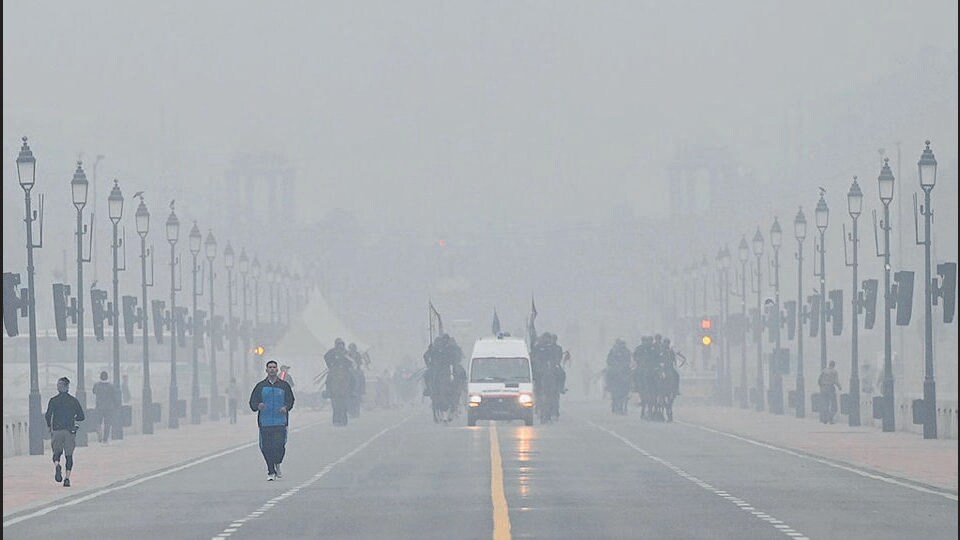
The National Capital Region (NCR) recorded its coldest day of the season on Sunday, with the maximum temperature plummeting and making the daytime feel virtually as frigid as the night – conditions brought on by a thick band of fog in the upper reaches of the atmosphere.
Delhi’s maximum temperature on Sunday was recorded at 15.9°C, which was a mere 4.2°C higher than the minimum. Some trans-Yamuna locations were even chillier, with weather stations at Ghaziabad, Noida and Mayur Vihar having a difference of 2.1, 1.5, and 1.4 degrees between day and night temperatures, respectively.
These figures lead to a near “cold day”-like conditions across Delhi-NCR, a classification when the maximum temperature is 4.5 degrees or more below normal and the minimum is below 10°C. While several stations met the first criteria, the minimum temperature remained above 10°C at all stations, meaning IMD did not officially classify it as a “cold day”.
Sunday’s daytime maximum was a significant drop from 19.8°C recorded on Friday, the last time the day felt so cold. Unlike that day, when the sun came out meekly for a brief couple of hours, there was virtually no sunshine all day on Sunday.
Such cold days, especially without sunlight, pose a risk for the elderly since this is the time of the day people are usually outdoors, away from the warmth indoors. Weather officials said that such a phenomenon is observed when upper-level fog is recorded, which is common during late December and early January.
During this period, a thick layer of fog stays prevalent in the northern plains, even during the day, preventing sunlight from breaking through.
Surface level fog, which hits visibility and disrupts travel, however, was not as dense — the lowest visibility recorded was at 500 metres. Kuldeep Srivastava, scientist at IMD, said that in the absence of sunlight and with cold northwesterly winds blowing, such conditions exacerbate how cold the winter feels, even though the numbers may not breach thresholds for a coldwave or a cold day classification.
To be sure, the onset of daytime chill in the last few days of the month do not change much how December was on average for Delhi: it was the warmest in six years, with the average peak coming to 23.7°C. The last time it was any warmer, on average, was in 2017 when the month had an average maximum of 24.1°C.
The India Meteorological Department (IMD) said a thick layer of fog has persisted across the northern plains on Sunday, leaving large parts of northwest India devoid of sunlight. The weather agency has forecast similar conditions for Monday as well, with the maximum forecast to hover around 16°C.
Srivastava said that the minimum might dip below 10°C in parts of Delhi on Monday. “This will mean ‘cold day’ conditions are likely for Delhi and surrounding region,” he added.
IMD’s forecast for Monday showed the maximum would be around 16°C, with the minimum likely to be 8°C.
Meanwhile, Delhi’s air quality improved marginally on Sunday but remained in the upper end of the “very poor” category. The average air quality index (AQI) was recorded at 382 (very poor) according to the Central Pollution Control Board’s national bulletin released at 4pm. It was 400 (very poor) at the same time a day earlier.
Forecasts by the Centre’s Early Warning System (EWS) said conditions would remain unfavourable for the dispersion of pollutants over the next three days, with air quality set to worsen if firecrackers are burst during New Year celebrations.
“Delhi’s air quality is likely to remain in the ‘very poor’ category from January 1 till January 3. As weather conditions are not favourable for effective dispersion of pollutants, emissions from firecrackers may deteriorate air quality,” EWS said in its daily bulletin on Sunday.
Last year, Delhi’s average AQI on December 31 was 349 (very poor), but this improved to 259 (poor) on January 1 due to strong winds. On December 31, 2021, the average AQI was 321 (very poor), but it deteriorated to 362 (very poor) the next day.
No flight diversions or cancellations were reported at Delhi’s Indira Gandhi International Airport on Sunday but a few flights were delayed, airport officials said.