
 E-Paper



RWA as historian, Mayfair Garden edition
Delhi’s settlement history has followed a discernible logic in which particular communities converge around shared origin, profession, or exile -- a pattern legible across the city’s 20th-century colonies

 Prefer HTon Google


Delhi’s settlement history has followed a discernible logic in which particular communities converge around shared origin, profession, or exile -- a pattern legible across the city’s 20th-century colonies. Judges settled around Niti Bagh, journalists around Gulmohar Park. Mayfair Garden belongs to this pattern but complicates it, since the community that formed it -- Sindhi families -- built its houses around a monument that predates the colony by half a millennium: the Makhdum Sabzwari mosque and dargah, a Lodi-period foundation that the neighbourhood has had to live with, negotiate around, and in some measure be shaped by.
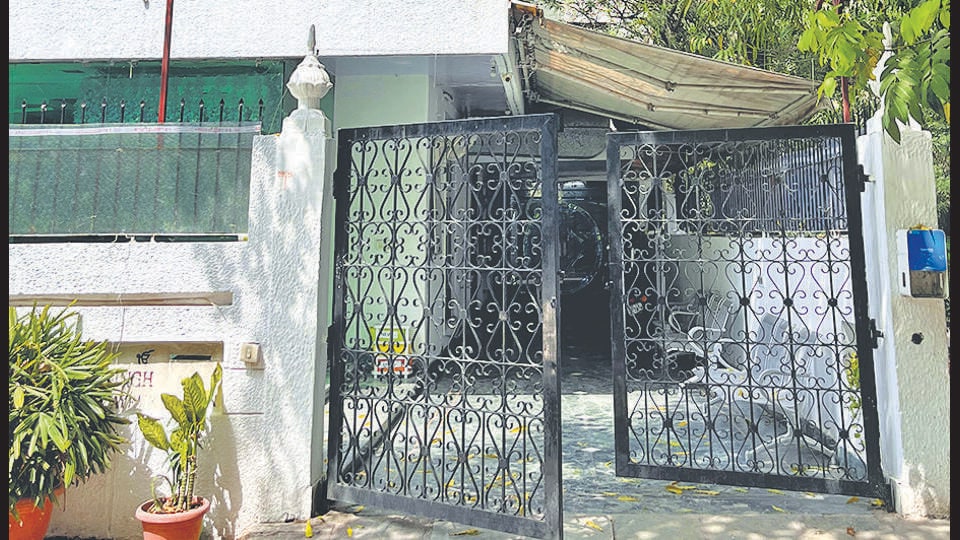
A colony that grows up around a protected monument inhabits its history differently from one that does not. Archaeological Survey of India regulations governing construction in the vicinity of a listed structure are meant to preserve continuity between the old fabric and the new. But the protection such regulations offer is procedural rather than aesthetic, and its limits show themselves precisely at the point where a resident’s need to rebuild meets the file that authorises it. What such files record is rarely a recommendation for restoration in kind. They record permission, leaving the question of what actually replaces the old fabric to the taste of whoever is doing the rebuilding.
What held that question together across the colony was not a colonial or Sultanate idiom but a modernist one. Bauhaus design took root across Delhi’s postcolonial residential quarters in part through architects who had fled the Nazi regime in the 1930s and continued their practice in Indian exile, and in part through the Indian architects who trained under them. One of the more legible products of this lineage, visible on the exteriors of Mayfair Garden’s houses to this day, is the iron grille and railing -- cast in the manner of the stucco relief it effectively replaced.
Considered as a single site, Mayfair Garden discloses three superimposed historical layers: the Lodi-period monument, the Partition-era settlement that grew up around it, and the modernist idiom that gave the colony’s houses whatever coherence they still possess.
The earliest layer is the mosque itself, dated to the Lodi period, 1451 to 1526 CE. The complex, known locally as Makhdumki, consists of a single-aisle prayer chamber opening onto a broad quadrangle, named for the saint whose tomb stands at its centre.
The colony that followed belongs to the wider history of Partition resettlement. Mayfair Garden’s Sindhi character fits this pattern, though it is documented far less thoroughly than comparable colonies such as Lajpat Nagar. In many ways, the people who continue to live in the colony still carry a sense of that original community, audible in the ordinary chatter about who grew up together in its parks and lawns.
For sites like this, ASI restricts structural change without its permission for two reasons. The first is that any digging near a protected monument risks turning up something, and it is the resident’s obligation to report what is found. The second is to preserve a cohesive architectural language in the immediate vicinity of the monument -- and this is by far the less reinforced of the two.
One may ask how far the community itself feels involved in the monument it settled around. For many homeowners, the monument functions as an ornament rather than a piece of cultural heritage they feel connected to. For others, it is closer to a liability, since its presence slows the routine upgrading of their homes. Some families lobby to restrict tourist access, citing security concerns, while others, more plainly, would simply prefer that visitors did not come at all, for reasons rooted in religious bias -- a strand of thinking that deserves to be named and condemned outright. Yet there are families who treasure this small enclosure precisely because it makes their life in Delhi feel more deeply tied to the city’s history, and a smaller number still feel something closer to custodianship.
Mayfair Garden is not unique in this respect. Many of Delhi’s monument-adjacent colonies still carry the modernist architectural language that grew up around them in the years after Partition. In Mayfair, there is a trace of Chandigarh-style brutalism but a far greater presence of Bauhaus: curved arches, metal grilles, railings worked with a geometric-floral vocabulary, and, inside, the kind of staircase that still holds its own against anything built since. A drive through this small colony of roughly a hundred houses remains recognisably the Delhi of the 1970s and 1980s.
One recommendation, deliberated over more than a decade by someone trained in archaeology, would be for the resident welfare associations (RWA) of colonies like this one to install signage recording the history of the land the colony sits on. This is not a speculative suggestion. Delhi already has a working precedent for what happens when a historic residential quarter treats its monuments as an asset. The Nizamuddin Urban Renewal Initiative took exactly this approach in Hazrat Nizamuddin Basti, treating conservation and community development as a single project. The initiative restored more than 20 monuments, achieved 15 of the 17 UN Sustainable Development Goals there, and won two UNESCO Asia-Pacific Awards for Cultural Heritage Conservation in 2021. Ratish Nanda, the project’s director, has described the aim as building a model in which heritage functions as an asset rather than a burden.
What Mayfair Garden and colonies like it have generally lacked is not the raw material for this kind of project, but the will of an RWA to treat that material as worth explaining to the people who live around it, rather than as a line item in a maintenance file. Nizamuddin suggests what becomes possible once that will exists. Mayfair Garden, for now, is still deciding whether it does.
Anica Mann works on archaeology and contemporary art in Delhi. The views expressed are personal

Stay updated with all top Cities including, Bengaluru, Delhi, Mumbai and more across India. Stay informed on the latest happenings in World News along with Delhi Election 2025 and Delhi Election Result 2025 Live, New Delhi Election Result Live, Kalkaji Election Result Live at Hindustan Times.


