
 E-Paper



Slum redevelopment in Delhi to open to private developers under new model
Unlike the previous framework, the new policy, a copy of which HT has accessed, emphasises financial viability, mixed-use redevelopment and private investment.


Slum redevelopment in the Capital, so far almost entirely a government-led programme, will now involve private developers through public-private partnerships (PPP) for executing projects for providing permanent housing to eligible residents, documents accessed by HT show.
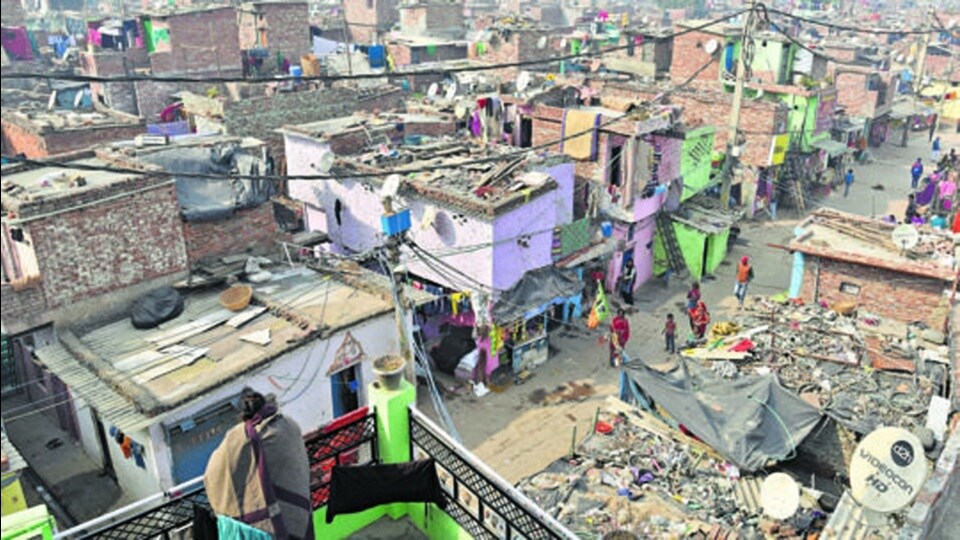
The Delhi Slum and Jhuggi Jhopri Rehabilitation and Relocation Policy, 2026, approved on June 23 after receiving the Centre’s nod, marks the first time private developers have been formally integrated into Delhi’s slum rehabilitation programme. Officials said the policy aims to leverage the commercial value of public land to fund redevelopment, reducing the financial burden on the government while accelerating rehabilitation.
To be sure, similar models have been deployed in cities such as Mumbai, where large-scale slum redevelopment has been undertaken through PPP projects that allow developers to build rehabilitation housing in exchange for development rights over the remaining portion of land.
The policy also expands the pool of beneficiaries by extending the eligibility cut-off date to January 1, 2025.
Unlike the previous framework, under which the Delhi Development Authority (DDA) and the Delhi Urban Shelter Improvement Board (DUSIB) were the principal implementing agencies, the new policy – a copy of which HT has accessed – emphasises financial viability, mixed-use redevelopment and private investment.
“The [new] policy seeks to attract private investment and scale up development efforts by leveraging land as a resource,” it states.
The old model, according to government officials aware of the matter, struggled to keep pace with the city’s growing needs, repeatedly slowed by land disputes, funding shortages and bureaucratic delays.
Officials said the objective is to move away from piecemeal rehabilitation projects towards integrated redevelopment, where the construction of rehabilitation housing is financed through the commercial development of a portion of the project land.
There are 675 recognised Jhuggi Jhopdi (JJ) clusters in Delhi. The Delhi Urban Shelter Improvement Board (DUSIB) is the primary body managing these slums.
The four models
The policy introduces four rehabilitation models divided into two categories.
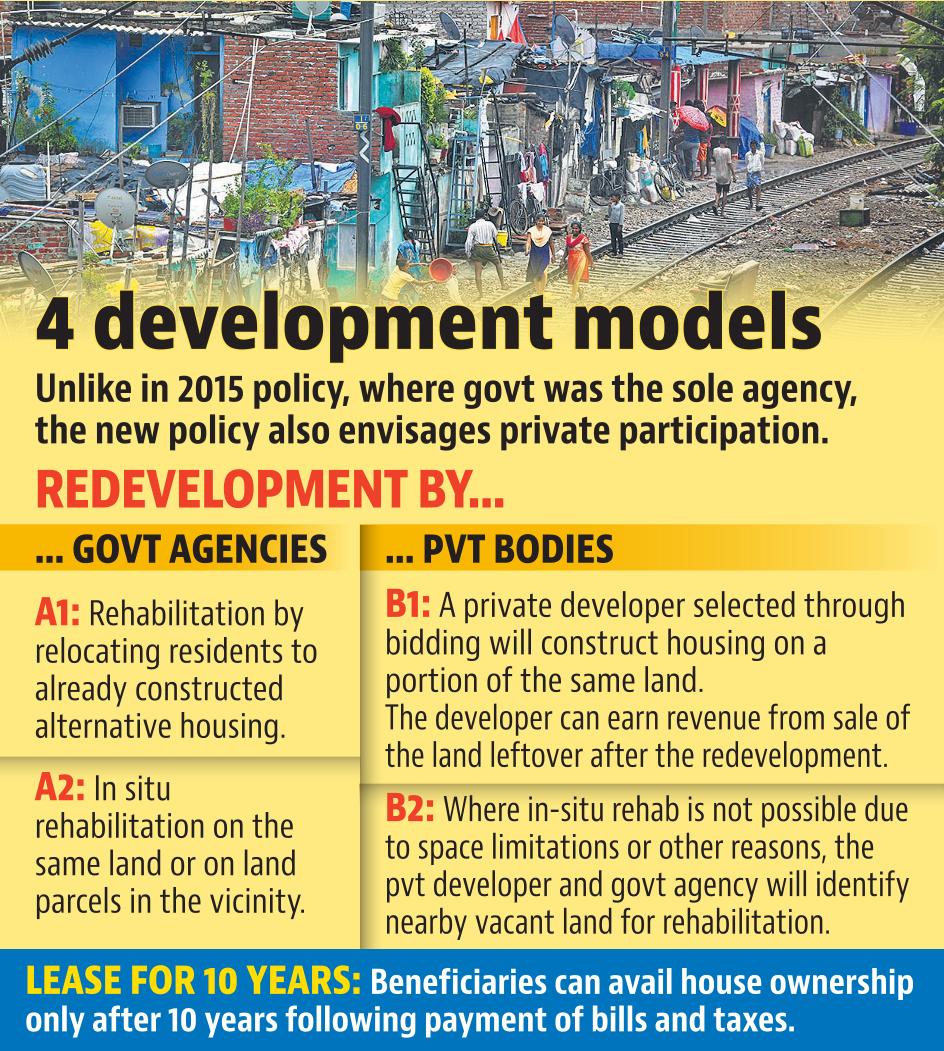
Category A continues the existing government-led approach. Under Scheme A1, eligible residents will be shifted to already constructed rehabilitation housing. Scheme A2 provides for in-situ rehabilitation by government agencies on the same land parcel or nearby land.
The biggest shift comes under Category B, which is entirely based on public-private partnerships.
Under Scheme B1, private developers selected through a competitive bidding process will construct rehabilitation housing as well as the commercial component of the project. Eligible beneficiaries will receive a 1BHK apartment comprising two rooms, a kitchen, bathroom, toilet and balcony, with a minimum carpet area of 25 square metres, along with basic civic amenities.
A senior DUSIB official, requesting anonymity, said the rehabilitation housing would be allotted on a leasehold basis with a 10-year lock-in period. “The ownership will be transferred only after all dues, including water bills, property tax and other charges, are cleared. The objective is to ensure proper maintenance and prevent misuse,” the official said.
During construction, developers will have the option of either providing transit accommodation or paying rent to displaced residents.
In return, developers will be permitted to commercially develop the remunerative portion of the project, enabling them to recover project costs through the sale or development of that land.
The policy also introduces Scheme B2 for densely populated slum clusters where in-situ redevelopment is not feasible because of planning constraints or insufficient land. In such cases, developers and land-owning agencies can identify additional vacant land, preferably nearby, for rehabilitation. The policy also allows multiple non-contiguous jhuggi clusters to be clubbed together into a single redevelopment project to improve financial viability.
To attract private participation, the government has offered a series of financial and regulatory incentives. Developers undertaking rehabilitation projects will receive exemptions from statutory charges, including development charges, scrutiny fees, layout deposits and other approvals related to the rehabilitation component.
The government has also promised single-window, time-bound clearances for building and layout plans, stamp duty concessions on the transfer of the commercial component, and flexibility in mortgage and lease arrangements.
The policy further introduces Transferable Development Rights (TDR), allowing developers to offset project costs through additional development potential elsewhere. Officials said the policy proposes an “optimal ratio” between rehabilitation housing and commercial development to ensure projects remain financially attractive while protecting rehabilitation obligations.
Unlike rehabilitation housing, which will continue to remain on leasehold land, the remunerative component may, in certain cases, be transferred as freehold to developers.
All redevelopment projects involving private developers will also be required to register under the Real Estate (Regulation and Development) Act (RERA), bringing them under a regulatory framework that was absent under the earlier policy.
The policy also clarifies that rehabilitation will not necessarily take place at the existing location of a slum cluster. While authorities will attempt to rehabilitate residents within a 0-3km radius, beneficiaries may be relocated anywhere in Delhi if rehabilitation nearby is not feasible because of planning, legal, infrastructure or security constraints.
Officials said this provision is expected to ease redevelopment in congested areas where land availability remains a major challenge. Beneficiaries will contribute ₹1.5 lakh towards the cost of their dwelling unit and deposit ₹50,000 into a five-year maintenance corpus for the upkeep of common facilities before resident welfare associations take over management.
The policy, however, is also expected to trigger debate over the expanding role of private developers in what has traditionally been a government welfare programme.
Sunil Kumar Aledia, the national convener at National Forum for Homeless Housing Rights (NFHHR), said the checks and balances are needed in the policy to take care of the rights of the slum dwellers. “The deadline extension is a welcome move to increase the ambit of the rehabilitation. Delhi faces acute land crunch and the primary drive of the slum rehabilitation should be welfare of the people.”


Stay updated with all top Cities including, Bengaluru, Delhi, Mumbai and more across India. Stay informed on the latest happenings in World News along with Delhi Election 2025 and Delhi Election Result 2025 Live, New Delhi Election Result Live, Kalkaji Election Result Live at Hindustan Times.


