
 E-Paper



Traffic cops go missing at critical points in Delhi during rush hour bustle
A ground check by HT– between 9am and 11am, and again between 4pm and 7pm – revealed the absence of traffic personnel at many of the busiest choke points.

 Prefer HTon Google


Every morning and evening, the people on Delhi’s streets grind to a halt. Cars crawl bumper to bumper, buses block entire lanes to jostle for passengers, and two-wheelers weave precariously through the chaos. For hundreds of thousands of commuters, the daily rush-hour ordeal has become a ritual of frustration. Yet amid this storm, the city’s roads are missing one crucial element: the traffic police.
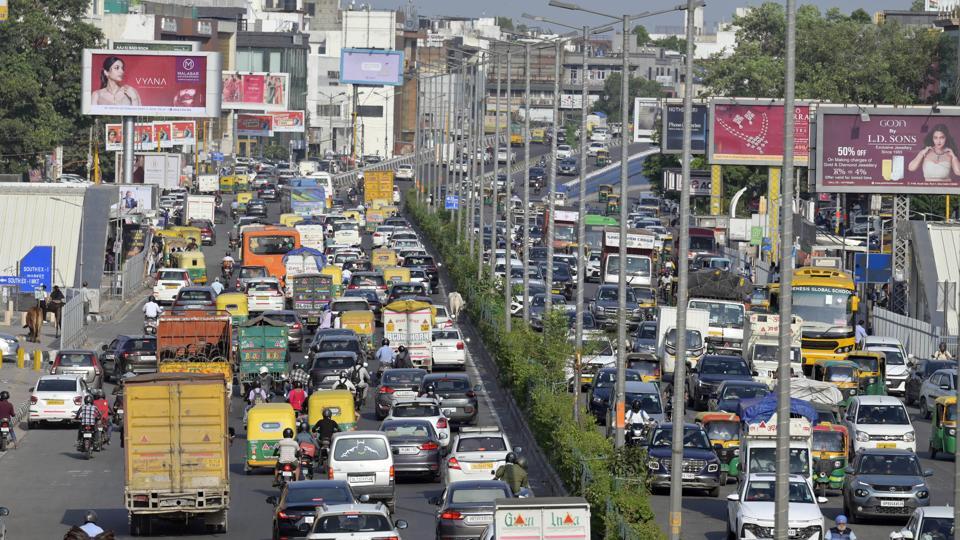
A ground check by HT along the Ring Road and Outer Ring Road during rush hour – between 9am and 11am, and again between 4pm and 7pm – revealed the absence of traffic personnel at many of the busiest choke points. Signals blinked unattended, intersections became free-for-alls, and gridlocks stretched for kilometres.
For commuters, the experience is maddening. Many expressed that they feel trapped in a futile daily struggle against a system that seems indifferent. Some described their daily commute as an exhausting battle that eats away hours each week; others pointed to the complete absence of traffic cops at points where enforcement is most desperately needed.
Choke points left unattended
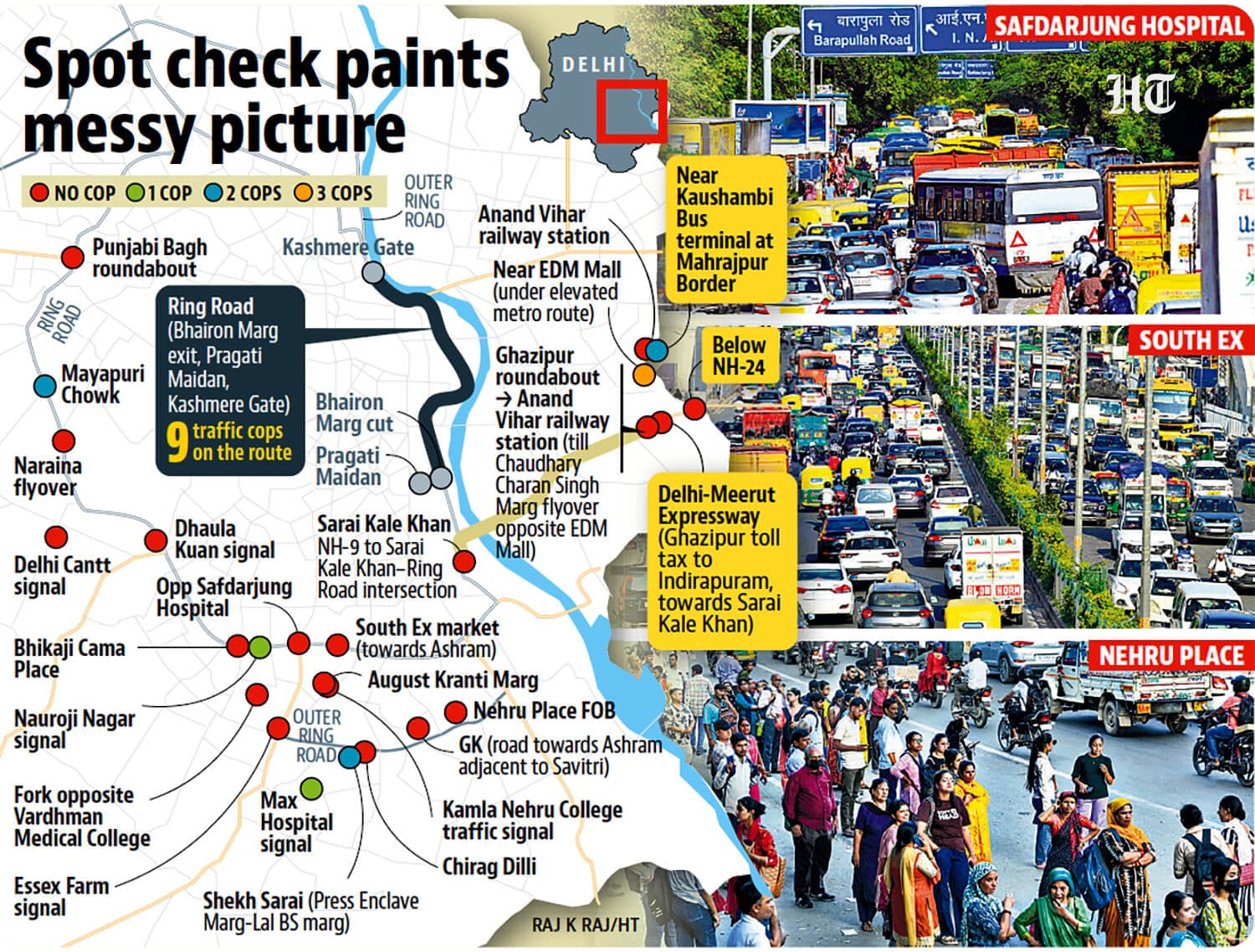
At Delhi Cantt (4.45pm) and Dhaula Kuan (5.18pm), two of southwest Delhi’s busiest intersections, not a single traffic officer was visible during HT’s visit. Further down the Ring Road at Bhikaji Cama Place and Safdarjung Hospital (5.34pm), buses stopped in the middle of the road to pick up passengers while cars skirted lanes around them, all with no regulation.
At South Extension (5.46pm), illegally parked vehicles occupied at least one lane, if not two at some points, shrinking the carriageway, turning the junction into a bottleneck.
The absence of enforcement was again visible on stretches such as August Kranti Marg (6.10pm), Essex Farm (6.12pm), and Nehru Place (7.09pm) where narrowing roads and market traffic created long snarls. Along the Outer Ring Road, at Greater Kailash (6.57pm), residential and market traffic collided near the Savitri flyover, roadside stalls spilling into the road. Again, no traffic personnel were present.
Travelling west on the Ring Road presented a similar picture. Punjabi Bagh roundabout (4.04pm) became a chaotic clash of vehicles and stray cattle; Naraina flyover (4.17pm) saw unchecked jams; Mayapuri Chowk (4.30pm) had just two officers struggling to manage.
Across all these points, a handful of exceptions stood out — at Naroji Nagar (5.23pm), Max Hospital signal (6.12pm), and Sheikh Sarai (6.34pm), officers were visible. But these were the exceptions, not the rule.
In eastern, central, and northern Delhi, the worst snarls were seen on the Delhi-Meerut Expressway, NH-9 and NH-24, where nearly a kilometre-long jam built up between the Ghazipur toll and Indirapuram between 8am and 11am. The biggest culprit were rows of commercial vehicles clogging lanes to pay tolls, blocking half the carriageway. Cash collectors stood dangerously in the middle of the road. It took nearly 20 minutes just to cross.
Below the Meerut expressway, waterlogging and merging traffic slowed vehicles further. No traffic personnel were found at any of these choke points.
At Anand Vihar ISBT and railway station, again a notorious location, buses parked on main roads to let passengers off, autorickshaws blocked lanes, and footpaths were occupied by vendors. A police booth nearby was locked. Only three DTC staff attempted to manage the traffic – not a single traffic policeman was spotted.
On the opposite side near Kaushambi bus terminal, vehicles were parked illegally, while pedestrians cut through railings to cross the road. Ironically, two traffic officials were seen using an unauthorised pedestrian shortcut near EDM Mall. Beyond this, some personnel were visible at Sarai Kale Khan and Kashmere Gate – five prosecuting violators near Bhairon Marg, another at Pragati Maidan tunnel.
The lack of on-ground enforcement is not new. Without officers at critical junctions, buses stop mid-road, autos block lanes, and jaywalkers spill onto arterial stretches. The result: jams worsen, tempers fray, and safety risks multiply.
For those caught in the daily crush, the problem feels both endless and avoidable.
Additional commissioner of police (traffic) Dinesh Kumar Gupta said that the unit has taken a number of measures to monitor the presence of officials at their designated points. “GPS-installed bikes patrol in different areas, which helps senior officers keep a check on where the officials are and at the same time, can help in coordination to alert about congestion. Traffic inspectors also keep a tab on Google Maps to check for congestion and take action. We try our best to act on people reporting traffic issues on social media,” he said.
Commuters bemoan mess
Commuters, especially office-goers who motor during the morning and evening rush hours, shared multiple problems, such as lack of police to direct traffic, subsequent flouting of norms and unregulated movement increasing their commute time.
Yogesh Gogia, 38, of Kirti Nagar, who works with a bank in Gurugram, said it takes him over two hours to reach his destination when his shift starts at 10am. “My travel time, both ways, sometimes added up to six hours. That’s just two hours fewer than my job shift. I had to take permission from my manager to change my shift time to 7am-3pm so I could travel in non-peak hours.”
Rasika Saha, 41, of Jhilmil Colony, who works in Noida, said that she often stays back after work hours for an hour to skip peak-hour traffic. “I usually get done with work by 7.30-8pm but when I check GPS, I only see red lines.”
Astha Mehra, 33, of Noida, who works in central Delhi, said she faces massive traffic snarls to and from work and while traffic policemen are mostly not available to manage traffic, they are sometimes present with barricades. “Right in the middle of peak traffic hour, police personnel install barricades to check bikers and it only adds to the congestion and frustration on road,” she said.
What experts say
Experts argue that Delhi’s traffic crisis is the outcome of both overwhelming vehicle numbers and outdated management strategies. The city’s streets, they said, have reached saturation and the traditional model of stationing traffic cops – which itself is rarely implemented – needs to be augmented by the use of new-age technologies and regular scientific studies
Amit Bhatt, managing director (India), International Council on Clean Transportation (ICCT), said that globally, traffic management is increasingly technology-driven, relying on real-time data and satellite maps. In Delhi, cameras for number plate recognition, red-light violations, and over-speeding already exist but are underused.
“If the majority of motorists in Delhi can use Google Maps to avoid jams, why can’t traffic police use the same tools for real-time deployment and interventions? The existing ANPR, RLVD and OSVD cameras are not being utilised to their full potential. They should also be linked with the central traffic control and command room for real-time identification of problematic corridors and junctions,” he said.
He also emphasised corridor management instead of junction management: Clearing one signal is meaningless if traffic snarls await a few hundred metres ahead, he said, adding that managing stretches – adjusting signal cycles, redistributing flow – is the only way forward.
“I personally believe that instead of having multiple agencies, there should be one centralised agency for integrated transport and traffic management in the city,” added Bhatt.
Other experts said that encroachment and illegal parking exacerbate jams. School buses parked along roads during the day are a glaring example, Bhatt said, pointing out that this is something that can only be addressed by schools and police working together.
Muktsh Chander, former Delhi Traffic Police chief, stressed the need for deeper research. “We must identify root causes – from road engineering to vehicle flow – and act accordingly… Of late, some roundabouts in central Delhi witnessed high traffic volume during the rush hours. And for that traffic personnel are deployed for manual regulation of vehicular. Such manual intervention should also be implemented on other traffic congestion points, but only after a thorough study of the problems and the possible solutions,” said Chander, a 1988-batch retired IPS.
Experts also said that inefficient manual operation of traffic signals is also a cause. Dr S Velmurugan of the Central Road Research Institute said Delhi’s fixed-time signals are inefficient. During peak hours, police resort to manual overrides, often extending green lights for five minutes on main approaches. “This only causes congestion to build on all the adjacent approaches. Instead, green phase should not exceed 150 seconds for any approach of the major intersections during such manual operations. Such operation is expected to bring in some efficiency,” he said.



Stay updated with all top Cities including, Bengaluru, Delhi, Mumbai and more across India. Stay informed on the latest happenings in World News along with Delhi Election 2025 and Delhi Election Result 2025 Live, New Delhi Election Result Live, Kalkaji Election Result Live at Hindustan Times.


