
 E-Paper



DMRC requests Centre to stagger office timings
DMRC managing director Mangu Singh, it is learnt, has written to Union housing and urban affairs ministry in this regard suggesting that government and private offices should work in two slots: 9am and 4pm and 11 am to 6pm.


The Delhi Metro Rail Corporation (DMRC) has requested the Centre to implement staggered office timings, both in government and private sector, in view of the surge in Covid-19 cases in the capital. DMRC officials said the measure is important to ensure social distancing during peak hours on its network.
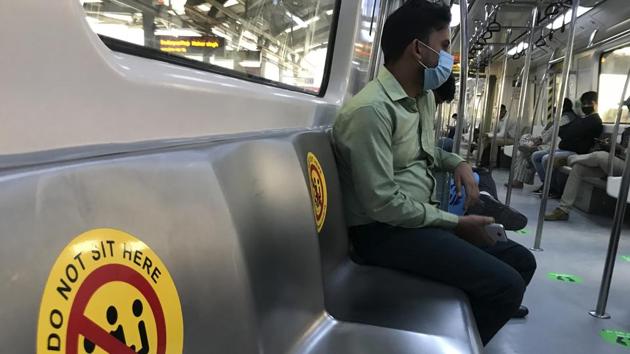
DMRC managing director Mangu Singh, it is learnt, has written to Union housing and urban affairs ministry in this regard suggesting that government and private offices should work in two slots: 9am and 4pm and 11 am to 6pm.
A housing and urban affairs ministry official said, “We have received the suggestion from the DMRC and the matter has been referred to the Department of Personnel and Training for consideration.”
A copy of the letter was also marked to the Delhi government.
Delhi recorded 5,023 new cases of the coronavirus disease (Covid-19) on Monday, fewer than 6,500 cases for the first time in six days. Also, the positivity rate has remained above 12%. Monday’s tally was the highest number of cases reported after a weekend, which usually see a drop in testing, and cases.
The Metro, which resumed operations on September 7 after a gap of 169 days, said its ridership has doubled—14 lakh passenger journeys are performed daily now—in the past two months. This is posing a serious challenge before the Metro, which is the transport lifeline of Delhi, to ensure social distancing at the station and on trains during peak hours.
The DMRC recently conducted an online survey to study the commuting pattern of Metro users and explore the possibility of them planning their travel as per flexible timings to avoid overcrowding, especially during peak hours.
As per the survey, nearly 66% of the Metro users travel during peak hours—63.1% between 8am and 10 am, and 66. 1% between 5pm and 7pm. DMRC official said that 68.5% commuters said that they don’t have the provision to work from home and 73.1% said that their offices won’t agree for staggered timing.
But to ensure smooth operations while following the Standard Operating procedures laid down by the Centre for social distancing, DMRC officials said that it is important to implement staggered timing for offices. The two time slots will ease the pressure on the network during peak hours.
Anuj Dayal, executive director, corporate communication, DMRC, said: “On a few corridors, the volume of traffic is exceeding the reduced carrying capacity of the system during the peak hours. Keeping this in view, the DMRC has repeatedly appealed to the passengers to ‘break the peak’ and stagger the timings of the journeys so that all Covid protocols can be stringently followed.”
DMRC officials said that currently the level of traffic during the peak hours on some corridors has actually exceeded the available capacity. However, enough spare capacity is available during the non-peak hours.
In the past two months of its operations, the carrying capacity has been exceeded on a number of sections during peak hours on DMRC’s Blue (Dwarka Sector 21 - Noida Electronic City and Vaishali), Red (Dilshad Garden - Shaheed Sthal) and Yellow (HUDA City Centre - Samaypur Badli) corridors.
With economic activities resuming on full scale in the Capital, the situation is the same on some sections of its Green(Inderlok - Mundka), Violet (Kashmere Gate- Raja Nahar Singh and Magenta (Botanical Garden- Kalkaji Mandir Section) corridors.
With Covid cases on the rise and air pollution slipping into severe category, public health and transport experts say that staggered office timing is important.
“It is a very good suggestion by the DMRC. This will not only help in ensuring social distancing but also help in reducing air pollution, as it will stagger the vehicular load during peak hours. In the present scenario, it’s advisable that people should stay at home and offices should encourage work from home,” said Dr Jugal Kishore, head of community medicine at Safdarjung Hospital.
Transport expert Amit Bhatt, director transport at WRI India, said staggered timing should be made a permanent feature in Delhi which faces a serious problem of pollution due to traffic congestion.
“Staggering of office timings becomes even more important now during the pandemic. It will help in ensuring social distancing in public transport. Currently, there is bunching of people happening during peak hours as offices start and end at almost the same time. While DMRC’s suggestion will help ease crowding on its network, there is also a need to stagger timings area-wise to ease congestion on roads,” said Bhatt.

Stay updated with all top Cities including, Bengaluru, Delhi, Mumbai and more across India. Stay informed on the latest happenings in World News along with Delhi Election 2025 and Delhi Election Result 2025 Live, New Delhi Election Result Live, Kalkaji Election Result Live at Hindustan Times.


