
 E-Paper



2,900kg explosives seized in F’bad; 7 held in ‘white-collar’ terror link
The three-day operation, jointly conducted by the Jammu and Kashmir Police and Haryana Police between November 8 and 10, uncovered what officials called one of the largest seizures of explosive materials in recent years.

 Prefer HTon Google


Security agencies have unearthed what they described as a “white-collar terror network” spanning Jammu and Kashmir, Haryana, and Uttar Pradesh, with the arrest of seven people – including two doctors — and the recovery of nearly 2,900 kilogrammes of explosive and inflammable materials, assault rifles, pistols, and improvised explosive device (IED)-making components during raids in Faridabad.
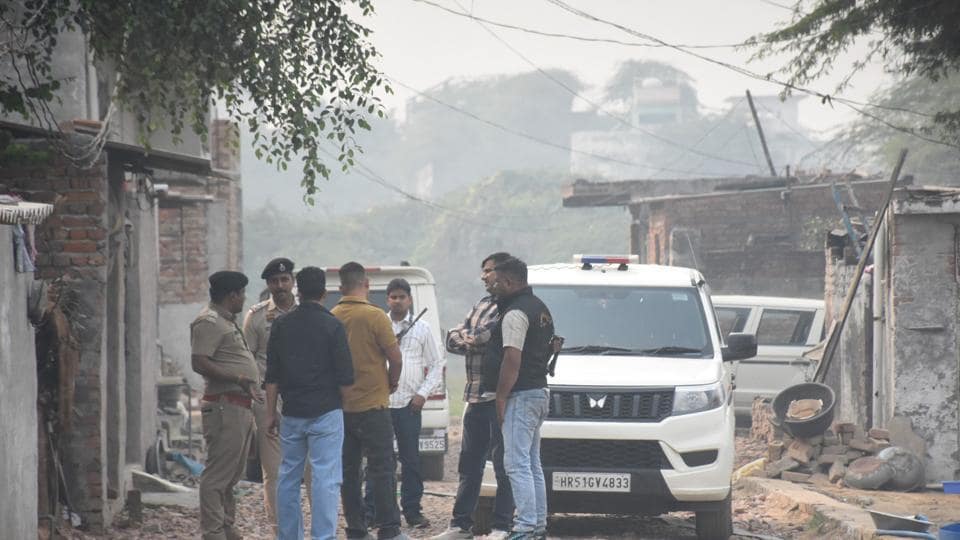
Investigators said the group was linked to the proscribed Jaish-e-Mohammad (JeM) and Ansar Ghazwat-ul-Hind (AGuH), with foreign handlers operating from Pakistan and other Gulf countries.
The three-day operation, jointly conducted by the Jammu and Kashmir Police and Haryana Police between November 8 and 10, uncovered what officials called one of the largest seizures of explosive materials in recent years.
“Investigation revealed a white-collar terror ecosystem, involving radicalised professionals and students in contact with foreign handlers, operating from Pakistan and other countries,” a spokesperson for J&K police said.
“It’s not RDX, as reported initially, but ammonium nitrate,” said Faridabad police commissioner Satender Kumar Gupta, adding that forensic analysis was underway.
The crackdown, officials aware of the matter said, stemmed from an investigation launched in October when posters of JeM and AGuH threatening security forces and calling for anti-India activities surfaced in Srinagar’s Nowgam area. The J&K Police registered a case under the Unlawful Activities (Prevention) Act (UAPA), Explosive Substances Act, and Arms Act, and began tracking a chain of radicalised individuals. Among the first to come under the scanner was Dr Muzammil Shakil, a 35-year-old medical student from Pulwama, who had been studying at Al-Falah Medical College in Dhauj, Faridabad, for over three years.
Shakil’s arrest in late October by the J&K Police, with the assistance of Faridabad’s Crime Branch, led investigators to a wider network of radicalised professionals and students allegedly coordinating with foreign handlers. “The group was using encrypted communication channels for indoctrination, coordination, fund movement, and logistics. Funds were raised through academic and social fronts disguised as charitable causes,” the J&K Police spokesperson said.
Disclosures made during Shakil’s interrogation triggered a series of coordinated raids in Faridabad. On November 8, police recovered a Krinkov assault rifle with three magazines, 83 live cartridges, a pistol with eight rounds, and additional ammunition. The following day, investigators raided a rented accommodation on the Dhauj-Fatehpur Taga Road, where they found 358kg of ammonium nitrate and explosive chemicals, along with batteries, timers, metal plates, remotes, wires, and other IED components, said Satender Kumar Gupta, Faridabad police commissioner.
The most significant recovery came on November 10, when a joint team discovered 2,563kg of ammonium nitrate from a house in Dehar Colony, Fatehpur Taga– 10km from Faridabad. The property belonged to Maulana Mohammad Istaq, a mosque cleric in Faridabad for over two decades, who had rented it out to Shakil about eight months ago. Police suspect the ammonium nitrate was being stockpiled for the manufacture of high-intensity explosives. Experts say the compound, when mixed with fuel oil or other accelerants, can create powerful blasts capable of demolishing buildings or vehicles.
“We have found two houses rented by the accused from where highly inflammable material has been recovered. We are questioning Maulana Istaq, but it is too early to share further details,” said ACP Varun Dahiya, who led the Faridabad operations. The total seizures from both sites –2,900kg of ammonium nitrate, detonators, and electronic triggering devices – were sufficient, according to one senior officer, to prepare several large IEDs.
“This was a joint effort that prevented what could have been a catastrophic terror attack… The scale of the recovery shows this was not an amateur operation – it was planned, structured, and driven by people who understood both explosives and networks,” Dahiya said.
Meanwhile, the Jammu and Kashmir Police in Srinagar said the arrests were part of a broader transnational crackdown targeting JeM and AGuH’s urban support cells. Those arrested include Arif Nisar Dar alias Sahil, Yasir-ul-Ashraf and Maqsood Ahmad Dar alias Shahid – all from Nowgam – Maulvi Irfan Ahmad of Shopian, Zameer Ahmad Ahanger alias Mutlasha of Ganderbal, Dr Muzammil Ahmad Ganaie alias Musaib of Koil, Pulwama, and Dr Aadil Rather of Wanpora, Kulgam.
A police spokesman said the accused were “part of a radicalised ecosystem” that identified potential recruits, raised funds under the guise of professional or social initiatives, and arranged logistics for terror acts.
Forensic experts from both states are examining the materials to determine their potency and intended use. Initial tests have confirmed the explosive nature of the seized substances.
Officials said the group was in contact with handlers operating from Pakistan and the Gulf region and was allegedly preparing for strikes in Delhi-NCR.
“Preliminary evidence suggests that the consignment recovered in Faridabad reached Muzammil about two weeks before his arrest,” said an officer. “The material was likely meant for assembling high-intensity IEDs to target public infrastructure or crowded locations.”
Investigators also suspect that the network received ideological and logistical guidance through encrypted apps and dark-web forums. A senior intelligence official called the case “a disturbing indication” of how educated individuals are being recruited into extremist movements. “Doctors, engineers, and students are being radicalised online through narratives that present extremism as humanitarian or intellectual resistance,” the officer said.
In Srinagar, a senior J&K Police officer described the case as one of the most significant breakthroughs in recent years. “This investigation has unearthed a white-collar terror ecosystem — not traditional militants, but educated professionals who use social credibility to conceal extremist operations,” he said. The police statement added that the accused were involved in identifying new recruits, procuring arms, and raising funds through local and international channels.
A financial probe has also been initiated to trace money trails and foreign remittances linked to the network. “Financial investigation regarding the flow of funds is on and all linkages are being traced and addressed expeditiously,” the J&K Police spokesperson said, adding that the case reflects “the diligence and determination” of the security teams involved.
The National Investigation Agency (NIA) and other central counterterrorism agencies are expected to formally take over the probe to trace international connections and funding sources. Raids and searches continue across Haryana, Delhi, and Jammu and Kashmir.


Stay updated with all the Breaking News and Latest News from Mumbai. Click here for comprehensive coverage of top Cities including Bengaluru, Delhi, Hyderabad, and more across India along with Stay informed on the latest happenings in World News.


