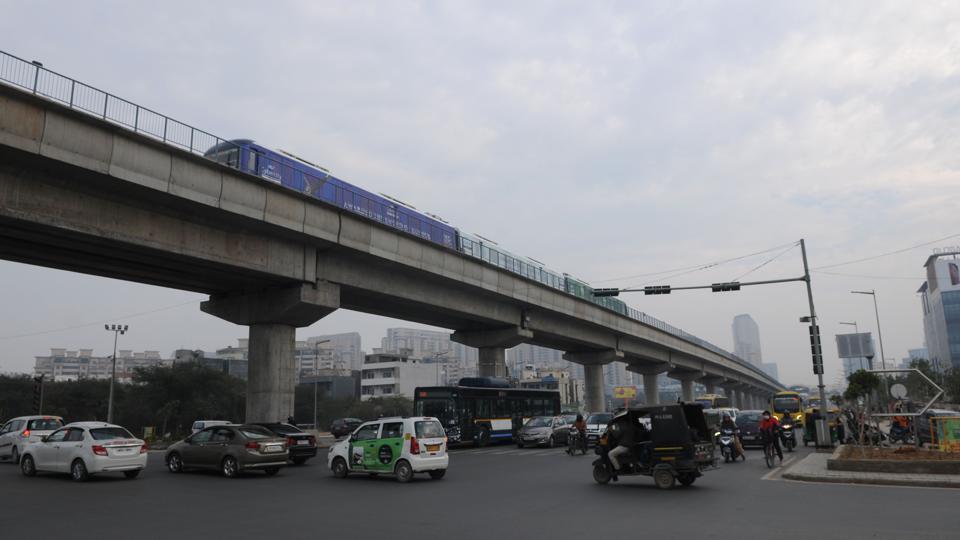
Gurugram: DLF Phase 1 residents raise alarm over traffic chaos, seek strict enforcement
According to the letter submitted by RWAs during the event, vehicles, particularly autorickshaws and cars regularly occupy the left lane at Gate No 10 (Ashoka Crescent Road), creating inconvenience for those turning toward Golf Course Road.
Residents of DLF Phase 1 on Saturday urged Gurugram Traffic Police to intensify enforcement to curb rising traffic violations, illegal parking and unsafe road behaviour across the neighbourhood.

At HT Gurugram’s First Dialogue, a civic platform created to enhance citizen–police interaction, five RWAs flagged several stretches of the neighbourhood, where congestion and accidents were frequently seen.
According to the letter submitted by RWAs during the event, vehicles, particularly autorickshaws and cars regularly occupy the left lane at Gate No 10 (Ashoka Crescent Road), creating inconvenience for those turning toward Golf Course Road. Residents alleged that vehicles are now commonly parked on sidewalks near the metro station and shops, blocking pedestrian movement and forcing people to walk on the road.
The letter also states that on crowded stretches such as Arjun Marg, the Shopping Mall stretch, Ashoka Crescent and the Qutub Plaza area, visitors, delivery vehicles and two-wheelers stop haphazardly along the road. Residents said several recent accidents had occurred due to speeding, wrong-side driving and illegal parking.
“This is not just an inconvenience, it is a serious safety issue. People are getting injured because vehicles park on blind spots and footpaths. We need strict and visible enforcement. Challans should be issued regularly,” said Rajeev Bajaj, advisor to Team One Welfare Society.
Harsh Khanna, a resident and member of the welfare society, said the situation had worsened over the past year. “Pedestrians cannot walk at Qutub Plaza. Vehicles stop wherever they want. Without consistent policing, nothing will change,” he said.
Responding to residents’ concerns, assistant commissioner of police (ACP) (traffic) Satyapal Yadav said enforcement would be intensified at all hotspots identified by RWAs. “We will increase towing, deploy more marshals during peak hours and take strict action against wrong-side driving. These issues have been taken up on priority,” he said, adding that technology-led solutions such as AI-based signal synchronisation and real-time monitoring were also being explored.
ABOUT THE AUTHORLeena DhankharLeena Dhankhar is Senior Editor and Bureau Chief, Gurugram, at Hindustan Times, where she has spent over 17 years chronicling the transformation of one of India's fastest-growing urban regions. From starting her career as a crime reporter to leading the Gurugram bureau, her journalism has been defined by investigative reporting, in-depth storytelling and an unwavering focus on public interest. Over nearly two decades, she has reported extensively across crime, politics, civic governance, elections, real estate, environment, courts, sports, education and entertainment, covering Gurugram, Faridabad, Nuh and Palwal. Her reporting has exposed several major scams and systemic failures, including insurance frauds, waste management irregularities, illegal arms manufacturing units in Nuh, illegal mining in the Aravallis, organised crime networks and governance lapses affecting millions of residents. Known for her investigative work and exclusive stories, Leena has reported on high-impact national issues, including the Nicaragua charter flight carrying Indian migrants that was turned back amid allegations of human trafficking, exposing the growing network of illegal immigration rackets. Her work has also focused on gang wars, prison administration, juvenile crime, women and child protection systems, the functioning of the Juvenile Justice Board and Child Welfare Committee, and environmental challenges such as pollution, waterlogging and deteriorating civic infrastructure. Beyond hard news, Leena has extensively documented Haryana's rich heritage, forests and wildlife, bringing attention to the state's historical landmarks, biodiversity, conservation efforts and ecological challenges through immersive reportage and feature writing. Her journalism has consistently gone beyond breaking news. She has documented Gurugram's rapid urbanisation through long-form narratives and enterprise reporting on issues ranging from pothole-ridden roads, flooding and waste management to the changing social fabric of India's Millennium City. She also writes widely read feature columns, including The Outsider, Changemaker, and Concern for Gurugram, profiling people, places and ideas shaping the city's identity. Leena is the author of Gurugram School Murder, published by Juggernaut Books, a deeply reported account of one of India's most high-profile school murder investigations. She is currently working on her second book, an investigative work exploring some of India's most significant scams and fraud investigations. Beyond print journalism, she has expanded her storytelling through public speaking and digital media. She is a TEDx speaker and has produced podcasts exploring Gurugram's transformation, civic challenges and untold stories. Her work reflects a commitment to narrative journalism that combines rigorous reporting with compelling storytelling. A law graduate with an MBA in Human Resources, Leena brings a multidisciplinary perspective to her reporting, particularly on governance, public policy and legal affairs. She has travelled extensively across India to pursue investigative assignments, often reporting from remote locations and conflict-prone areas in search of stories that matter.Read More
Stay updated with all the Breaking News and Latest News from Mumbai. Click here for comprehensive coverage of top Cities including Bengaluru, Delhi, Hyderabad, and more across India along with Stay informed on the latest happenings in World News.

E-Paper