
 E-Paper



From tomorrow, MCG to dump waste at new site in Bandhwari
A National Green Tribunal-appointed panel has urged the Municipal Corporation of Gurugram (MCG) to expedite the remediation of legacy waste at the Bandhwari plant to meet the September 2023 deadline. MCG has prepared a two-acre plot near the landfill for solid waste from Gurugram. The panel has asked MCG to start daily monitoring of landfill remediation activities and submit a weekly report. Over 40ft high, the Bandhwari dump is one of the largest landfills in north India and leachate and garbage from the mega dump have started affecting the ecologically sensitive Aravallis, posing health hazards.

 Prefer HTon Google


A National Green Tribunal-appointed panel on Thursday asked the Municipal Corporation of Gurugram (MCG) to expedite the remediation of legacy waste at the Bandhwari plant to ensure that they meet the September 2023 deadline set by the green tribunal.
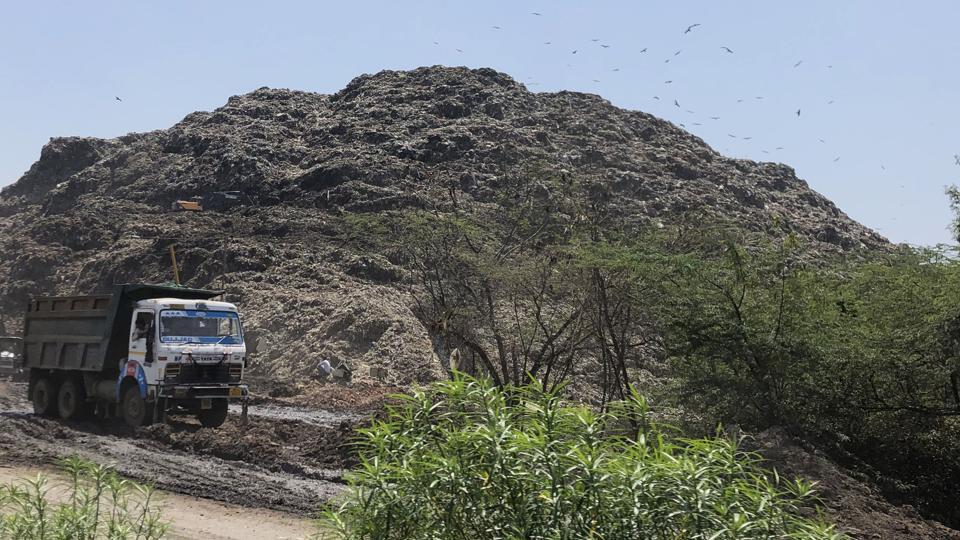
The MCG has prepared and constructed a two-acre plot near the Bandhwari landfill for dumping and processing the daily solid waste from Gurugram and officials said fresh waste will be dumped at the new site from Saturday.
The panel has also asked MCG to start daily monitoring of Bandhwari landfill remediation activities and to prepare and submit a weekly report.
At a meeting in Chandigarh on Thursday, MCG outlined its plan to treat daily solid waste generated from Gurugram, and the road map for treating legacy waste, and assured that the waste processing units will complete the task by September.
Over 40 foot high, the Bandhwari dump is one of the largest landfills in north India and towers above the mesquite forests and surrounding Aravalli hills. It is impossible to miss this man-made mountain of garbage, or the foul stench which emanates from it, as one crosses the district border into Faridabad.
Residents from nearby areas and environmentalists have time and again alleged that the leachate and garbage from the mega dump have started affecting the ecologically sensitive Aravallis as well as pose health hazards.
On December 30, to resolve the issue of excess legacy waste at Bandhwari, the panel had decided that from February 15, 2023, onwards, 70% fresh waste generated by Gurugram and 50% waste from Faridabad will not be sent to the landfill.
Currently, 250 tonnes of garbage is treated at waste plants in the city, while the remaining 950 tonnes is sent to Bandhwari.
The deadline was extended till March 31 and then till Saturday (April 15), post which no fresh waste will reach the landfill, said municipal officials.
City’s 30% fresh waste is sent to material recovery facilities (MRFs) in Beri Bagh, Badshapur, Sector 44 and Darbaripur for processing. Operations at Ullawas, South City-2, and Basai MRFs were suspended after protests by residents, said officials. Similar objections were also raised by residents of Begumpur Khatola and Daultabad against the setting up of MRFs in those places.
PC Meena, MCG commissioner, said four agencies have started processing waste and clearing and processing legacy waste at the landfill. “The new agencies have been asked to increase their capacity and within this week, we will increase it to 15,000 tonnes daily from the present 13,000 tonnes,” he said.
Maintaining that the process is time consuming, Meena said the new agencies are first finishing bio remediation of waste at the landfill and then using trommel machines to produce compost, inert (concrete waste) and refuse derived fuel (RDF).
MCG joint commissioner Naresh Kumar said directions have been given to two processing units to increase their capacity from 6,500 metric tonnes to 10,000 metric tonnes daily. “Once all agencies increase their capacity, we will be able to complete task well on time. The work will get impacted by the monsoon; so we are trying to process as much waste as possible by then,” he said.
“Currently, Bandhwari is estimated to have 2.8 million tonnes of waste. We have submitted a report on the work done in January and March to the NGT committee. We are going to process 300,000 tonnes of legacy waste in April and achieve the target of processing 10,000 tonnes of legacy waste per day,” he said.
Meena said of the total 614 bulk waste generators in the civic body limits, 206 bulk generators were performing on-site garbage treatment in January. Teams comprising senior officers were formed by the civic body to continuously motivate them and to ensure compliance of Solid Waste Management Rules, 2016.
“The effort is showing positive results and now 261 bulk waste generators have started on-site waste treatment,” he said.
Commissioner Meena said from January 2023 to April 12, 450,000 tonnes of legacy waste at Bandhwari has been disposed of. In the months of April and May, another 600,000 tonnes of waste will be disposed of. For this, four of five agencies are each disposing of 11,500 tonnes of waste daily
In the next few days, the fifth agency will also start disposing of 2,000 tonnes of waste per day. In June, more than 600,000 tonnes of waste will be treated by eight agencies daily. He informed that the tender allotment process for disposal of 1.5 million tonnes of waste is in the final stage and 1.2 million tonnes of waste, or 40% of the total waste, will be disposed of before the monsoon.
Meena said there were seven ponds of legacy leachate at Bandhwari, of which one pond of 8,000 cubic metres has been filled with soil and the work on filling another pond of a similar capacity will be over in the next 10 days. . The legacy leachate has been diverted to sewerage treatment plants of the Gurugram Metropolitan Development Authority, the commissioner said.
He said for the treatment of 400 kiloliters of leachate generated daily at the plant, a leachate treatment plant of 500 kiloliters capacity is working there.


