
 E-Paper



Recovering from deluge: A calm in Gurugram day after chaos
With most corporate offices declaring work-from-home and schools moving classes online, the city’s roads wore an unusually empty look.

 Prefer HTon Google


On Tuesday, Gurugram residents woke up to an eerie calm after the storm that had crippled the city a day earlier. The deluge on Monday had left thousands stranded in cars, trapped in gridlocked traffic, and wading through waist-deep water after one of the heaviest spells of rain in a decade.
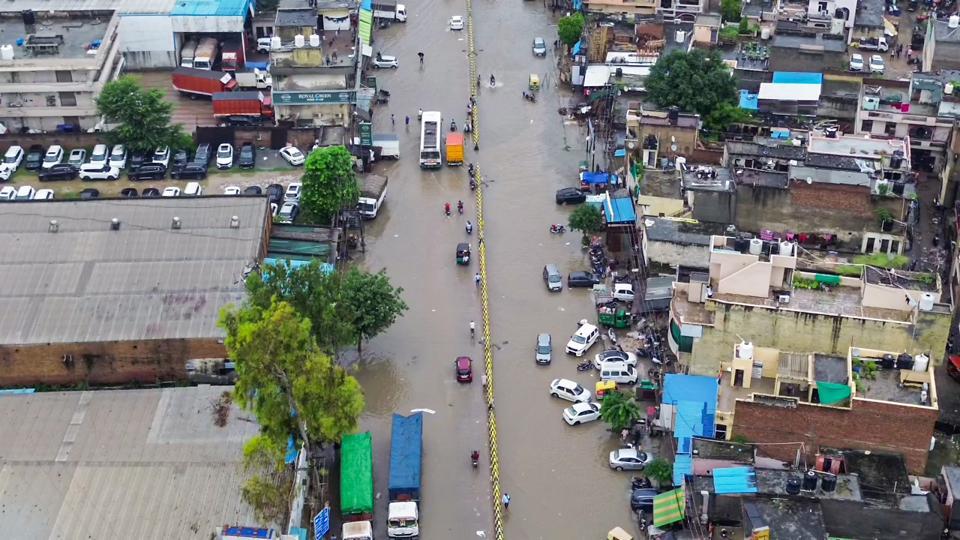
With most corporate offices declaring work-from-home and schools moving classes online, the city’s roads wore an unusually empty look. But the scars of the downpour were unmistakable – stretches of roads were caved-in, foul-smelling waterlogged patches littered all neighbourhoods, and pot-holes the size of craters pock-marked streets.
According to the India Meteorological Department (IMD), Gurugram received nearly 160 mm of rainfall in 24 hours on Monday – leaving the Millenium City’s infrastructure completely crippled.
Arterial junctions including Rajiv Chowk, Hero Honda Chowk, Subhash Chowk and Sohna Road were submerged, traffic choked for hours, and thousands of commuters were stranded in gridlock. For many, it took between eight and ten hours to reach home, with some even abandoning their vehicles and sleeping inside cars as rainwater rose across key stretches.
For many, the commute home stretched into the night. Some reported eight to ten hours on the road; others abandoned vehicles and sought shelter. Several even slept inside their cars as rainwater continued to rise.
Residents shared harrowing accounts of their ordeal.
“Every time it rains heavily, our lives come to a standstill. I left my office at 5pm from Sohna Road and reached home in Palam Vihar at 11pm, after abandoning my car midway. Why do we pay taxes if the city cannot handle rain that comes every year?” asked Dharamveer Saini, a software professional.
Others described it as a test of endurance. “It felt like driving through a river. My scooter broke down near Subhash Chowk, and I had to push it through knee-deep water while cars splashed all around. Officials show up only after the crisis, not before,” said Pulkit Malik, a student who commutes daily through the expressway.
Roads crumble under pressure
On Tuesday morning, residents found themselves navigating submerged potholes and broken roads. The Sector 9–9A road near ESI hospital developed a 500-metre stretch of deep potholes, while the route from Daultabad flyover to Dwarka Expressway remained under nearly 1.5 feet of water.
“I came from Sector 92 and twice lost balance due to potholes. I finally turned back—it was impossible to continue,” said commuter Diwakar Kumar.
Similar scenes unfolded at Basai, Sector 23, and the Southern Peripheral Road (SPR) – all crucial links that connect Dwarka Expressway, Golf Course Road, Sohna Road and NH-48. “The condition of roads inside Palam Vihar and Sector 23 is even worse. Authorities must step inside the colonies to see the damage,” said Pawan Kumar, a Palam Vihar resident.
On the stretch between Hero Honda Chowk and Umang Bhardwaj Chowk, sewage leakage from Mohammadpur Jharsa village compounded the mess.
Public anger, accountability
The chaos has once again fuelled frustration over Gurugram’s preparedness for monsoons.
“Every year we are given promises and advisories. What we need is long-term planning, not temporary fixes after the city has drowned,” said Rajkumar Yadav, president RWA, Sector 46.
Others voiced anger over what they called systemic neglect.
Others echoed the frustration. “We expect a decent living experience when paying premium property prices. Instead, we risk our vehicles and lives every time it rains. Garbage piles up, potholes multiply, and no one is held accountable,” said Nitin Sirohi, a Sector 66 resident.
Amid mounting public anger, top officials fanned out across the city on Tuesday, in an apparent attempt at damage control.
Deputy commissioner Ajay Kumar, police commissioner Vikas Arora, and MCG commissioner Pradeep Dahiya conducted inspections and promised swift redressal.
Kumar said the administration had acted on IMD alerts by issuing work-from-home advisories and suspending physical classes. “The safety of citizens is our highest priority. Disaster management teams are on standby and officials have been instructed to monitor vulnerable points round the clock,” he said.
Arora said that nearly 5,000 police personnel were deployed across the city on Monday. “At every 10-metre stretch in waterlogging-prone areas, personnel were stationed to assist commuters. Timely intervention brought traffic under control in most places,” he claimed.
MCG chief Dahiya said he inspected multiple sites – including Rajiv Chowk, Subhash Chowk, South City-2, Sector 50, Mayfield Garden and Sector 46. “The corporation’s primary objective is to provide citizens with a clean, healthy and convenient environment. Area-wise inspections and grievance redressal will continue,” he said.
170 complaints
Officials said the city’s grievance redressal system received nearly 170 complaints on Monday alone, mostly about sewage overflow, blocked drains and waterlogging. These were escalated to GMDA, MCG and MCM for immediate action.
The Gurugram Metropolitan Development Authority (GMDA) said its Flood Control Office has been operational 24x7 since July, with suction pumps, tractors and staff deployed at critical junctions. A consultant has also recommended large-scale mechanical pumping at vulnerable spots.
“Our priority is to ensure that residents face minimal inconvenience during heavy rains. We are committed to continuous monitoring and prompt response,” senior GMDA officials said.
But despite official assurances, commuters remain unconvinced.
For them, Monday’s chaos was not an isolated event but part of a recurring cycle—civic collapse with every heavy downpour.
Amit Jindal, RWA president of Vipul Greens, Sohna Road said, “What we need is drainage that works, roads that don’t cave in, uninterrupted power supply, and planning that anticipates rain, not panicked responses after the city has drowned. Until then, Gurugram will remain Gurujam.”


Stay updated with all the Breaking News and Latest News from Mumbai. Click here for comprehensive coverage of top Cities including Bengaluru, Delhi, Hyderabad, and more across India along with Stay informed on the latest happenings in World News.


