
 E-Paper



Trial to decongest Sirhaul toll plaza on Delhi-Gurgaon e-way planned next month
Congestion has been a constant problem at Sirhaul toll plaza, which is located on the Delhi-Gurugram border, since work for the widening of the Delhi-Gurgaon Expressway began in 2004.

 Prefer HTon Google


To decongest the Sirhaul toll plaza on the Delhi-Gurgaon Expressway, the police are likely to reduce the width of each carriageway on a trial basis next month to prevent the converging of traffic, which they say is the main reason for congestion and accidents.
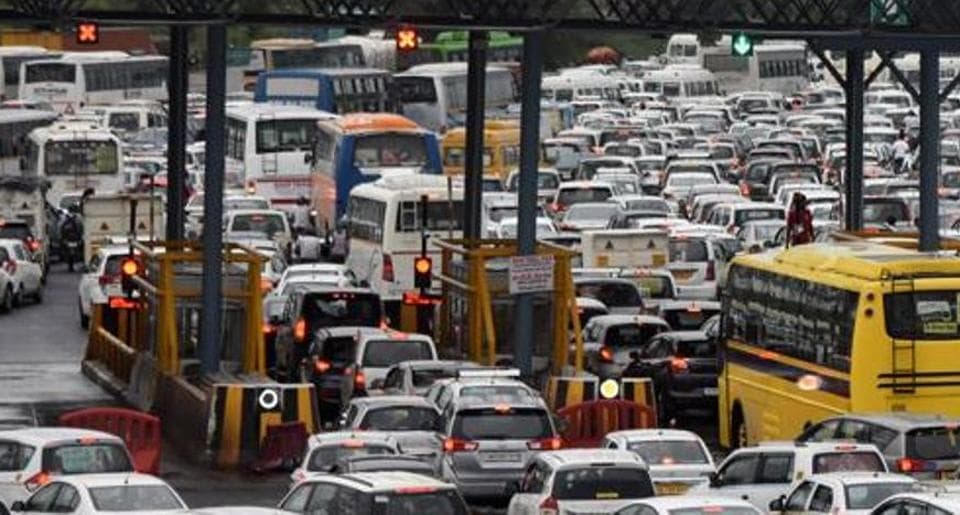
Congestion has been a constant problem at Sirhaul toll plaza, which is located on the Delhi-Gurugram border, since work for the widening of the Delhi-Gurgaon Expressway began in 2004. However, the problem has only worsened in the last six months, said police, due to the ongoing construction of the urban extension road, the Dwarka exit, as well as due to drainage work near Terminal 3 of the Indira Gandhi International Airport--all located near the Delhi-Gurgaon Expressway. These projects result in a backlog of traffic, stretching all the way to the Sirhaul toll plaza.
These days, commuters take at least 10-15 minutes to cross the Sirhaul toll plaza, even during non-peak traffic hours on weekends, while during peak traffic hours on weekdays it takes them a minimum of 20 minutes.
“Crossing the Sirhaul toll plaza is a major issue every day. Each time, it takes me at least 20 minutes to cross the stretch,” said Sahil Mishra, a resident of RK Puram in Delhi.
“Clearing the stretch can take anywhere between 20-45 minutes during peak traffic hours. I have to keep an extra hour of travelling time in hand to ensure I don’t get delayed while reaching important meetings,” said Dhruv Singla, a resident of DLF Phase 1.
According to the 2019 comprehensive mobility plan of the Gurugram Metropolitan Development Authority, around 300,000 vehicles cross the toll plaza every day.
“The Sirhaul toll plaza is the most congested stretch in Gurugram. We are in the final stages of a traffic trial at Rajiv Chowk and are in the process of making permanent changes there. Once this is complete we will take up the Sirhaul toll plaza traffic trial on priority and finalise a traffic plan, which we are aiming to implement in May,” said Ravinder Singh Tomar, DCP, Gurugram traffic police, adding the traffic police will jointly carry out the trial at Sirhaul toll plaza with Trax, a road safety NGO.
According to the traffic police, the width of the Delhi-Gurgaon Expressway (on both the carriageways) varies between 12 and 16 lanes, which increases to 32 lanes at the Sirhaul toll plaza. To streamline vehicular movement, the existing width of eight lanes on each carriageway heading towards Rajokri and Iffco Chowk respectively will be reduced to four lanes to ensure it is aligned with the rest of the expressway.
The eight left-most lanes on each carriageway, which are used by commuters to cross the MCD toll and the Haryana toll tax booth to head towards Rajokri and Ambience Mall respectively, will largely remain unaffected.
However, commuters driving on these lanes can no longer veer towards the right-most lanes to head towards Mahipalpur or Iffco Chowk as jersey barriers will prevent them from doing so.
Signs will be erected around 100 metres before the Shankar Chowk flyover and just a few metres after the Rajokri flyover cautioning commuters to use the eight left-most lanes to head towards Rajokri and Ambience Mall respectively.
Those driving on the remaining four lanes can continue to head towards Iffco Chowk and Mahipalpur respectively.
On March 26, the traffic police compacted Rajiv Chowk, created waiting areas for vehicles, and reduced the distance pedestrians and cyclists needed to cross the junction by placing traffic cones and jersey barriers at various points. Tomar said that within this week, a traffic signal will be put up at Rajiv Chowk while jersey barriers and cones will be replaced with kerbstones to make the changes more permanent.
He also said that since Sirhaul toll plaza has virtually no pedestrians or cyclists, due to the absence of residential and industrial areas in the area, the upcoming trial will be solely focused on vehicular traffic management.
“All the changes in the trial will be implemented to reduce the converging of traffic which is the main reason for congestion and collisions at the toll plaza. We observed that reducing the width of carriageways and aligning them with the width of the approaching roads at Rajiv Chowk significantly helped reduce vehicular congestion, and we aim to replicate the same method at Sirhaul. Depending on the success of the trial, changes will be made on a permanent basis,” said Tomar.
To be sure, experts said that signages will play an important role in the trial.
Sewa Ram, an urban transport systems, design expert and a faculty member at the School of Planning and Architecture (SPA), Delhi, said, “Stretches with large widths tend to encourage lane-changing behaviour, which causes accidents and congestion. Thus, reducing lane widths at key crossings is needed. The success of the trial, however, will be decided by the proper implementation of signages. For such a trial to work, it is important there is clarity among commuters about the diversion, and minimal confusion, otherwise the changes will have an opposite effect.”


