
 E-Paper



Two hours of rain leaves 8 dead across Gurugram
Once again, Gurugram found itself knee-deep in grief, sewage, and questions that have echoed through its flooded streets for years. What does it take for one of India’s wealthiest, fastest-growing cities to prepare for something as predictable as rain?

 Prefer HTon Google


It was chaos that is all too familiar for people living in the so-called Millennium City. On Wednesday night, a two-hour downpour triggered a cascade of tragedies across Gurugram, leaving at least eight people dead—electrocuted, drowned, swept into manholes or killed in road accidents.
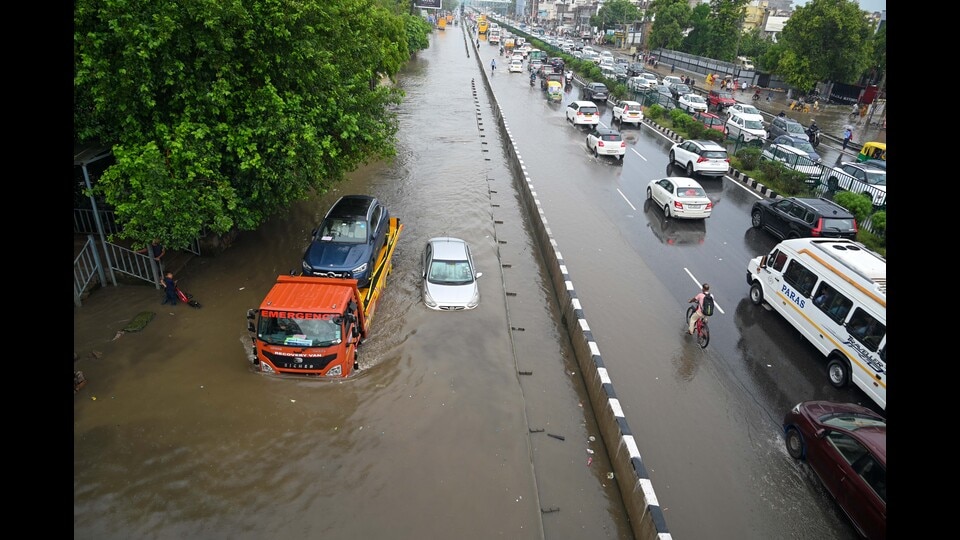
Once again, Gurugram found itself knee-deep in grief, sewage, and questions that have echoed through its flooded streets for years. What does it take for one of India’s wealthiest, fastest-growing cities to prepare for something as predictable as rain?
By morning, roads remained submerged, drains were choked with sludge, and anger among residents had risen almost as fast as the floodwaters. Once again, the promise of a world-class urban centre lay shattered in the deluge, exposing the threadbare fabric of civic planning, even as officials and politicians continue to point fingers and deflect blame.
However, the chaos did not end there. Taking note of the severe disruption, the Deputy Commissioner issued an advisory to all corporate offices and private institutions, urging them to allow employees to work from home on Thursday. “This measure is intended to mitigate traffic congestion, as the India Meteorological Department (IMD) has issued an Orange Alert for the city,” the order stated.
Eight lives lost
The first death was reported around 9.30pm, barely half an hour after the rain started. Akshat Kumar Jain, a 30-year-old software engineer, was riding home from the gym on Ghasola Road when his motorcycle slipped on waterlogged tarmac. He skidded into a pole with exposed live wires submerged in calf-deep water. Eyewitnesses tried to rescue him using bamboo poles but could not save him. Jain, a resident of Delhi’s Vishwas Nagar, was declared dead at a private hospital. Police later booked officials of the private power distribution company for negligence under IPC Section 304-A.
The second tragedy struck three-and-a-half hours later in nearly identical circumstances. Pawan Kumar, 26, a food delivery executive, stopped near Plot 22 in Sector 18 to buy a snack. Minutes later, he was heard whispering “Bachao, bachao” (Save me, save me) on the phone before the line went dead. His body was found next to an electric pole submerged in water. A nearby shopkeeper who tried to pull him free suffered burns. An FIR has been registered.
At 10pm, 22-year-old Prashant Mishra was electrocuted while climbing rain-slicked stairs in Arjun Nagar’s Sector 8. He had touched a railing charged by a frayed wire running through ankle-deep water. He was dead before help arrived. Residents later found the cable lying in ankle-deep water.
Then, at 10.30pm, 28-year-old auto-rickshaw driver Shailender Kumar parked near Sispal Vihar in Sector 49. Police believe he stepped off the road to relieve himself and was “sucked” head-first into an uncovered roadside manhole by the current in the knee-deep water. Locals spotted his body minutes later. A negligence case has been filed against Municipal Corporation of Gurugram (MCG) employees at Sadar police station, police said.
At 3.30am, a taxi carrying a contractual employee of an airline operator and two security guards from Delhi airport slammed into uprooted concrete median blocks on Khandsa Road. The driver, blinded by rain and glare from headlights on the water’s surface, never saw the obstacle submerged below. Vanshika (24) died on the spot. The driver and another guard were hospitalised with fractures. Police said the blocks were left behind by a contractor working on storm drains.
By morning, news arrived of another tragedy from Bhondsi’s Aravalli hills: 11 teenagers had visited a disused mining pit that had overnight turned into a rain-filled pool. Three—Ashish Kumar, Surjeet, and Devender, all 16 or 17—slipped under. Villagers retrieved their bodies. “We’ve asked for these pits to be fenced, but no one listens,” said village sarpanch Shyam Lal.
Sandeep Kumar, public relations officer of Gurugram police said that a case of causing death by negligence was filed at Sector 37 police station in Vanshika’s death. “We have asked the discom and MCG officials to fix the responsibility of erring employees in the drowning and electrocution cases,” he said.
DCP (traffic) Rajesh Kumar Mohan said police personnel remained deployed at more that 100 locations till 12.30am on Thursday for controlling the traffic movement. “More than 222 vehicles had broken down across the city which traffic police personnel helped in getting towed amid water logging. Uprooted trees were also removed from multiple locations,” Mohan said.
Roads collapse
The slip-road of the Southern Peripheral Road (SPR) near Sectors 75–75A caved in—again—for the third time in just over a year. This time, a truck carrying beer crates was half-swallowed by the crater. Engineers blamed water infiltration near an under-construction drain for the collapse, which barricaded one carriageway and choked traffic on the stretch from Vatika Chowk to NH-48.
“This road is a death trap,” said commuter Ajay Rana, stuck in the jam for over two hours. A technical probe has been launched, with preliminary findings pointing to poor drainage and soil instability.
Deputy commissioner Ajay Kumar visited multiple flooded locations—Vatika Chowk, Hero Honda, Subhash Chowk, Palam Vihar, Sushant Lok, Sector 9, and the collapsed SPR section—wading through ankle-deep sludge with MCG engineers. He promised an audit of all live-wire hazards and open drains within 48 hours.
“Accountability will be fixed for every fatality,” he said.
A city in deluge
In households across the city, people experienced the usual monsoon woe. In neighbourhoods like Palam Vihar, Sushant Lok, Heera Nagar, and Sectors 5, 6, 10A and 15, residents woke up to find their living rooms flooded, basements submerged and sewage flowing uphill. In Palam Vihar’s C-Block, drains stood taller than the lanes they were supposed to empty, pushing effluents into homes.
“We had to move our kids and grandparents to a neighbour’s first floor,” said Sameer Khurana. With most autos refusing trips and cabs quoting five times the fare, many were stranded for hours.
Sector 56 RWA president Harish Yadav pointed out five open manholes in just one block. “One misstep and you’re gone,” he said.
One of the most striking images of Gurugram’s civic collapse on Wednesday night emerged from the Rajiv Chowk underpass, which was transformed into a deep, debris-laden pool after hours of torrential rain. Water levels rose above car windshields, completely submerging vehicles and leaving several commuters stranded. Visuals of people wading through waist-deep water as emergency responders struggled to reach them went viral on social media, highlighting the sheer scale of the chaos. The flooding at this key junction caused massive traffic jams on Sohna Road, where vehicles were stuck bumper-to-bumper for hours. In desperation, many commuters began driving on the wrong side of the road to escape the gridlock.
MCG commissioner Pradeep Dahiya said the city received 133mm of rainfall in 90 minutes and that teams had cleared 40 major choke points overnight.
Residents, however, dismissed this as bureaucratic theatre. “They conduct pre-monsoon desilting every year, but nothing changes,” said advocate Ritu Bhariok, legal adviser to the Federation of Affordable Homebuyers. “It’s the same story—corruption, collusion, and cheap materials.”
Political blame-game
As visuals of floating cars, caved-in roads, and grieving families flooded social media, outrage spilled onto streets and into political circles.
Former Congress MP Raj Babbar called the deaths “institutional murder,” saying: “Gurugram sells million-dollar dream homes but can’t build a working drain. These were not accidents—they were avoidable deaths caused by criminal indifference.”
Congress leader Pankaj Dawar echoed the sentiment. “Waterlogging in Gurugram isn’t new. What’s new is the silence from those in power. This isn’t just water on roads—it’s corruption flowing unchecked.”
“The government has taken several initiatives in Gurugram to address waterlogging and improve overall infrastructure. Drains have been cleaned ahead of the monsoon, and new drainage systems are being laid across multiple sectors. The kind of infrastructural transformation the city is witnessing today should have been done years ago, but the previous Congress governments only focused on selling land to benefit vested interests and fuel corruption. Unlike them, the BJP is committed to making Gurugram a livable, modern city with long-term planning and execution,” Arun Yadav, BJP Social Media Head.
Long-term drainage blueprint underway
The Gurugram Metropolitan Development Authority (GMDA) said it had hired a consultant to map natural stormwater channels and master drains using three decades of rainfall data. “We’ll expand outfall capacities and divert runoff to ponds,” said GMDA’s superintending engineer Sudhir Ransiwal. New drains are under construction: ₹105 crore for SPR, ₹51 crore for Sectors 68–75, and ₹31 crore for Sectors 112–115.
Yet experts warn that none of it will matter unless the city reclaims its water bodies, restores its natural drainage, and halts construction in flood-prone areas.
Vivek Singh Rao, chairman, Indian Institute of Architects, Gurugram chapter said that there was urgent need to conduct a topographical survey of the entire city from Faridabad road upto Dhanwapur as the entire drainage system has been changed due to implementation of the Gurugram masterplan. “The development of the city has taken place in such a manner that the natural drainage has got changed. Now the only solution is that drains along the roads should be channelised as per the new topography. Apart from that the larger three natural drains should be interconnected like irrigation channels,” he said, adding that there was urgent need to double the capacity of large box drains in the city.


Stay updated with all the Breaking News and Latest News from Mumbai. Click here for comprehensive coverage of top Cities including Bengaluru, Delhi, Hyderabad, and more across India along with Stay informed on the latest happenings in World News.


