
 E-Paper



Assembly elections: Going solo, Congress braces to make a mark in Uttar Pradesh
Despite going it alone, the Congress has managed to create a buzz by already giving 40% tickets to women in its two lists for the Uttar Pradesh assembly elections declared so far

 Prefer HTon Google


The Congress has remained firm on the strategy of going solo in the seven-phase Uttar Pradesh assembly elections that will begin on February 10. Now, with less than three weeks for the first round of voting, this strategy may not change.
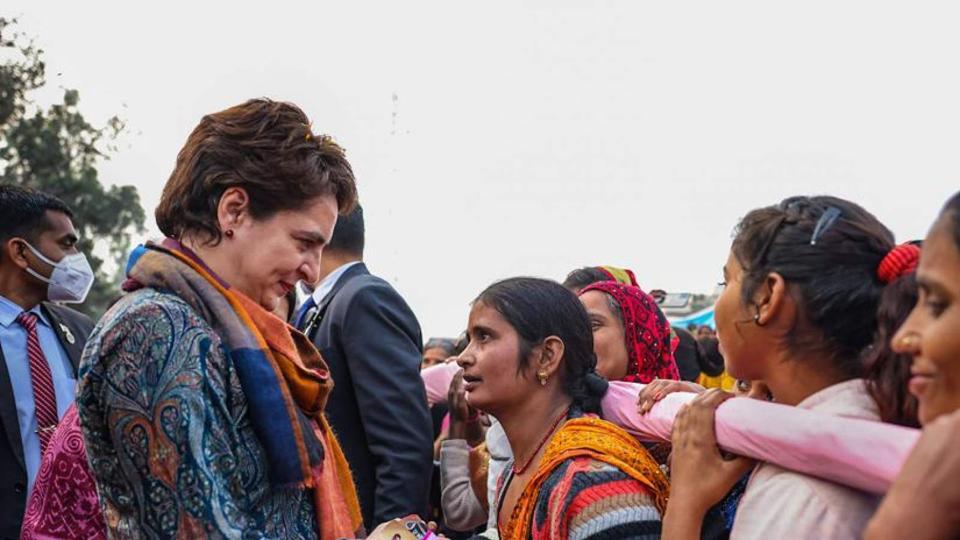
There is more than one reason for the party’s stance. For one, alliances have failed to work for the Congress in the past. Besides, other major opposition parties did not consider it to be a strong contender. Hence, the party was not left with any other workable option in Uttar Pradesh.
Despite going it alone, the party has managed to create a buzz by already giving 40% party tickets to women in its two lists for the state assembly elections declared so far and announcements focusing on women.
Indeed, this game of political one-upmanship to woo women began after Congress general secretary Priyanka Gandhi Vadra made the announcements and released a women’s manifesto, listing more promises, much before the poll schedule was declared.
“The Congress is full of hopes. Our consistent struggle under the leadership of Congress general secretary Priyanka Gandhi Vadra is giving positive signals. There has to be a change and the Congress has given a new thought for bringing about this change,” said Uttar Pradesh Congress Committee (UPCC) president Ajay Kumar Lallu.
Months before the poll schedule was announced, a booklet targeting the Bharatiya Janata Party (BJP), the Samajwadi Party and the Bahujan Samaj Party (BSP) alike (brought out recently to train Congress workers) and a resolution (adopted by Congress minority department) promising a probe into communal riots during the SP regime gave sufficient indications about the prevailing mood in the party.
The Congress’s mood is also a reflection of its alliance experiences in the past. The Congress had allied with the BSP in the 1996 assembly elections, contesting 126 seats in the 425-member state assembly of the undivided Uttar Pradesh.
The Congress won only 33 seats, securing 8.35% of the total votes. Its vote share on the seats contested was 29.13%. In the 1993 assembly polls, the Congress had won 28 of the 421 seats contested and secured 15.08% votes and 15.11% votes on the seats contested. The SP and the BSP had contested the 1993 polls together.
Similarly, the Congress contested the 2017 assembly elections in alliance with the SP, fielding its candidates on 114 seats in the 403-member UP assembly. It won only seven seats, securing 6.25% of the total votes with its vote share on seats contested being 22.09%. In 2012, it had won 28 out of the 355 seats contested, securing 11.65% of the total votes and 13.26% on the seats contested.
“As the Congress left a large chunk of seats, nearly three-fourths, for the alliance partners, its workers felt demoralised. In many constituencies, its workers joined the parties they supported in the polls in the past. As a result, the Congress organisation structure ceased to exist on most of the seats that the party left for the BSP and the Samajwadi Party in the 1996 and the 2017 polls respectively,” said a senior Congress leader.
“An apparent anti-incumbency factor is working against the BJP in the state,” said the leader.
The Congress that seems to be working at cross purposes with the SP for now does not appear to have a committed vote bank of its own.
“But the Congress definitely has traditional voters in all the constituencies. This has been reflected in every election consistently. We are going with a plan to project the Congress as an alternative and seeking the support of all sections of the society,” said another leader.
After the Congress debacle in the 2019 Lok Sabha elections, Priyanka Gandhi Vadra had decided to go in for a revamp of the organisation and get the party ready for the future.
“You all (Congress workers) have identified those who worked. I will now identify those who did not,” said Priyanka Gandhi Vadra to the party leaders and workers in Rae Bareli on June 12, 2019 after holding feedback sessions to ascertain the factors responsible for the poll debacle.
Although a new organisation structure has been put in place, she feels a lot more needs to be done and the party workers need to work harder to get the “right” results.
“Our effort has been to take the Congress organisation to the grass roots level. We will get the right results in the assembly elections only if all the partymen join hands and work harder in the next few months, ” Priyanka said to party workers at the UPCC headquarters here recently.
Priyanka also asked the party workers, the new ones and the veterans alike, to strive together and strengthen the party organisation at the booth levels as well.
“We need to have ‘jitau’ (winnable) and ‘tikau’ (loyal) candidates for the 2022 assembly elections,” she had said.
“Besides setting up new organisation structure at district/city levels, we now have verified units in all the 831 blocks, 2614 wards and 8134 nyay panchayats. The party has organisational units in all the 58,000 village panchayats under the Har Gaon Congress (Congress in every village) programme,” said UPCC organisation secretary Anil Yadav.
After being appointed Congress general secretary in the midst of the 2019 Lok Sabha election, Priyanka has been visiting different parts of the state to raise issues of public concern amid challenges of putting an efficient, energetic and effective team in place in the state. The overnight sit-in she led at Chunar fort in eastern UP in 2019 (after being stopped in Mirzapur on the way to Sonbhadra to meet the families of those killed in the Umbha village massacre), the demonstrations and signature campaign organised at her instance to demand justice for the Unnao rape survivor, her visits to different districts to meet victims of police excesses during CAA/NRC protests gave indications of what she wanted from her team in Uttar Pradesh.


