
 E-Paper



TechSangam 2026: Investigators must stay ahead of criminals exploiting digital tools, says HC judge
Addressing the concluding session of the three-day international seminar, TechSangam 2026, at the Uttar Pradesh State Institute of Forensic Science (UPSIFS), Justice Singh cited the sensitive issue of alleged tampering with human DNA inside a laboratory to underline the evolving challenges confronting investigators. He called upon forensic experts and students to develop solutions that contribute to a secure and just society.

 Prefer HTon Google


As technological advances create new opportunities for criminals to manipulate evidence and exploit digital vulnerabilities, investigative agencies must stay a step ahead through scientific vigilance and innovation, Justice Rajiv Singh of the Lucknow bench of the Allahabad high court said on Sunday.
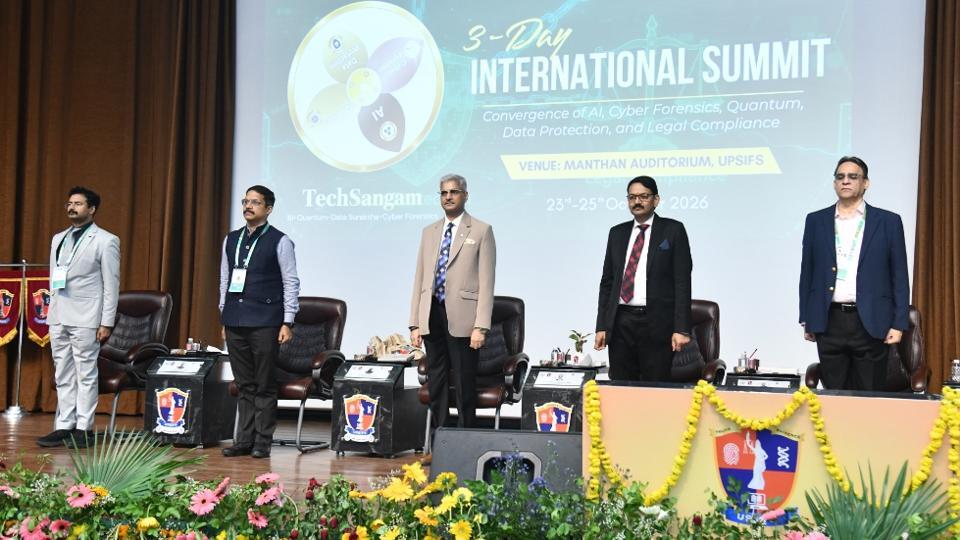
Addressing the concluding session of the three-day international seminar, TechSangam 2026, at the Uttar Pradesh State Institute of Forensic Science (UPSIFS), Justice Singh cited the sensitive issue of alleged tampering with human DNA inside a laboratory to underline the evolving challenges confronting investigators. He called upon forensic experts and students to develop solutions that contribute to a secure and just society.
Justice Singh also urged UPSIFS experts to prepare an authoritative commentary on the Digital Personal Data Protection (DPDP) Act, incorporating parliamentary debates, committee reports and expert analysis to provide practical guidance to the judiciary and law enforcement agencies.
The seminar brought together experts from forensic science, cybersecurity, law, academia, industry and law enforcement to discuss emerging technologies and their implications for investigations, digital security and the criminal justice system.
During the concluding ceremony, Justice Singh inaugurated the Centre of Excellence in IT-OT Security and Forensics, adding a new institutional focus on the security of information technology, operational technology and their forensic applications.
UPSIFS founding director GK Goswami said theoretical knowledge alone was insufficient to address the growing complexity of cyber crime and forensic investigations. Technological innovation needed to be integrated with practical policing and the functioning of the judicial system, he said.
He added that the institute was providing students with opportunities for global careers while also training police officers in contemporary cyber laws and the practical handling of forensic evidence.
Goswami said the ultimate purpose of technology was to ensure security and access to justice for ordinary citizens.
Prof Pawan Sharma highlighted industry expectations, global projects, student innovations and the role of mentorship in preparing young professionals for emerging career opportunities.
He said recruitment increasingly depended not merely on grade point average (GPA), but also on practical competence and an understanding of the broader professional ecosystem.
Ahmedabad IG Raghavendra Vats stressed interdisciplinary learning, hands-on experience and industry readiness in forensic science and emerging technologies.
Vats also highlighted the discussions on the DPDP Act, saying they helped broaden participants’ legal and practical understanding of data protection.
Special guest Satish Kumar, commandant of the Special Security Force (SSF), emphasised multidisciplinary learning, professional networking and the importance of scientific and digital evidence in the criminal justice system.
Recounting the security arrangements coordinated during the 2025 Mahakumbh, which drew more than 65 crore devotees, he spoke about his team’s experience and its receipt of the Mahakumbh Seva Medal.
Referring to David Epstein’s book Range, Kumar argued that broad-based knowledge across disciplines, rather than narrow specialisation alone, could drive meaningful innovation. He called upon students of law, forensic science, quantum computing and cybersecurity to collaborate in developing new tools, software and procedures. Weak evidence could undermine an investigation, he cautioned, stressing that accurate scientific and digital evidence was essential to ensuring fair justice.
Additional director Sanjeev Suman delivered the vote of thanks.


