
 E-Paper



Regional disparities persist, west U.P. far ahead of east
Analysts acknowledge the state government has made consistent efforts to bring about development in all the backward districts and regions and claims to have attracted investment of ₹33.50 lakh crore at the UP Global Investors Summit-2023 but add that more such steps are needed.

 Prefer HTon Google


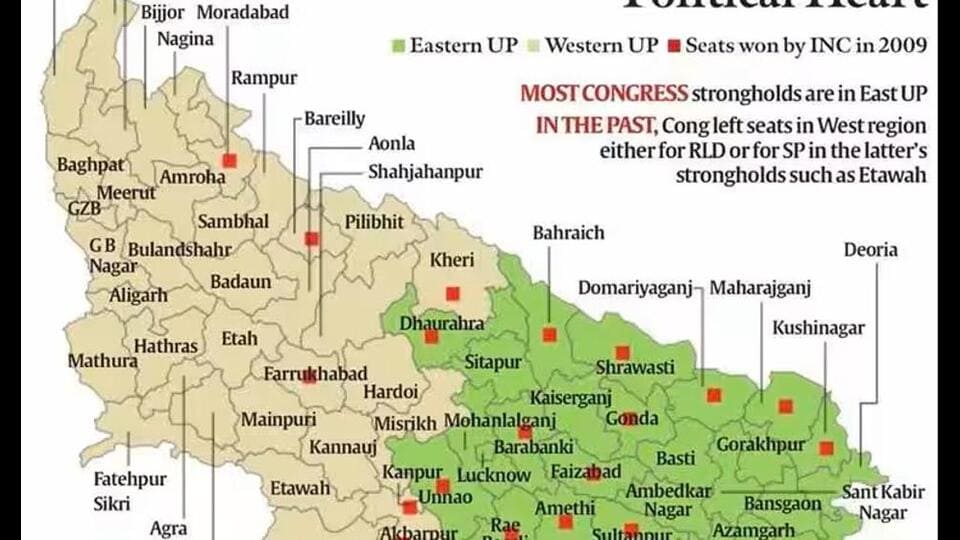
Uttar Pradesh continues to have regional disparities with the western districts of the state taking the lead in development indictors like the per capita district development product (PCDDP) and gross district development product (GDDP).
Analysts acknowledge the state government has made consistent efforts to bring about development in all the backward districts and regions and claims to have attracted investment of ₹33.50 lakh crore at the UP Global Investors Summit-2023 but add that more such steps are needed.
A scrutiny of the list of top 10 districts in terms of per capita district development product (in descending order) indicates that western districts take the lead. Central U.P. and Bundelkhand regions are second and third, respectively, but no district of eastern UP figures on the top 10 chart.
Gautam Buddha Nagar, Meerut, Etah, Agra, Amroha, Ghaziabad and Hapur of western U.P. are seven districts on the top 10 list. Lucknow and Kanpur Nagar of central U.P. region and Hamirpur of the Bundelkhand region are the remaining three districts among the top 10 in terms of per capita district development product.
The bottom 10 includes the east U.P. districts of Azamgarh, Chandauli, Siddharthnagar, Deoria, Ballia, Pratapgarh, Jaunpur, Santkabir Nagar, Bahraich and Balrampur. The per capita district domestic product of Gautam Buddha Nagar, the top ranked district, is 20 times higher than the per capita district development product of Balrampur that is on the bottom of the list.
The Gross District Domestic Product estimates for 2021-22 for the state’s four regions also indicate gross regional disparities. The GDDP for west U.P. at current prices is estimated to be ₹9.44 lakh crore, while for east U.P, it is estimated to be ₹5.37 lakh crore. For the Bundelkhand and central U.P regions, the GDDP is estimated to be ₹99,029.34 crore and ₹3.36 lakh crore, respectively. U.P’s overall GSDP for 2021-22 at current prices remained ₹19.17 lakh crore.
Principal secretary, state planning department, Alok Kumar-III said the state government has been focusing on development of the backward districts/regions through schemes like the aspirational districts’ and the aspirational blocks’ programmes. He said the state government has also launched the one district one product (ODOP) scheme while special funds are allocated through Purvanchal Vikas Nidhi and Bundelkhand Vikas Nidhi for development of the east UP and Bundelkhand regions. He said the state’s industry policy also provided for special incentives for bringing about investment in these regions.
Professor Yashvir Tyagi, former head of department of economics, Lucknow University, said, “Understanding the regional and inter-district disparities is important for formulating appropriate policies for balanced regional development. The disparities can be gauged by analysing the Gross District Domestic Product and per capita district domestic product data. Gross district domestic product indicates the general level of development of a region or a district while the per capita district development product is a broad indicator of the average standard of living of people in a district.”
Tyagi said Varanasi, Prayagraj and Gorakhpur in Purvanchal and Jhansi and Chitrakoot in Bundelkhand are fast emerging as the “growth poles” that would lead to “spread effects” of development in the neighbouring districts also. All these efforts should, hopefully, lead to a pattern of more balanced development in U.P, he said.


