
 E-Paper



After a transcontinental taleem, the Lahore gharana of Kathak comes to Mumbai
After 27-year-old Sushant Gaurav mastered the Lucknow gharana under the tutelages of Ustad Birju Maharaj and his daughter Mamta Maharaj, he decided to move away from the tradition to follow a new pedagogy


MUMBAI: A Delhi-based human resources professional of an electronics company who trained in the Lucknow gharana of Kathak over 12 years, will perform a distinctive lineage of the dance form in the city today which few know about and fewer practice. While three gharanas -- Benaras, Jaipur and Lucknow -- are popular, not many know of the Lahore gharana, which is a study of stylised movements of the Mughal-era.
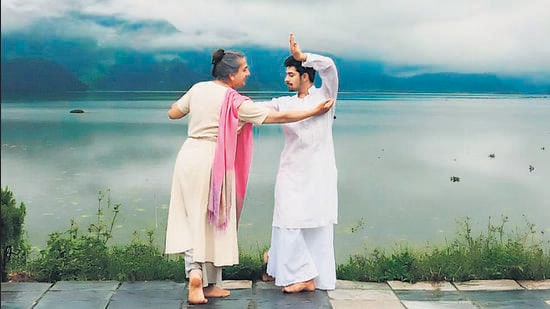
After 27-year-old Sushant Gaurav mastered the Lucknow gharana under the tutelages of Ustad Birju Maharaj and his daughter Mamta Maharaj, he decided to move away from the tradition to follow a new pedagogy. Research and YouTube searches revealed the Pakistani Kathak guru Ustad Fasih-ur-Rehman’s rendition of the form, and Gaurav was captivated.
“I wanted my dance to go beyond, and was smitten with his perfection of movement, footwork and andaz,” said Gaurav. “I immediately wanted to train under him.”
But that was easier said than done.
Rehman was a lone male dancer in Pakistan during the regime of Mohammed Zia-ul-Haq. At the time artists were targeted for pursuing what was seen as anti-religion, anti-culture and anti-country. After first shifting classes to the basement of the Lahore Arts Council to muffle the sounds of ghungroo, Rehman stopped them altogether. Many artists left Pakistan permanently at the time. He did too, choosing to make London his home; although with subsequent change of governments, Rehman could afford the luxury of dividing his time between London and Lahore.
In 2019 Gaurav’s first 10 attempts to reach out to the 67-year-old London-based Rehman over Facebook messenger were unsuccessful, but the ustad and shagird did manage to connect over a video call eventually. “I found his humility, submission and enthusiasm for learning endearing and told him to join an upcoming online session,” said Rehman, on a phone call from London.
Gaurav persisted with his pursuit “to comprehend the subtleties of dance” that the maestro had himself acquired from his mentor Maharaj Ghulam Hussain, a pupil of Pt Jagannath Maharaj, better known by his stage moniker Acchan Maharaj.
The more he trained the more Gaurav fell in love with his ustad’s style. “I now know why it is said: ‘Ustad se mohabbat na hui, toh kya seekha?’”
“While most Kathak in India is centered around the Bhakti movement, I wanted a focus on Mirza Ghalib, Amir Khusro, Siraj Aurangabadi, Bulle Shah and other Sufi composers whose works find lesser representation,” said Gaurav.
After two years of online classes, he finally met his guru in July 2022 for one-on-one sessions in Kathmandu. That was a chosen destination as Gaurav could afford the air ticket and Rehman could obtain a visa to Nepal effortlessly.
“This dance and its geometry of movement is part of the larger tapestry of architecture, language, lifestyle, textile and poetry of the subcontinent with each form borrowing from the other. This, combined with the foundations of the gayaki ang, is what gives Kathak its composite beauty,” said Rehman.
Rehman frowns at flashy routines that focus on fast rhythm. “The Lahore gharana’s style uses ati vilambhit laya (grave tempo) with a very strong command on movements. First it explores extreme bending and curves and progresses to brisk footwork and movement,” he said, adding, “Much like an artist’s canvas remains white within despite the colour-play, the accompanying ati vilambhit laya stays constant despite the dancer’s footwork. Unlike other forms, here the dancer leads, not musicians.”
This great-grandson of Princess Fatima Sultana of Kabul, (who owned the Darya-e-Noor diamond), enjoyed dancing to the semi-classical songs of Noor Jehan, Lata Mangeshkar and Asha Bhosale on Radio Pakistan when he was a child. His family recognized his talent and assigned him to learn Kathak with Maharaj Ghulam Hussain at 10. “By the time I began performing, General Zia-ul-Haq declared martial law and became President (1977),” he recounted. “Those were the toughest 11 years for the arts scene. The government banned music and dance and wearing ghungroos was considered anti-Islamic!”
Maintaining a career while attending college was difficult. “The only reason I persisted was because of my Ustad, who had defied opposition from the government, clergy and the public at large to re-create Kathak in Pakistan after Partition.”
Gaurav too recollects the bigoted barbs he faced some from his own fraternity when they heard he had accepted Rehman’s tutelage. “Convert toh nahin ho rahe ho? Kya ab pranaam ki jagah salaam karoge?” he was asked. Wishing his shagird well Rehman said: “I want to nurture him in the legacy of aesthete and nuance to revive the elements of Kathak we have lost.”
Sushant Gaurav will perform at Bhavan’s Cultural Centre, Andheri, today.

Stay updated with all the Breaking News and Latest News from Mumbai. Click here for comprehensive coverage of top Cities including Bengaluru, Delhi, Hyderabad, and more across India along with Stay informed on the latest happenings in World News.


