
 E-Paper



BLOs, the foot soldiers at SIR frontline
Since they were enlisted for the SIR in April, BLOs have attended four, two-hour training sessions even as they roll out the SIR. They say the SIR exercise has taught them new skills, particularly stress management and multi-tasking

 Prefer HTon Google


MUMBAI: Behind the political battles and growing questions over the Special Intensive Revision (SIR) of India’s electoral rolls are thousands of people working largely out of sight. They weave through narrow lanes, knock on doors, verify identities and chase missing details, often working against the clock to ensure that no name is wrongly left out. These are the foot soldiers of a vast democratic exercise – the people on whose work the right to vote ultimately depends.
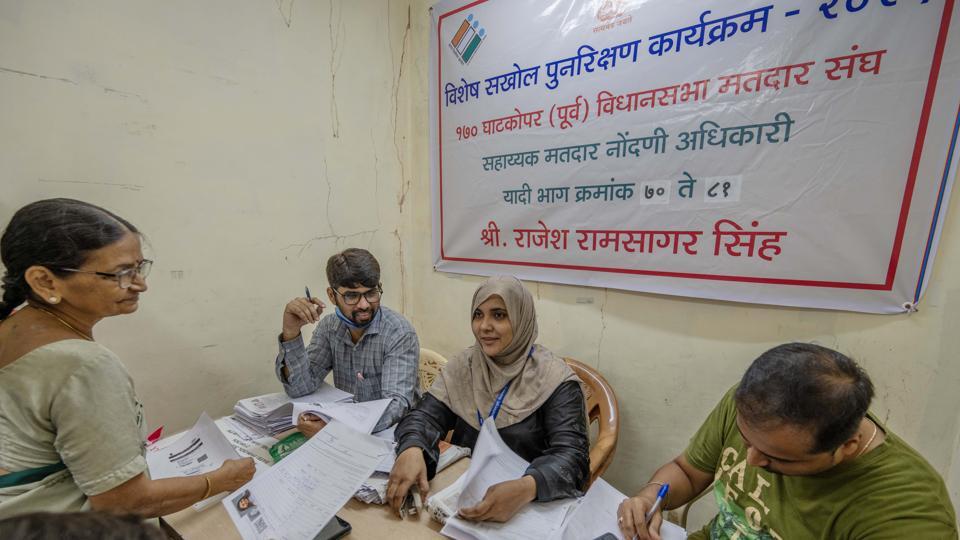
“We have forfeited our summer vacation and will also work through the Diwali season. Although it sometimes feels like an almost impossible assignment, it is our national duty to conduct the SIR. That’s what keeps us going,” says Naresh Kumar, a teacher from Kandivali.
Conducting the SIR in Maharashtra are 1,00,300 “Booth Level Officers”, or “BLOs”, three letters that, along with “SIR”, have entered everyday conversation in recent times. Around 60% of BLOs are teachers in municipal and government-aided schools, and the rest Class III employees working in government and semi-government offices such as the Collector’s Office and local bodies.
“In 2002, it took 13 months to update the electoral rolls, whereas, this time, the Election Commission wants it completed in six months,” says a BLO, summing up how stressful the exercise has been.
Since they were enlisted for the SIR in April, BLOs have attended four, two-hour training sessions even as they roll out the SIR. They say the SIR exercise has taught them new skills, particularly stress management and multi-tasking.
Depending on the phase of the SIR, they have visited households, many multiple times, to drop off forms, collect documents and record details. They have mapped voters to earlier rolls, updated details, deleted the names of deceased voters and duplicate entries, served notices asking citizens to appear for hearings, and also conducted those hearings. Currently, in phase two of the SIR, BLOs are addressing anomalies and mapping for 12.2 million voters, and registering new electors across the state.
Then, there’s the backend work, of uploading documents and data-entry. This, alongside coordinating with their assigned Election Registration Officer (ERO). For many BLOs, the repetitive nature of the job has been numbing, and managing confused and difficult citizens daunting.
And yet, their enthusiasm has not waned. “We have not enjoyed a single weekend with our families for the last six months. We have worked through the summer heat and even heavy rain as it is our national duty,” says Seema Alaskar, a surplus teacher recently placed in a BMC school in Malad.
‘How can we teach?’
The SIR is a highly structured exercise. Each polling station in the state has 1,000-1,200 registered voters, and each BLO is assigned one polling booth. This means handling the voter registration details of more than 1,000 citizens during the SIR cycle – from April to October before the final electoral rolls are announced on November 16.
But, for many BLOs, discharging academic duties alongside SIR work can be overwhelming. Nanda Kamble, vice-president of Shikshak Bharati, a teachers’ organisation, says, “This year, the government will be conducting periodic assessment tests after Diwali, although these were to be held in August. When teachers spend so much time away from classrooms, how will the government assess students’ academic progress?”
Teachers doubling as BLOs are allowed to leave school an hour to make time for SIR work. “That may offer us some relief but it also means we have to rush through the syllabus to complete it. One workaround is to cancel the revision period and not actual classes,” says Seema Koli, a teacher and a BLO in the western suburbs.
Concessions like these mean little to Umesh Tiwari, a mathematics and science teacher and a BLO, whose day begins at 4:00am and often ends at 10:00 pm. Living in Panvel, he leaves home at 5:00am to reach school in Dahisar by 7:00am. He conducts his SIR field work until 7.30pm and reaches home only at 10:00pm – only to prepare for the next day’s classes and complete pending BLO work.
His wife, Sapna, also a teacher, has been assigned BLO duties in Andheri. With both parents working all day, the couple often leaves their children at a neighbour’s home after school.
“We understand that this is our national duty but our family life has been upended,” says Sapna.
Another sore point is the lack of sufficient remuneration. BLOs receive ₹12,000 a year for conducting the ongoing annual Summary Revision (SSR) of the electoral rolls, and an additional ₹6,000 for this year’s SIR. EROs, who are Class I government employees, receive an annual remuneration of ₹30,000 for ongoing SSR work, while Assistant EROs receive ₹25,000. There are 7,000 AEROs in the state, and one ERO for each of the 288 assembly constituencies.
Revised guidelines
There was a complete change in the ECI’s approach after alleged irregularities in the SIR surfaced and revised guidelines were announced on September 30, says an assistant ERO (AERO) from Govandi. “The list of documents accepted as residential proof and nationality were expanded, and personal hearings for voters who were flagged were done away with,” he says. “We used to conduct 75 to 90 hearings a day. Now everything has moved online, taking some of the pressure off us.”
The new guidelines have also given EROs discretionary powers earlier vested only with the ECI and limited by the software used for the SIR. “Earlier, we had to approach the deputy electoral officer to correct discrepancies. Now, these can be made at our level,” says another ERO.
But there are challenges as well. “We have to work longer hours during the SIR. It has been very hectic as we have to complete the exercise in just six months. Lack of resources and frequently changing guidelines compounded our difficulties,” said an ERO.
Another positive was the ECI’s decision to share the list of 12.2 million voters flagged for anomalies with Booth Level Agents (BLAs) appointed by political parties to assist with the SIR. This helped ensure that eligible voters in their respective constituencies were not left out. They were also able to assist BLOs when necessary.
However, it’s the frontline cadres – largely teachers – who bear the brunt. Vikas Ghuge, a teacher from a Ghatkopar-based BMC school, explains, “Teachers are always the first choice to implement government schemes. From May 16 to June 15, thousands of teachers were deployed on Census duty. Likewise, we have to work on the Adult Education Programme and keep a track daily of the Midday Meal stock. We are constantly roped in for non-academic work.”

Stay updated with all the Breaking News and Latest News from Mumbai. Click here for comprehensive coverage of top Cities including Bengaluru, Delhi, Hyderabad, and more across India along with Stay informed on the latest happenings in World News.


