
 E-Paper



How ‘Chakachak Dadar’ team makes it their business to collect thermocol at fish market
A group of volunteers in Dadar, Mumbai, known as 'Chakachak Dadar', is collecting thermocol waste from the fish market and sending it to a recycling plant. The volunteers took action after the municipality failed to pick up the waste. The thermocol is recycled into beads for making other products.

 Prefer HTon Google


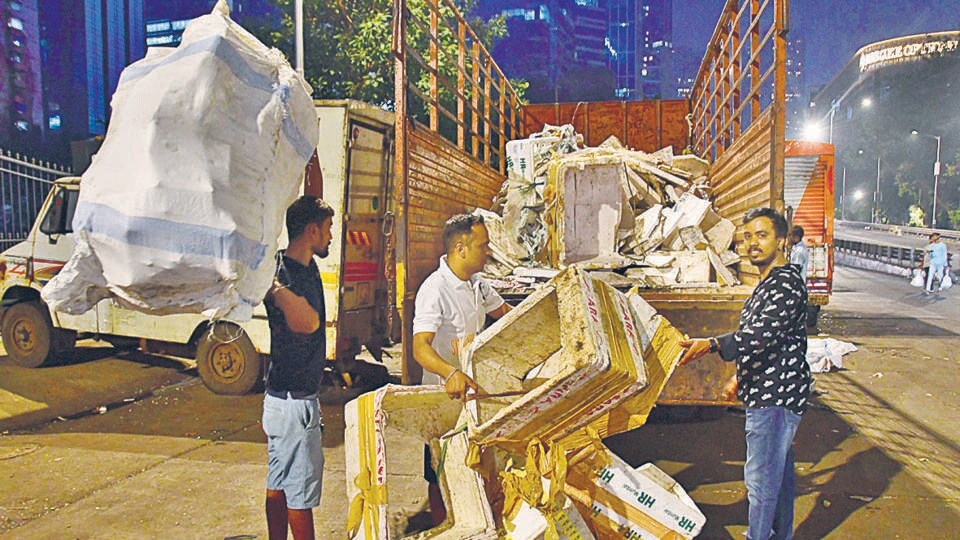
A group of working professionals from Dadar has taken it upon themselves to collect large quantities of thermocol waste generated at the fish market every day and send them to a recyling plant. The initiative, ‘Chakachak Dadar’, began six years ago after the volunteers could not avoid the sorry sight of the waste being scattered all over the road and choking storm water drains.
The fish market at Senapati Bapat Marg in Dadar West is operated by the Brihanmumbai Municipal Corporation (BMC). However, BMC vans allegedly skip thermocol, the common name for polystyrene foam, while picking up other garbage.
An official from BMC’s solid waste management department said they have a dry waste collection facility under which thermocol is picked up and sent to a plant in Taloja, but since the fisherman are managing on their own, the civic body is not sending its vans.
Chetan Kamble, one of the volunteers, disputed the claim. “BMC keeps talking about picking up the thermocol waste. But had that been the case we wouldn’t have to look for a solution in the first place.”
Bhamini Bavkar, a fisherwoman from the market, said, “We buy second-hand thermocol boxes from fish sellers at ₹50 per piece and it has a shelf life of around 15-20 days since we store ice in it. After we have used them for storing and transporting fish, they get broken. That is when the ‘Chakachak Dadar’ team sends them for recycling.”
Prashant Sawant, another member of the initiative, said previously material made from saw dust was used for transporting fish. “Then fishermen switched to thermocol, but it was not picked up by BMC. So, we started looking to see who would buy this and shortlisted two vendors who had been in this business for 50 years.”
“We break and flatten the boxes, remove the tapes and then we have trucks coming in every alternate day or every few days to pick them up,” Sawant added.
Kamble said since 2017, he and his friends have been going to the market by taking turns and assisting in breaking the thermocol boxes and then loading them on to the trucks.
The thermocol then reaches a recycling plant in Bhiwandi where under high temperature it is recycled and turned into beads for making other products such as bangles, photo frames, etc.
Tufel Memon from TM Thermoplastics that owns the plant said, “Each tempo carries around 550 kg of thermocol.”
“On an average, 5,000 kg of thermocol is collected at the market every month. It would really help us if BMC provided us with some space to store it till it is sent for recycling every few days,” Kamble added.
Thermocol is dangerous to the environment. It can block water channels and break into beads that resemble fish eggs, with marine life ingesting it.


