
 E-Paper



Mankhurd slum pocket gets a promise of good health
The mohalla clinic is the city’s first community initiative, along the lines of Delhi chief minister Arvind Kejriwal’s 2015 drive to offer quality healthcare to the vulnerable section for a nominal fee. The clinic in the Mankhurd neighbourhood was started in the first week of October to meet the acute demand of primary healthcare in the area

 Prefer HTon Google


Mumbai: It was unlike any other Sunday afternoon at Janta Nagar’s primary school – in one of the classrooms, around 70 women had gathered to offer feedback on a medical centre that opened in the neighbourhood, which has a population of 12,500.
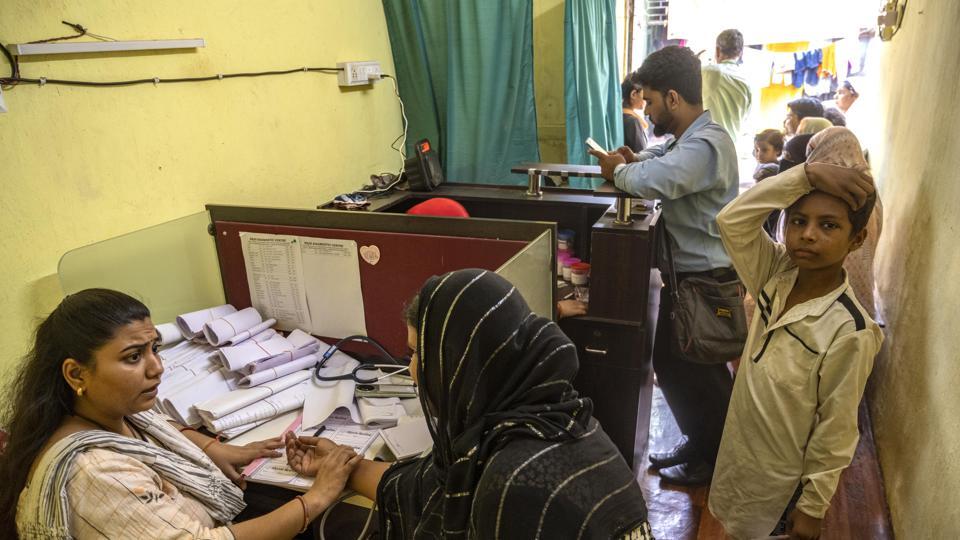
The mohalla clinic is the city’s first community initiative, along the lines of Delhi chief minister Arvind Kejriwal’s 2015 drive to offer quality healthcare to the vulnerable section for a nominal fee. The clinic in the Mankhurd neighbourhood was started in the first week of October to meet the acute demand of primary healthcare in the area.
The community initiative is being run by Kamgar Sannrakshan Samman Sangh (KSSS), an informal trade union representing labourers, daily wage earners, masons, carpenters, electricians and taxi drivers. It is funded by a group of Indian-origin doctors based in the USA.
Taking a break from collecting feedback forms from the mothers, Mohammed Umar Shaikh, coordinator of the new healthcare facility, said, “We need an average of ₹1.50 lakh per month (which goes to pay the doctor’s fee, medicines and electricity bill) to run this clinic. US-based neurologist Dr Nilay Shah, and his group of friends are presently helping us with the funds.” The clinic operates out of a 10x20 ft shop in the Janta Nagar slums.
Noor Fatima, 30, and her five-year-old son who were recently treated for cough, cold and fever said the facility has lifted their burden of budgeting for expensive healthcare. Earlier people would turn to private doctors or visit civic-run facilities such as Shatabdi Hospital in Govandi, or Rajawadi Hospital in Ghatkopar.
“My husband earns ₹15,000 as a taxi driver. We used to spend ₹250-300 as doctor’s fee and ₹1000-2000 on medicines. Travelling to the hospitals set us back by ₹400. Additionally, we would have to wait for our turn in long queues. This clinic has been a boon for us,” said Fatima.
Gulista Khan, 38, hesitated meeting male doctors at the hospitals to discuss gynaecological problems. Her husband cannot accompany her as he is house-bound with health concerns. “A clinic run by a female doctor is a blessing,” said Khan. Fatima and Khan are just two of the 1,122 patients who have benefited from the mohalla clinic. They now do not have to travel long distances for healthcare.
Since distance and expense were impediments, many turned to quacks. As Shaikh, a Janta Nagar resident for two decades, said, “Many of them do not hold degrees. They have set up shops here and when civic officials arrive for inspections, we see them pull down shutters and run away. People either spend ₹150-250 on consulting a quack and ₹60-50 on medicines or spend ₹150-200 on a one-way travel to government hospitals, wait in long queues and spend a steep sum on consults and medicines.”
He said, since the clinic was inaugurated, 60-70 patients arrive here every day, “most of them are women”.
They are happy that a female doctor – Dr Shilpa Varma – is available at the clinic between 12 noon and 5 pm daily. While medicines are given free, patients pay ₹20 for a single consultation. Razia Shaikh, 28, who has been living in the locality for the last 10 years, said, “She gives us time and we are comfortable with her, unlike civic-run hospitals or private clinics.”
Dr Varma, who heads the clinic, said typhoid, colds, coughs, fever and skin-related ailments are prevalent in the area. She emphasised that the locality is home to one of the most vulnerable populations, grappling with poverty, income uncertainty and drug-related issues.
“I have worked in slum pockets of Dharavi and Kurla but health issues
here are different. They are in dire need of a good healthcare facility,” said Dr Varma, a Jui Nagar resident.
Bilal Khan, president, KSSS, said despite 90% of the population living in slums the ward does not have a government hospital.
“With limited public healthcare facilities, residents have no choice but to seek expensive private clinics. Often, these expenses affect their children’s education and nourishment. As the government failed to act, our community did,” said Khan.
A 2021 study conducted by NGO Apnalaya, working in the ward (M-East), revealed only 17% of the 433 families surveyed reported having one or two meals a day, while the rest struggled for even one meal. The study also found that over 40% families faced food insecurity, spent over ₹50 per day on drinking water with 17.2% paying ₹100 or more, adding to their financial burden.


