
 E-Paper



New study: SGNP has highest documented density of leopards in world
Our study provides further empirical evidence of this, making SGNP a truly unique landscape, said Nikit Surve, wildlife biologist at WCS who led the study

 Prefer HTon Google


Mumbai: The Sanjay Gandhi National Park (SGNP), in Mumbai Metropolitan Region, has the highest documented density of leopards in the world, at about 26/100km2, a new study has found. Based on data gathered in 2015 and 2016, researchers at the Wildlife Conservation Society (India), in collaboration with the Wildlife Institute of India (Dehradun) and the Maharashtra forest department, on Thursday published the results of a long-standing study on human-leopard interactions in and around SGNP.
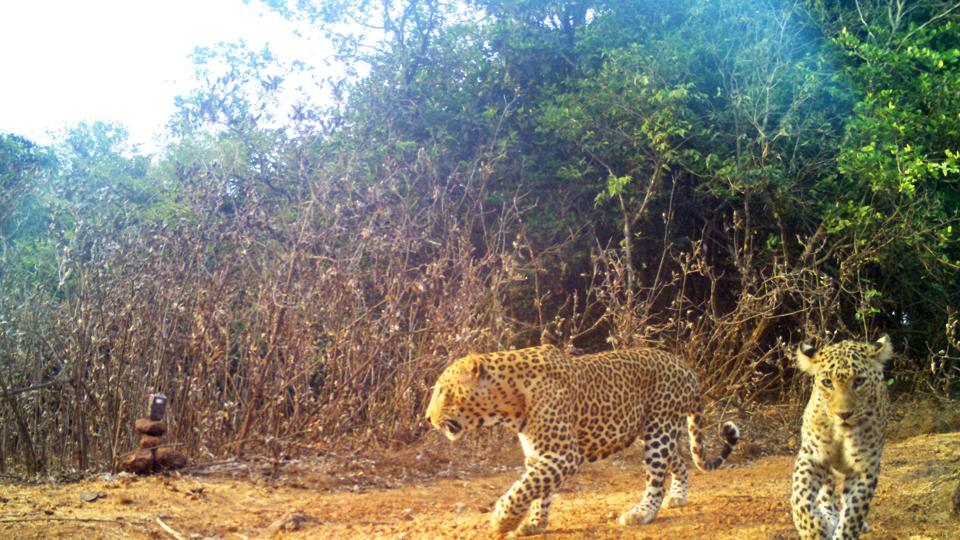
“No other landscape in the world has yet shown such a high number of leopards packed into a small area, that too an area which is surrounded by such a large density of humans. It has been commonly held that large carnivores are not able to adapt and thrive in human-dominated landscapes, but recent studies have shown that some large carnivores can share space with humans. Our study provides further empirical evidence of this, making SGNP a truly unique landscape,” said Nikit Surve, wildlife biologist at WCS who led the study.
The paper titled, Leopards in the city: Tale of Sanjay Gandhi National Park and Tungareshwar Wildlife Sanctuary, two protected areas in and adjacent to Mumbai, India, was published in the international journal Frontiers.
Interestingly, SGNP (with a surrounding human density of about 20,000/km) had a higher density of leopards than the adjoining Tungareshwar WLS (TWLS), which is more secluded. TWLS showed a density of about 5.40 leopards per 100km2, despite a surrounding human density of just 1,700/km2. This discrepancy was attributed to varying availability of food sources (including domestic dogs and wild prey), between TWLS and SGNP.
Results from leopard scat analyses showed that dogs are an essential part of leopards’ diet in the study area (which includes 104 km2 of SGNP, 85 km2 of TWLS, 12.8 km2 of Aarey Colony, 2.20km2 of Film City and 1.77 km2 of Powai lake, where leopard presence has been observed).
“In TWLS, despite lower domestic dog density than SGNP, domestic dogs constituted 66.76% of the leopard’s diet. This was higher than SGNP which had 32.01% of domestic dogs in the leopard’s diet.” Domestic dogs occurred at an average density of about 17.26/km2 in the areas sampled around SGNP, and about 7.7/km2 around TWLS.
Researchers also discovered sufficient presence of leopard prey in SGNP, including chital, sambar, barking deer, wild pig, common langur, bonnet macaque, grey jungle fowl, and red spurfowl, as opposed to the TWLS area where these species were much scarcer.
“While densities of dogs are lower in TWLS, so are the densities of leopards as well as wild prey (so low, in fact, that we were unable to derive estimates),” the researchers have noted, adding “The differences in leopard densities, dog densities, wild prey densities, as well as the contribution of domestic dogs to leopard diet in the two PAs present a discrepancy that we have not been able to fully resolve.”
One speculation offered, however, is that the availability of domestic dogs over and above wild prey leads to high leopard density in SGNP, while in TWLS, extremely low densities of wild prey led to a very high representation of dogs in leopard diet, without accompanying rise in leopards. This requires further study to be proven. It also remains to be seen whether the prey-predator dynamics are affected in the long-term due to the availability of human-associated domestic prey.
“What’s clear is that the human dominated area of SGNP is providing cost-effective and energy-rich food resources for the leopards which increases their survival and densities,” said Surve. This is, however, a tedious ecological balance and requires concerted management efforts. While the area provides leopards with incentives for survival, it conversely also presents serious risks to their long-term wellbeing.
“The rapid development and urbanisation of Mumbai and Thane could prove a potential threat to future leopard populations. Linear intrusions like national and state highways, already present along the periphery of the two PAs, can serve as a barrier for dispersal of carnivores. There is a need for further research to understand threats to leopards associated with this habitat,” the study notes.
G Mallikarjuna, park director, SGNP, said that this study lays a basis for more research work in SGNP and TWLS. “We will be continuing research work in this landscape to better understand these leopards. As a part of our recent research work, we are monitoring daily movement and activities of four radio-collared leopards as part of another study.”
Such high densities of leopards have not been observed even in India’s other protected areas. For example, at Achanakmar Tiger Reserve in Chhattisgarh, a 2017 study found leopard density to be in the region of about 12 per 100km2. At Uttarakhand’s Rajaji Tiger Reserve, there are about 15 leopards per 100kms, as per a 2009 study. “Even in human dominated landscapes of western Maharashtra and Rajasthan, reported leopard densities were 6.4 ± 0.78/100 km2 and 6.38 ± 2.4/100 km2,” the study notes, citing past research.


