
 E-Paper



Over 1500 complaints against auto drivers; 666 permits suspended
Commuters in Mumbai are facing increasing difficulties with the city's public transport system, with complaints of refusals, overloading, and rude behavior from auto rickshaw drivers. Regional Transport Offices have received over 1,500 complaints since mid-July, leading to the suspension of 666 permits. The rise in shared auto routes and the proliferation of aggregator cabs are cited as reasons for the decline in service from auto rickshaws. The RTOs are now focusing on addressing the issue and taking action against errant drivers.


Mumbai A city that is always on the go has a driven workforce, high net worth individuals on a constant hustle, matched by an efficient system of transportation. Until recently, Mumbai was defined by all the three characteristics. Today, the system has become lopsided as Mumbaikars on the move increasingly face deprivation from a section of the public transport system.
The kali-peeli taxis and autos became a Mumbai subculture simply because they were available to people in transit round-the-clock -- outside housing societies, institutions, market places, offices and commercial hubs. No one ever denied rides to customers.
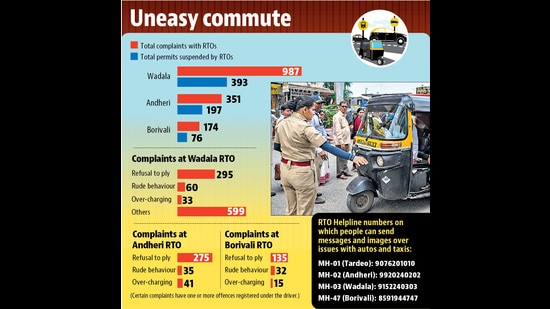
That ease of travel is a thing of the past, evidenced by the fact that the Regional Transport Offices (RTO) of Andheri, Borivali and Wadala have received 1,512 complaints from commuters on their WhatsApp helpline numbers and email from mid-July to October 15.
Today, while auto rickshaw drivers operate on cartelisation, the RTO is looking to punish errant drivers; and the passenger is caught in a fix. Most refuse rides, do not go by meters and over-load the vehicles.
The RTOs started special helpline numbers three months ago and pasted them behind most auto rickshaws for commuters to register their complaints, as reining in errant drivers refusing rides had become a challenge. Now, based on the complaints, RTOs have started taking action -- 666 permits have been suspended over complaints of refusals, over seating of passengers and rude behaviour of drivers.
Manpreet Singh, a Ghatkopar resident, often comes across auto rickshaw drivers outside railway stations who refuse rides and indicate a direction from where they can board autos. “They choose the locations where they wish to go. Why is the government giving valuable land to these drivers when they don’t want to ply,” questioned Singh.
“Almost eight to ten years ago, I could easily get conveyance from outside my society or office. The situation has changed now. Today, there are barely a couple seen on these spots – the drivers use them to park and take rest. Most ply on shared auto routes and there is no saying if they have permits and licenses,” said Raj Kashyap, a resident of Lokhandwala.
The share-auto space has significantly increased in the eastern and western suburbs, said unions. “A decade or less ago, they made up 10 to 12 per cent of the lot on the roads; today they are close to 35-40 percent. It is not only beneficial for passengers but also drivers as they have to operate in a limited area,” said Shashank Sharad Rao, trade union leader who heads the Mumbai Autorickshaw Taximen’s Union.
The reason behind the shift, said KK Tiwari, another union leader, is the proliferation of aggregator cabs nearly a decade ago. They ran on ₹5 to ₹6 per kilometre and became a choice for cheap and comfortable travel. “The auto drivers realised that people use them only for short distances. Also, they could easily dodge signals, operate without much checks and no one questioned them about wearing uniforms or running on correct meters on shared routes,” said Tiwari.
There are currently 2.60 lakh auto rickshaws registered in Mumbai RTOs plying in the suburbs. All the railway stations on both east and west have shared auto routes. These autos block the roads and their numbers depend on the time of day. “These shared auto drivers refuse regular fares at will and they ply only on selected routes. There are no fare charts of shared routes anywhere. They also drive rashly,” said Dhawal Vora, resident of Kandivali West.
About the ongoing drive, Ashok Pawar, head of Andheri and Borivali RTOs, said, “Soon we will focus on Bandra, and revisit Andheri and Borivali where there are many complaints.”
Vinay Ahire, head of Wadala RTO said, “We have issued noticed and suspended 393 permits in this period and collected fines of ₹10,2500. The suspension is for 10-15 days. Refusal to ply is one of the main grievances faced by commuters.”

Stay updated with all the Breaking News and Latest News from Mumbai. Click here for comprehensive coverage of top Cities including Bengaluru, Delhi, Hyderabad, and more across India along with Stay informed on the latest happenings in World News.


