
 E-Paper



State exploring all avenues to restore OBC reservation
As the Supreme Court on Thursday rejected the Maharashtra government’s plea and refused to allow reservation for the Other Backward Classes (OBC) in the local body elections, the state directed the law and judiciary department and advocate general Ashutosh Kumbhkoni to submit a report on the options available to restore the quota


As the Supreme Court on Thursday rejected the Maharashtra government’s plea and refused to allow reservation for the Other Backward Classes (OBC) in the local body elections, the state directed the law and judiciary department and advocate general Ashutosh Kumbhkoni to submit a report on the options available to restore the quota.
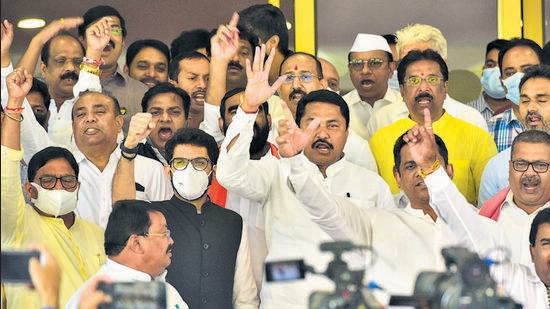
One of the alternatives the state is looking at is to collect data on political reservation in local bodies for the OBC community from the State Election Commission (SEC) and submit it to the Maharashtra State Backward Class Commission (MSBCC) to prepare a fresh interim report, which will be placed again before the apex court. This is because the SC, while rejecting the interim report, pointed out that there was no data and analysis related to political reservation for the OBC community in local bodies.
“The SC had already quashed our ordinance issued for up to 27% reservation for the OBCs in the local body polls, a few months ago. We are contemplating if another amendment to the respective laws backed with fresh data is possible. The option appears to be untenable as the apex court has already turned down our earlier attempt and it has come down heavily on the interim data submitted by us,” said a cabinet minister after a meeting on Thursday.
Another minister said the state cabinet also discussed the Madhya Pradesh pattern. “The MP government has taken the powers of delimitation and formation of the wards to itself, unlike in Maharashtra where it is done by the SEC. By making the change, the government is taking its own time in completing the process so that it will get time to collate the empirical data for the restoration of the OBC quota. We are checking on that option too, but the delimitation and the formation of the wards in most of the corporations in the state have already been completed and that option too is unlikely to come to the rescue of the government,” he said.
Food and civil supplies minister Chhagan Bhujbal said they are looking to revise the interim report by incorporating data on political reservation for the OBC community in the local bodies as sought by the SC. “For this, the state government will collect data on political reservation from the SEC, submit it to the MSBCC for an analysis, and get a fresh interim report, which can again be submitted before the apex court,” he said.
Meanwhile, the state government decided that the elections to the local bodies should not be held without OBC reservation.
“Elections to the local bodies should not be held without OBC quota. The decision was unanimously taken by the state cabinet at the meeting today,” said Bhujbal, who is also an OBC leader.
The state government will also write to the SEC in a day or two requesting it to not hold the elections without OBC quota, said a minister, wishing not to be named.
“The SC in its earlier ruling had clarified that the elections could not be put on hold for the want of empirical data. We had received a letter from the state government requesting us to put the polls to district councils and nagar panchayats on hold. We followed the SC order and held the elections in January,” an official from the SEC said.
Constitutional experts are of the view that the state cannot postpone the elections as per constitutional provisions. Also, it has no option but to collect empirical data, which will help restore the reservation for the community at least in the next elections.
“The SC has made the triple test mandatory for providing reservation to the community. While talking about empirical data, it used two words ‘collate’ and ‘contemporaneous’, which mean the data can be evaluated and will be useful in the current circumstances. The rejection of the interim report means it was not fulfilling the criteria. It clearly means reservation for OBCs in the local bodies cannot be given,” said Ulhas Bapat, an expert.
Neither the state government nor the election commission can postpone the polls, he said. “If the state wants to collect empirical data it should start the process and complete it even if it is taking one or two years. But it will ensure that the OBC community will at least get reservation in the next elections,” he added.
The state government is further considering replacing the existing MSBCC after the rap by the SC over the interim report. According to an official from the general administration department, the government may reconstitute the MSBCC with the responsibility of collecting empirical data for OBCs and the Maratha community. The state last week announced a separate commission for Marathas.
On January 19, the SC allowed the state to submit the data available related to OBC population to the MSBCC for assessment. The apex court also directed the commission to examine the data and submit its interim report to the state in the next 15 days from the day it was received.
The Bharatiya Janata Party (BJP) alleged that the state government failed in providing reservation to the OBC community. “This is unfortunate. The government should have completed the task of collecting data in the last one-and-a-half years. It wasted time. Our stand is that elections should not be held till OBC reservation is restored,” said former chief minister Devendra Fadnavis.
State OBC welfare minister Vijay Wadettiwar said, “We have been doing whatever we can to restore OBC reservation. Elections should not be held until the quota is restored. The BJP has no business in blaming us because the same has happened in states like MP and Karnataka where it is in power.”
Manisha Kayande, Shiv Sena spokesperson, said the BJP is responsible for this mess.
“They have the empirical data but are not ready to share with the state government and are using it for all other purposes. Even in the last five years of their regime, they were dilly-dallying on the issue. The state will explore all the alternatives that are available and take the matter forward,” she said.
On March 4, 2021, the SC had stayed the 27% political reservation for OBC candidates citing lack of empirical data about the exact nature of their backwardness. This put the Maharashtra Vikas Aghadi (MVA) government on a sticky wicket as the OBCs stood to lose 57,000 reserved seats in local bodies. Elections to 17 municipal corporations like Mumbai, Thane, Pune, Nagpur and Nashik and 27 zilla parishads are due this year and the MVA anticipates a backlash from the OBCs.
Though Marathas dominate Maharashtra’s politics, the OBCs, who are spread across religions, classes and castes, are considered the largest social bloc at around 53% of the population. Though some estimates put their population lower, there is no scientific measurement of caste numbers in the state, with the last caste-based census having taken place in 1931 in British India. The commission’s proposed empirical survey will thus be the first of its kind in a century.
Stay updated with all the Breaking News and Latest News from Mumbai. Click here for comprehensive coverage of top Cities including Bengaluru, Delhi, Hyderabad, and more across India along with Stay informed on the latest happenings in World News.


