
 E-Paper



‘My father fought for years to prove he was an Indian’
The family of Lucknow’s Hasan Raza, who died last year without being able to prove his Indian nationality, say they suffered years of trauma and social boycott


At a time when the Citizenship (amendment) Act (CAA), 2019 is being hotly debated across the country, with protests erupting in several parts, there’s one family living in Lucknow’s densely populated Old City area that is keeping aloof from the discussions.
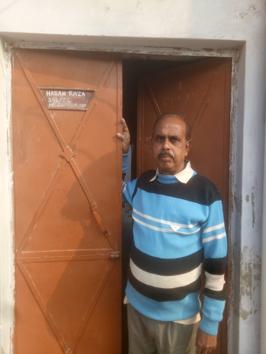
It is the family of Hasan Raza, a man who, his kin say, fought for 63 years to prove his Indian nationality and who breathed his last in November, last year, without being able to do so.
They say they have no interest in any discussion related to the CAA after the “trauma” and “social boycott” they suffered for years.
“The Act and any developments and controversies related to it seem meaningless to us. My father fought for years to prove that he was an Indian. He died at the age of 86 without being able to do so. What bothers me the most is that we failed to fulfil his last wish — to die as an Indian and not with the tag of being a Pakistani,” said Hasan Raza’s eldest son, Zafar.
Recalling the family’s plight, he said it went all the way back to August 12,1956.
“We were not born at that time. On that day, my father, then a 23-year-old, returned to India after paying a short visit to an ailing relative in Pakistan. He was accompanied by my grandmother (Hasan’s mother). Little did he know what awaited him,” said Zafar.
“My father, who was born and brought up in India, had intelligence officers approach him and ask him about his whereabouts. A few started calling him a Pakistani spy. Over the next few days, he was put behind bars for being a Pakistani citizen who was illegally staying in India,” he said.
The family believes that the situation was a fallout of some confusion among intelligence officials due to “similar sounding names”. “It has to be the result of some confusion. My father went to Pakistan for the first time in his life in 1956. And just after that, these problems started. He was born and brought up in India,” said Zafar.
He said after almost a yearlong fight, Hasan Raza was released but with a rider -- if he wanted to stay in India, he had to file for long-term visa (LTV) every year.
Zafar claimed that the issue of his father’s nationality refused to abate, as it had only been nine years since the country’s Partition and the situation was still quite tense. “There were instances when our house was raided in the middle of the night and family members were bullied for nothing,” he alleged.
Hasan’s daughter, who did not wish to be named, said that the situation continued to remain the same till the mid 1980s. “There were times when my father was picked up by plainclothes officers and released after a week or so. It was torturous for us. I believe it was due to this that my mother passed away (more than a decade ago) and I developed mental illness.”
The family, she said, was also subjected to social embarrassment and trauma, as they were interrogated in public on many occasions. “The ‘Pakistani’ tag did not leave our family. Some people even boycotted us, avoiding us in social gatherings. Even our neighbours started behaving differently,” she said.
THE OTHER VIEW
Intelligence agency officials, however, have a different story to tell. According to them, Hasan Raza was a Pakistani national who stayed illegally in the state capital for all these decades.
“Hasan came from Pakistan along with his mother, travelling on her visa, and never went back,” said an officer of the local intelligence unit here.
According to the officer, Hasan never applied for Indian citizenship.
“As per government norms, a foreigner can apply for Indian citizenship after completing a regular stay of seven years -- but that stay should be continuous. Now days, foreigners, including Pakistanis, can apply online for Indian nationality. The same could be granted to them after due verification of documents,” he said.
“However, Hasan never applied for Indian nationality -- not even once. Hence, he was never considered an Indian citizen,” said the officer.


