
 E-Paper



UP's Ghaziabad emerges as the most polluted city
Sunday was the first “severe” AQI day for Ghaziabad in 2025. The city last recorded “severe” air on December 17, 2024, when the AQI touched 403 .

 Prefer HTon Google


The city on Monday became the most polluted city in the country and the only one to record a “severe” Air Quality Index (AQI), according to the daily bulletin released by the Central Pollution Control Board (CPCB) at 4pm. This was the second consecutive day of “severe” air for Ghaziabad after Sunday’s AQI stood at 419.
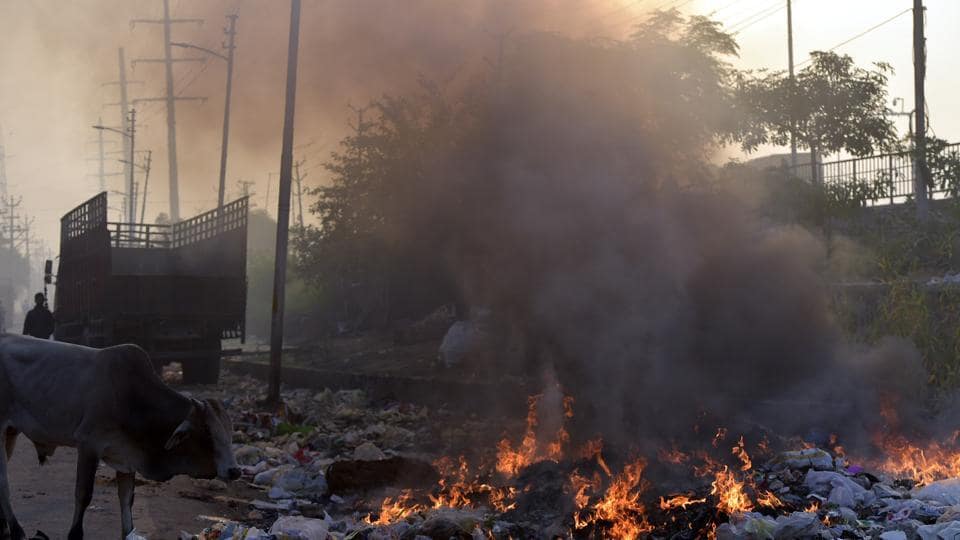
CPCB data showed Ghaziabad recorded an AQI of 401 on Monday, with PM2.5 as the primary pollutant. Three of the four monitoring stations at Indirapuram, Loni and Sanjay Nagar recorded AQI levels of 365, 414 and 433, respectively by evening. Figures from the Vasundhara station were unavailable due to a technical issue.
ALSO READ | Ghaziabad: Pollution board shuts eight RMC plants operating under Grap 3
The Indirapuram monitoring station, operated by the Uttar Pradesh Pollution Control Board (UPPCB), reported consistently high pollutant levels on Monday. PM2.5 concentrations averaged 366 micrograms per cubic metre, with the maximum touching 423 around 8 pm. PM10 levels followed a similar trend, recording an average of 367 and a peak of 452. Nitrogen dioxide (NO2) levels were also elevated, with an average of 92 and a maximum of 157.
At the Loni station, also operated by UPPCB, the average PM10 level stood at 413 and climbed to a maximum of 491. NO2 levels were recorded at 99 (average) and 153 (maximum). PM2.5 data for Loni was not available on Monday at around 8 pm, according to the CPCB’s Sameer app.
The Sanjay Nagar station reflected some of the highest concentrations in the city. Average PM2.5 levels were recorded at 426, reaching 500 at their peak, a likely upper measurable limit for sensors at these stations. PM10 levels at Sanjay Nagar averaged 399 and peaked at 490. NO2 levels remained comparatively lower, with an average reading of 18 and a maximum of 25.
ALSO READ | Ghaziabad: About 40% pollution complaints relate to garbage burning, says UPPCB
Sunday was the first “severe” AQI day for Ghaziabad in 2025. The city last recorded “severe” air on December 17, 2024, when the AQI touched 403.
Ankit Kumar, regional officer of the Uttar Pradesh Pollution Control Board (UPPCB) in Ghaziabad, said the Vasundhara station had been non-operational for two days. “This has been repaired now, and it has started functioning from Monday afternoon,” he said. “It has happened that the AQI figures were gathered for only three stations, including Loni, which remains high. So, the average of three stations increased our overall average AQI for Sunday and Monday.”
Kumar said enforcement teams have intensified action. “Our enforcement teams are working day and night and have cracked down on ready-mix concrete plants, illegal dyeing units, and we have also sent communications to other agencies to increase pollution-abatement measures. Our teams are regularly focusing on instances of garbage burning,” he said.
ALSO READ | Delhi can’t be brought to standstill: SC junks plea for drastic steps to curb pollution
UPPCB officials said the rise in pollution levels is primarily due to road dust, unpaved roads and traffic snarls.
Apart from Ghaziabad, AQI levels in Greater Noida and Noida stood at 390 and 358, respectively, under the “very poor” category on Monday. On Sunday, Greater Noida recorded “severe” air at 419 while Noida remained in the “very poor” category with an AQI of 385.
On Monday, Noida recorded AQI at 358. The city has been lying in the “very poor” category since November 13 after recording two days of “severe” AQI on November 11 and 12. Greater Noida was in the “severe” category on November 15 and 16, recording an AQI of 418 and 419 respectively.
The Central Pollution Control Board (CPCB) classifies an AQI of 0-50 as “good”, 51-100 as “satisfactory”, 101-200 as “moderate”, 201-300 as “poor”, 301-400 as “very poor” and 401-500 as “severe”.
According to the India Meteorological Department (IMD), Ghaziabad recorded a maximum temperature of 27.5 degrees Celsius and a minimum of 10.3°C on Monday. In Gautam Budh Nagar, which comprises Noida and Greater Noida, the maximum temperature settled at 27.1°C, while the minimum dipped to 9.4°C.
Weather conditions are likely to remain unchanged. “Northwesterly, dry and cold winds will be blowing and there is no western disturbance predicted for about a week. In the next one or two days the wind velocity may decrease a bit, and that may help the accumulation of pollutants. So, there is no drastic change predicted in weather conditions for one week,” said Mahesh Palawat, vice president, Climate and Meteorology, Skymet Weather.


