
 E-Paper



With 3 ‘severe’ air days, Gzb sees least polluted Grap period since 2017-18
The Grap is implemented in Delhi-NCR for a period of about six months that starts before the onset of winter in October and extends up to end of February or mid March


Air pollution levels in Ghaziabad city during this winter’s Graded Response Action Plan (Grap) period -- the six months between October and March -- was the lowest since 2017-18, with the city recording an average air quality index (AQI) of 239, said the Uttar Pradesh Pollution Control Board (UPPCB).
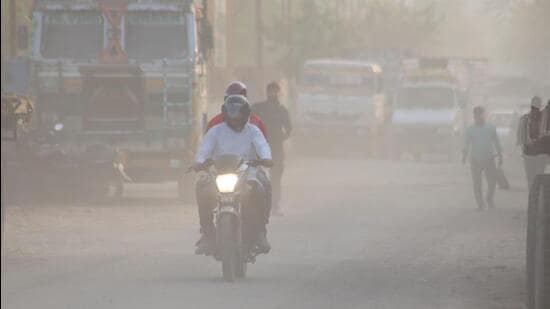
Apart from the low AQI, the average PM10 and PM2.5 (fine particulate matter) levels have also been the lowest this winter.
The Grap is implemented in Delhi-NCR for a period of about six months that starts before the onset of winter in October and extends up to end of February or mid March.
The figures from the UPPCB indicate that the average AQI stood at 362, 320, 295, 336, 275 and 239 during the Grap period of 2017-18, 2018-19, 2019-20, 2020-21, 2021-22 and 2022-23, respectively.
“This Grap period this winter has seen the lowest AQI between October 1 and March 15. This is result of strict enforcement and activities taken up on the directions of the Commission for Air Quality Management (CAQM). In Ghaziabad, the reduction in pollution is also due to the completion of several infrastructure projects such as the Delhi-Meerut Expressway and the Eastern Peripheral Expressway. Most of the work on the Regional Rapid Transit System line will also get over this year and better air conditions will prevail,” said Utsav Sharma, regional officer of UPPCB.
The UPPCB indicate that the city during the 2022-23 Grap period suffered only three “severe” days as compared to 14 during the Grap period in 2021-22, 34 in 2020-21, 24 in 2019-20, 44 in 2018-19 and 62 in 2017-18.
An AQI between zero and 50 is considered “good”, 51 and 100 “satisfactory”, 101 and 200 “moderate”, 201 and 300 “poor”, 301 and 400 “very poor”, and 401 and 500 “severe.”
The figures also indicate that the average PM2.5 levels during the Grap period this winter stood at 119 μg/m3 in 2022-23, which is the lowest in at least five years. The figures stood at 260 μg/m3 in 2017-18, 199 μg/m3 in 2018-19, 180 μg/m3 in 2019-20, 204 μg/m3 in 2020-21, and 158 μg/m3 in 2021-22
The average PM10 levels during the Grap period this winter stood at 245μg/m3, which is also considerably lower than the readings of previous years. The figures stood at 418 μg/m3 in 2017-18, 321 μg/m3 in 2018-19, 278μg/m3 in 2019-20, 348μg/m3 in 2020-21, and 284μg/m3 in 2021-22.
The national safe limit for PM10 is 100μg/m3 while it is 60μg/m3 for PM2.5.
“The PM2.5 limit is still two times higher than the safe limit, while PM10 is almost 2.5 times higher than the safe limit in 2022-23. The pollution this time is primarily on lower side due to favourable meteorological conditions. The ground level enforcement against road dust, traffic congestion and polluters is still very lenient. This must improve for sustainable decline in pollution levels,” said Akash Vashishtha, a city-based environmentalist and lawyer.
The city was ranked the second-most polluted city in the world after Bhiwadi in Rajasthan, on the World Air Quality Report in 2021 prepared by Switzerland-based organisation IQAir. However, according to the recently released 2022 report by IQAir, ranked Ghaziabad more favourably at the 11th spot.
“The city has numerous damaged roads in industrial areas which generate road dust. Illegal factories also add to pollution. We currently have four air quality monitoring stations, but the city would need at least 10 more stations in different areas to get the correct picture of prevailing pollution levels,” said Sushil Raghav, a city-based environmentalist.

Stay updated with all the Breaking News and Latest News from Mumbai. Click here for comprehensive coverage of top Cities including Bengaluru, Delhi, Hyderabad, and more across India along with Stay informed on the latest happenings in World News.


