E-Paper



Delhi Police dog squad: Too many threats, too few paws
As bomb threats surge in the Capital, Delhi Police’s dog squad is operating with just 60% of its sanctioned strength

 Prefer HTon Google


In a city rattled by hoax bomb threats, high-stakes security drills and drug busts, Delhi’s most loyal frontline defenders are falling short — not in spirit, but in numbers. The Delhi Police dog squad, vital to detecting bombs, tracing suspects, and locating the missing, is operating at just 60% of its sanctioned strength.
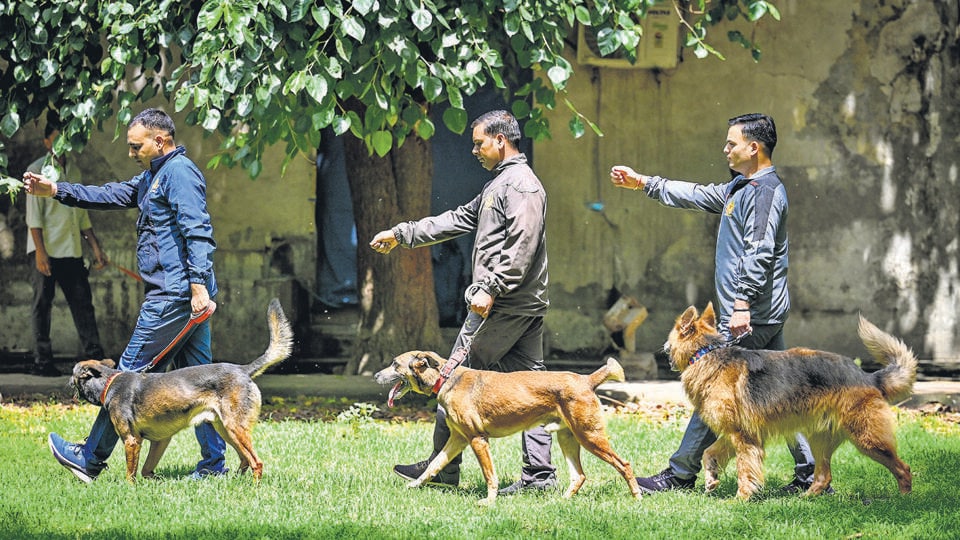
With only 64 dogs on duty instead of the required 105, the Capital’s canine force is stretched dangerously thin.
The pressure has only intensified since July last year, when the Bharatiya Nagarik Suraksha Sanhita (BNSS) came into effect, calling for forensic-led policing across India. In Delhi, where more than 500 hoax bomb threats were recorded in 2024 alone—targeting schools, railway stations, and markets—the demand for trained dogs has skyrocketed. Yet, in six of the city’s 15 police districts, dogs are not easily available.
Back in August 2023, police commissioner Sanjay Arora issued a directive: every district must have its own dog squad, and select police stations should be equipped with specialised kennels. Two years later, that vision remains mostly unfulfilled. Vast swathes of the city—police districts including South, Southeast, Dwarka, Shahdara, Rohini and Outer Delhi—remain without a single dog. And in the districts that do, numbers barely meet emergency needs.
According to the Crime Branch, which oversees the K9 squad, each district should house at least seven dogs—trained in explosives, narcotics, and tracking. But internal records accessed by HT show a stark shortfall: Northeast Delhi has just two dogs; North has four; Central and East have five each. New Delhi and Southwest fare slightly better with eight and nine dogs respectively. Eleven of the 64 dogs are stationed with the Crime Branch, serving citywide emergency needs.
Senior police officers say they’re often forced to “borrow” dogs from neighbouring districts or the Crime Branch for routine security checks, VIP movements, and special events. “We even rely on CISF’s dogs for help during large-scale deployments,” said an officer in New Delhi district, which handles the bulk of VIP movements.
Even where dogs are available, they are often overworked and fatigued.
“Dogs can work for about an hour at a time, especially Labradors and Golden Retrievers. In summer, they tire quickly and need at least 30-45 minutes of rest between deployments,” said head constable Vishal Singh, a dog handler. “Belgian Malinois are more efficient—they can go longer, but they’re also expensive and difficult to procure.”
Of the 64 dogs currently in service, 58 are trained in explosive detection, just three are tracker dogs, and three are trained for narcotics. They include 22 Labradors, 17 Belgian Malinois, 16 German Shepherds and nine Golden Retrievers.
But Delhi needs more—and needs them fast. The workload has become overwhelming.
Each bomb threat, even if a hoax, triggers a full-scale response: bomb disposal units, sniffer dogs, and crime teams are dispatched to every location named in the threat. And each email often lists 10 to 15 schools or locations.
“We need two to three dogs per school to sweep every floor and room. When we get multiple threats in a day, it’s physically impossible to manage,” said a canine handler in Model Town.
Last October, an explosion outside a CRPF school in Rohini damaged walls and nearby vehicles. The following month, another low-intensity blast occurred in Prashant Vihar. While there were no casualties, the dog squad was pressed into action both times to trace the source and remnants of the improvised explosive devices (IEDs).
Then came the real test of endurance. Last week, a four-storey building collapsed in northeast Delhi’s Mustafabad, killing 11. The rescue operation ran for 16 hours, and a three-member dog squad was deployed to search for trapped victims. A similar building collapse in Burari three months earlier had killed five and left over a dozen trapped. Tracker dogs helped locate survivors in both instances.
“These incidents involve multi-storey structures, and first responders often can’t see through the debris. Dogs are crucial in helping us detect trapped persons or bodies,” said a senior fire department official.
The dog squad had once been stronger.
In November 2023, during the G20 summit, the Delhi Police had 95 dogs. That number climbed to 98 by year-end. But since then, a wave of retirements and deaths has thinned the ranks. By mid-2024, the number dropped to 72. As of May 2025, it stands at 64. Another six dogs are expected to retire by year-end.
“We only use dogs between the ages of two and 10. Beyond that, they grow weak and can no longer serve in high-pressure environments,” said a dog squad official. “We inducted 30 dogs between 2023 and 2024, mostly from military and paramilitary training centres. But we lost nearly the same number to retirement or illness.”
At present, 115 police personnel are posted with the canine unit to train, care for, and operate the dogs across districts. But those numbers, too, are under strain.
Recognising the growing burden, the Delhi Police has now begun drawing up plans to expand the scope of the canine unit. Senior officers told HT that two new categories of dogs—combat dogs and life-saver dogs—will soon be introduced for the first time in Delhi.
“These dogs will go beyond bomb and narcotics detection. Combat dogs will help during raids, and life-saver dogs can assist in medical emergencies and disaster rescues,” said Devesh Kumar Srivastava, special commissioner of police (Crime Branch). “The aim is to build a more versatile, responsive, and resilient squad.”
But as the city waits for that upgrade, the immediate concern remains dire: a squad on the brink, a city vulnerable, and the rising weight of emergencies falling on four legs that are simply too few.