
 E-Paper



Delhi’s Covid-19 curbs, relaxations, now brought under colour-coded action plan
The government will now issue daily alerts twice in the day, first in the morning and evening, informing about the level of alert according to the colour-coded system under the graded response action plan (GRAP) so that corresponding prescribed actions can be taken up .


The Delhi Disaster Management Authority (DDMA) on Sunday directed all district administrations to strictly adhere to the graded response action plan (GRAP) to help the government take decisions on restrictions and relaxations in the wake of Covid-19 pandemic.
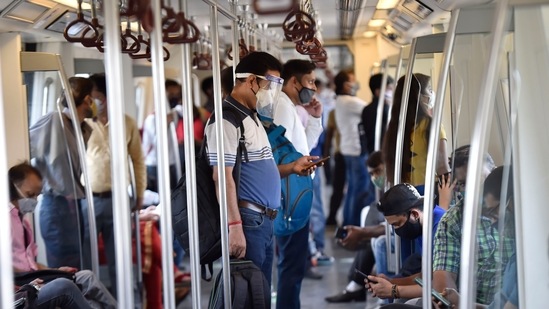
The government will now issue daily alerts twice in the day, first in the morning and evening, informing about the level of alert according to the colour-coded system under the GRAP so that corresponding prescribed actions can be taken up .
“The permitted, prohibited and restricted activities shall be as per level of alerts specified in the graded response action plan with immediate effect and till further orders… GNCTD shall be responsible to broadcast daily morning and evening press bulletin regarding the level of alert… Secretary (I&P), district magistrates and deputy commissioners, as well as all authorities concerned shall ensure that the alert should be immediately disseminated extensively,” the DDMA said in an order issued on Sunday, a copy of which HT has seen.
The graded response action plan, which harks back to a similar mechanism to fight air pollution during pre-winter months, was drafted by an expert committee formed by the Delhi government and approved by the Delhi Disaster Management Authority (DDMA) on July 8. It classifies outbreak severity into four bands – yellow, amber, orange and red – with each representing a more severe outbreak and, thus, stricter curbs than the one preceding it.
According to the plan, private offices, malls, weekly markets and the Metro will be shut down in Delhi if the test positivity rate (TPR) rises above 2%, and the city will be put under a curfew if the number breaches 5%, according to a new Covid-19 action plan approved by authorities that sets clear thresholds for curbs that kick in from as low as 0.5% TPR in order to scuttle an outbreak.
The colour-coded classifications take into account three factors: the test positivity rate over two consecutive days, new cases over a seven-day period, and the average weekly hospital occupancy rate.
According to the plan, seen by HT, the first category of the curbs are triggered when the positivity rate crosses 0.5%, or new cases over a week exceeds 1,500, or if there are more than 500 oxygen beds occupied on average over a seven-day period.
Once any of these thresholds are breached, the city will be put under the yellow alert mechanism in which non-essential shops are allowed to open only on an odd-even basis, a night curfew comes into force, and offices are required to move half of their staff to a work-from-home function.
Currently, the Covid-19 situation in Delhi, based on any of parameters, does not necessitate any alert even though schools, colleges and education institutes remain closed; political, cultural, religious, academic and all form of large gatherings remain prohibited; public transport is limited to seating capacities of vehicles; and there are restrictions applicable on economic activities such as 50% capacity for restaurants and bars, no visitors in religious places, maximum caps on marriage and funeral events, etc.
If test positivity, case numbers and hospitalisations rise further, the amber alert comes into effect. In this scenario, some venues and activities are completely halted: parks need to close, barber shops cannot open, and dining in at restaurants will be prohibited (as will the opening of bars). Amber alert is when TPR rises above 1%, or if there are more than 3,500 cases over a week, or if oxygen bed occupancy surpasses 700.
The next alert level, orange, takes effect if TPR breaches 2%, the number of new cases in a week goes beyond 9,000, or if the average number of oxygen beds occupied over the week goes beyond 3,000. In this scenario, private offices, malls, Metro rail services and weekly markets will be shut down.
In the most severe red alert category (if TPR is above 5%, cumulative weekly case above 16,000 or hospital occupancy above 3,000), there will be a 24-hour curfew with people allowed outside only for essential services. In this scenario, all offices engaged in non-essential work need to shift to a completely work-from-home functioning.

Stay updated with all top Cities including, Bengaluru, Delhi, Mumbai and more across India. Stay informed on the latest happenings in World News along with Delhi Election 2025 and Delhi Election Result 2025 Live, New Delhi Election Result Live, Kalkaji Election Result Live at Hindustan Times.


